
[论文解读] Mine yOur owN Anatomy: Revisiting Medical Image Segmentation with Extremely Limited Labels
MONA 是一个半监督的二维医学图像分割框架,在极少量标注下学习多样但一致的解剖特征,在多个基准数据集上取得了最先进的结果。
Recent studies on contrastive learning have achieved remarkable performance solely by leveraging few labels in the context of medical image segmentation. Existing methods mainly focus on instance discrimination and invariant mapping. However, they face three common pitfalls: (1) tailness: medical image data usually follows an implicit long-tail class distribution. Blindly leveraging all pixels in training hence can lead to the data imbalance issues, and cause deteriorated performance; (2) consistency: it remains unclear whether a segmentation model has learned meaningful and yet consistent anatomical features due to the intra-class variations between different anatomical features; and (3) diversity: the intra-slice correlations within the entire dataset have received significantly less attention. This motivates us to seek a principled approach for strategically making use of the dataset itself to discover similar yet distinct samples from different anatomical views. In this paper, we introduce a novel semi-supervised 2D medical image segmentation framework termed Mine yOur owN Anatomy (MONA), and make three contributions. First, prior work argues that every pixel equally matters to the model training; we observe empirically that this alone is unlikely to define meaningful anatomical features, mainly due to lacking the supervision signal. We show two simple solutions towards learning invariances - through the use of stronger data augmentations and nearest neighbors. Second, we construct a set of objectives that encourage the model to be capable of decomposing medical images into a collection of anatomical features in an unsupervised manner. Lastly, we both empirically and theoretically, demonstrate the efficacy of our MONA on three benchmark datasets with different labeled settings, achieving new state-of-the-art under different labeled semi-supervised settings.
研究动机与目标
- 用极少量标注和大量未标注数据来解决医学图像分割的挑战。
- 研究对比学习是否能够在长尾类别分布下学习有意义、具有一致性的解剖特征。
- 开发一个促进尾部感知采样、解剖学一致性和视角多样性以提高分割的框架。
提出的方法
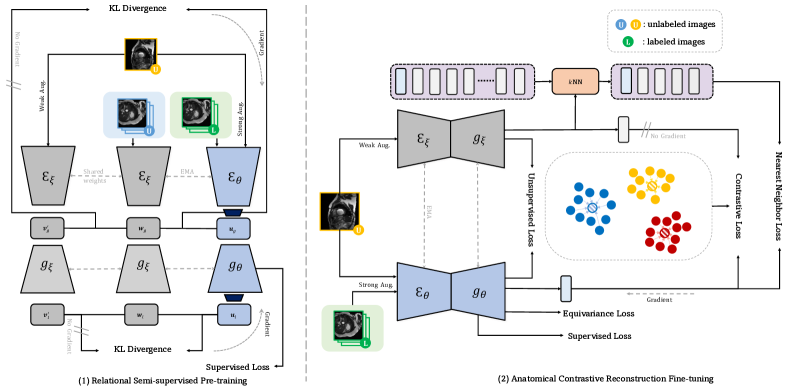
- 引入 MONA,含两个阶段:关系式半监督预训练和解剖对比重建微调。
- 使用像素级锚点和类别平均的正样本,并配合记忆库以处理长尾类别分布(tailness)。
- 加入等变性(一致性)损失,以强制对图像变换的鲁棒性。
- 在输出空间采用最近邻损失,以在不大量消耗内存的前提下促进语义多样性。
- 在预训练阶段结合全局/局部实例判别、伪标签和监督分割损失。
- 提供理论与经验分析,展示标签高效学习的有效性以及与其他对比学习框架的互补性。

实验结果
研究问题
- RQ1对比学习是否能在极少量标注的情况下有效地应用于医学图像分割?
- RQ2如何在像素级、解剖意识框架中解决长尾类别分布、类内变异和类间多样性?
- RQ3尾部性、一致性和多样性是否能共同在不同数据集和标注比例下提升分割性能?
主要发现
- MONA 在 ACDC、LiTS 和 MMWHS 基准上,在 1%、5% 和 10% 标注比例下超越了最先进的 SSL 方法。
- 在 ACDC 1% 标注下,MONA 实现 82.6% DSC 和 2.03 mm ASD,相较于以往方法有显著提升。
- 在 LiTS 1% 标注下,MONA 实现 64.1% DSC 和 20.9 mm ASD,并在其他标注比例下保持优势。
- MONA 在定性可视化中始终产生更尖锐的解剖边界和更好的边界贴合。
- 消融研究表明,结合尾部性、一致性和多样性可获得最佳性能,增广策略进一步提升鲁棒性。
- 作者为 MONA 的标签高效学习提供理论依据,并证明其与多种对比学习框架的兼容性。
更好的研究,从现在开始
从阅读论文到最终审阅,大幅缩短您的研究时间。
无需绑定信用卡
本解读由 AI 生成,并经人工编辑审核。