
[论文解读] Mixed Quantum-Semiclassical Simulation
本文提出了一种混合量子-半经典的模拟框架,利用库普曼-冯·诺伊曼(KvN)形式化方法,将半经典系统编码于量子模拟架构中。通过利用KvN力学的希尔伯特空间结构,该方法实现了对混合量子-半经典(MQS)系统的高效量子模拟,表明场论模拟可实现与量子与半经典作用量之比($S_q/S_c$)成比例的资源优势,尤其在半经典引力方面具有显著潜力,因该作用量比极大($ extasciitilde 10^{-18}$)。
We study the quantum simulation of mixed quantum-semiclassical (MQS) systems, of fundamental interest in many areas of physics, such as molecular scattering and gravitational backreaction. A basic question for these systems is whether quantum algorithms of MQS systems would be valuable at all, when one could instead study the full quantum-quantum system. We study MQS simulations in the context where a semiclassical system is encoded in a Koopman-von Neumann (KvN) Hamiltonian and a standard quantum Hamiltonian describes the quantum system. In this case, because KvN and quantum Hamiltonians are constructed with the same operators on a Hilbert space, standard theorems guaranteeing simulation efficiency apply. We show that, in this context, $ extit{many-body}$ MQS particle simulations give only nominal improvements in qubit resources over quantum-quantum simulations due to logarithmic scaling in the ratio, $S_q/S_c$, of actions between quantum and semiclassical systems. However, $ extit{field}$ simulations can give improvements proportional to the ratio of quantum to semiclassical actions, $S_q/S_c$. Of particular note, due to the ratio $S_q/S_c \sim 10^{-18}$ of particle and gravitational fields, this approach could be important for semiclassical gravity. We demonstrate our approach in a model of gravitational interaction, where a harmonic oscillator mediates the interaction between two spins. In particular, we demonstrate a lack of distillable entanglement generation between spins due to classical mediators, a distinct difference in dynamics relative to the fully quantum case.
研究动机与目标
- 确定针对混合量子-半经典(MQS)系统的量子算法是否相较于经典模拟具有计算优势。
- 研究MQS模拟是否在量子比特资源使用方面优于完全的量子-量子模拟。
- 开发一种统一的量子模拟框架,将标准量子哈密顿量与基于KvN的半经典动力学相结合。
- 探讨作用量比($S_q/S_c$)在决定MQS模拟资源效率中的作用。
- 通过引力相互作用由谐振子介导的原理验证模型,验证该方法的有效性。
提出的方法
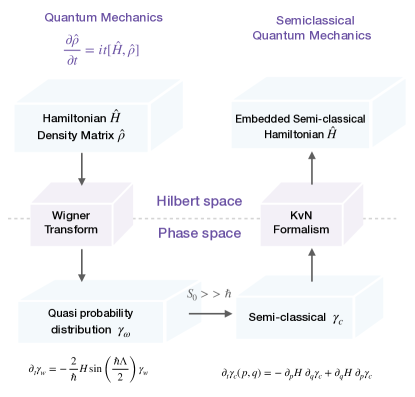
- 使用库普曼-冯·诺伊曼(KvN)形式化方法表示半经典子系统,该方法将经典动力学映射到具有厄米哈密顿量的希尔伯特空间。
- 利用标准量子模拟技术,将量子系统与半经典(KvN)系统共同编码于同一希尔伯特空间。
- 利用KvN算符可对易的特性,通过标准量子算法实现高效的时序演化模拟。
- 对组合的KvN-量子哈密顿量应用哈密顿量模拟算法(例如,Trotter-Suzuki方法),确保系统规模的对数级缩放。
- 将作用量之比($S_q/S_c$)作为关键参数,评估相对于全量子模拟的资源效率。
- 实现一个由两个自旋-1/2粒子通过谐振子耦合的模型,其中谐振子被处理为量子力学系统或经典系统(KvN),以比较纠缠动力学。
![Figure 1: Examples of MQS systems of interest. (i) In molecular scattering, the Born-Oppenheimer approximation is used to describe the light electronic degrees of freedom quantum mechanically, but the heavy nuclear system semiclassically [ 1 , 2 , 3 , 4 ] . (ii) Backreaction in gravity is studied wi](https://ar5iv.labs.arxiv.org/html/2308.16147/assets/x1.png)
实验结果
研究问题
- RQ1MQS系统量子算法是否能为经典模拟带来计算优势?若能,其条件是什么?
- RQ2KvN形式化方法是否能实现在统一量子框架内对半经典系统的高效量子模拟?
- RQ3MQS模拟在何种情况下所需的量子比特数少于等效的完全量子-量子模拟?
- RQ4量子与半经典作用量之比($S_q/S_c$)如何影响MQS模拟的资源效率?
- RQ5在类似引力的相互作用模型中,量子与经典媒介在纠缠动力学上存在哪些差异?
主要发现
- 采用KvN形式化的MQS模拟实现了与系统规模对数级缩放的资源消耗,从而在量子框架内高效模拟经典动力学。
- 对于多体粒子系统,MQS模拟相较于全量子模拟的资源优势是有限的,其缩放与作用量比 $S_q/S_c$ 呈对数关系。
- 在场论设置中,MQS模拟可实现与作用量比 $S_q/S_c$ 成比例的资源减少,对 $S_q/S_c$ 较大的系统具有显著潜力。
- 粒子与引力场的作用量比估计为 $S_q/S_c \sim 10^{-18}$,表明MQS模拟在半经典引力中可能具有极高优势。
- 在原理验证的引力模型中,经典媒介(KvN谐振子)无法在自旋之间生成可提取的纠缠,而量子谐振子则可以。
- 该模拟框架实现了对量子与经典反作用下纠缠动力学的直接比较,凸显了量子信息行为的根本差异。
更好的研究,从现在开始
从阅读论文到最终审阅,大幅缩短您的研究时间。
无需绑定信用卡
本解读由 AI 生成,并经人工编辑审核。