
[论文解读] MMC: Advancing Multimodal Chart Understanding with Large-scale Instruction Tuning
本文提出了 MMC-Instruction,一个包含 600k 个实例的多模态图表理解指令微调数据集,以及基于该数据集微调的 MMCA 视觉-语言模型,其在图表问答基准上实现了最先进性能。此外,本文还提出了 MMC-Benchmark,一个由人工标注的综合性评估套件,包含九项多样化任务,揭示了现有大模型(包括 GPT-4V)在复杂任务(如图表到表格、图表到 JSON 转换)上的显著局限性。
With the rapid development of large language models (LLMs) and their integration into large multimodal models (LMMs), there has been impressive progress in zero-shot completion of user-oriented vision-language tasks. However, a gap remains in the domain of chart image understanding due to the distinct abstract components in charts. To address this, we introduce a large-scale MultiModal Chart Instruction ( extbf{MMC-Instruction}) dataset comprising 600k instances supporting diverse tasks and chart types. Leveraging this data, we develop MultiModal Chart Assistant ( extbf{MMCA}), an LMM that achieves state-of-the-art performance on existing chart QA benchmarks. Recognizing the need for a comprehensive evaluation of LMM chart understanding, we also propose a MultiModal Chart Benchmark ( extbf{MMC-Benchmark}), a comprehensive human-annotated benchmark with nine distinct tasks evaluating reasoning capabilities over charts. Extensive experiments on MMC-Benchmark reveal the limitations of existing LMMs on correctly interpreting charts, even for the most recent GPT-4V model. Our work provides an instruction-tuning methodology and benchmark to advance multimodal understanding of charts. Code and data are available at https://github.com/FuxiaoLiu/MMC.
研究动机与目标
- 解决大型多模态模型(LMMs)在理解复杂抽象图表元素(如趋势线、图例和坐标轴标签)方面的能力缺口。
- 克服现有图表理解数据集的局限性,这些数据集通常规模小、模板化,或在语言风格和图表类型上缺乏多样性。
- 构建一个全面的、人工标注的评估基准(MMC-Benchmark),用于在超越简单问答的多样化、认知对齐任务上评估 LMMs。
- 通过使用多样化、开放式指令的数据集进行大规模指令微调,提升 LMM 在图表理解任务上的表现。
- 识别并分析当前 LMM 的持续性弱点,特别是在数据提取任务(如图表到表格、图表到 JSON 转换)上的表现,尽管其在通用视觉-语言能力上表现强劲。
提出的方法
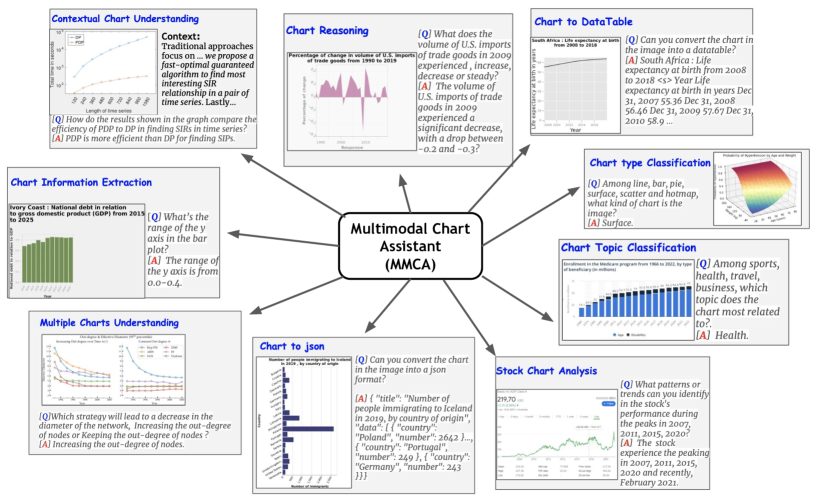
- 构建 MMC-Instruction,一个包含 600k 个实例的数据集,利用 GPT-4 生成涵盖 9 项不同图表理解任务的多样化、自由形式、开放式指令。
- 设计 MMC-Benchmark 作为人工标注的综合性评估套件,包含 9 项子任务,包括图表信息提取、推理、主题分类以及数据格式转换(如图表到表格、图表到 JSON)。
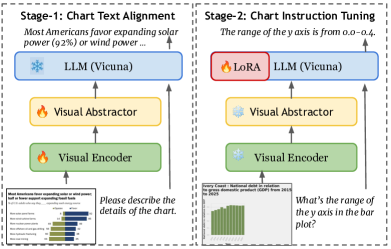
- 开发 MMCA,一种模块化、指令微调的 LMM,基于 MMC-Instruction 进行微调,采用统一的指令微调策略,并更新视觉投影器以提升视觉-文本对齐能力。
- 采用两种评估协议:使用 ChatGPT 进行自由生成评估,以及多项选择题问答,以同时评估推理能力和事实准确性。
- 采用统一的训练策略,在微调过程中更新视觉投影器,以更好地将视觉特征整合到 LLM 的输入空间中。
- 在标准基准(如 ChartQA)和 MMC-Benchmark 上进行广泛的消融实验与对比实验,以评估在多样化图表类型和任务上的性能表现。
实验结果
研究问题
- RQ1大规模、多样化的指令微调是否能显著提升 LMM 在多模态图表理解任务上的性能,超越零样本或少样本能力?
- RQ2现有 LMM(包括 GPT-4V)在复杂、开放式图表理解任务(如图表到表格、图表到 JSON 转换)上的表现如何?
- RQ3所提出的 MMC-Benchmark 在多大程度上揭示了现有基准未暴露的当前 LMM 的局限性?
- RQ4当前 LMM 在图表理解中的主要失败模式是什么,特别是关于指令遵循和视觉特征整合方面?
- RQ5采用大规模、多样化数据集(如 MMC-Instruction)的统一指令微调方法,能否缩小开源 LMM 与 GPT-4V 等专有模型在图表推理任务上的性能差距?
主要发现
- MMCA 在现有图表问答基准上实现了最先进性能,在 MMC-Benchmark 的全部九项任务中均显著优于现有开源 LMM。
- 即使是最先进的多模态模型 GPT-4V,在图表到表格和图表到 JSON 任务上的表现也较差,表明在数据提取准确性方面存在关键差距。
- 现有 LMM 在 MMC-Benchmark 上的整体得分远低于以往基准(如 ChartQA),这是由于问题和答案的多样性及开放式特性显著提升。
- MMC-Instruction 数据集在 MMC-Benchmark 的全部九项任务上均显著提升了基线 LMM 的性能,证明了其在指令微调中的有效性。
- 常见失败模式包括指令遵循能力差(如对比例问题回答 '是')、视觉编码器能力弱(如基于 CLIP 的模型),以及类似 OCR 的数据提取不准确。
- 视觉编码器能力限制以及缺乏针对图表数据的精细微调,是导致性能不佳的主要原因,尤其在需要精确提取数据值的任务中。
更好的研究,从现在开始
从阅读论文到最终审阅,大幅缩短您的研究时间。
无需绑定信用卡
本解读由 AI 生成,并经人工编辑审核。