
[论文解读] Modeling and Analysis of Reconfigurable Intelligent Surfaces for Indoor and Outdoor Applications in Future Wireless Networks
本文提出了一种统一框架,用于建模和分析在子6 GHz至毫米波频段的室内和室外6G无线网络中可重构智能表面(RIS)的性能。结果表明,RIS通过实现智能波束调控,显著提升了频谱效率和误码性能;在存在实际相位和信道估计不完善的情况下,多RIS选择可使可实现速率比非选择系统高出最多30%。
Reconfigurable intelligent surface (RIS)-empowered communication is one of the promising 6G technologies that allows the conversion of the wireless channel into an intelligent transmit entity by manipulating the impinging waves using man-made surfaces. In this paper, the potential benefits of using RISs are investigated for indoor/outdoor setups and various frequency bands (from sub 6 GHz to millimeter-waves). First, a general system model with a single RIS is considered and the effect of the total number of reflecting elements on the probabilistic distribution of the received signal-to-noise ratio and error performance is investigated under Rician fading. Also for this case, the path loss exponent is analyzed by considering empirical path loss models. Furthermore, transmission models with multiple RISs are developed and analyzed for indoor and outdoor non line-of-sight (NLOS) scenarios. The conventional RIS selection strategies are also integrated for systems equipped with multiple RISs for the first time. Through extensive simulations, it is demonstrated that the RIS-assisted systems provide promising solutions for indoor/outdoor scenarios at various operating frequencies and exhibit significant results in error performance and achievable data rates even in the presence of system imperfections such as limited range phase adjustment and imperfect channel phase estimation at RISs.
研究动机与目标
- 研究RIS增强型无线系统在不同室内和室外传播环境下的性能增益。
- 分析RIS反射单元和路径损耗模型在Rician衰落条件下对接收信噪比(SNR)和误比特率(BER)的影响。
- 针对具有实际硬件约束的非视 Line-of-sight(NLOS)场景,提出并评估多RIS传输模型。
- 提出并评估多RIS系统中新型RIS选择策略,以在用户动态移动条件下优化性能。
- 评估在非理想条件下的系统鲁棒性,包括有限相位分辨率和不完全的信道相位估计。
提出的方法
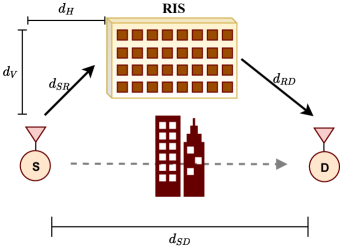
- 在Rician衰落和经验路径损耗模型下,构建了通用的单RIS系统模型,并进行基于概率的SNR和BER分析。
- 利用基于坐标的RIS位置部署和跨频段路径损耗建模,为NLOS场景制定多RIS传输模型。
- 提出一种新颖的RIS选择策略,通过在多个RIS对之间基于SNR的链路选择来优化性能。
- 集成实际硬件约束:有限相移范围(−150°至140°)和非理想反射系数(|Γ| = −1 dB)。
- 采用以集中参数κ为参数的零均值冯·米塞斯分布对相位估计误差进行建模,以模拟真实世界中的不完善性。
- 通过广泛仿真比较理想与非理想RIS性能,涵盖不同反射单元数量(N)和估计精度(κ)的情况。
实验结果
研究问题
- RQ1在Rician衰落环境中,单个RIS上反射单元数量的增加如何影响SNR分布和误码性能?
- RQ2经验路径损耗模型对室内和室外RIS辅助场景下整体系统性能有何影响?
- RQ3与单RIS配置相比,多个RIS如何提升非视 Line-of-sight(NLOS)环境下的可实现数据速率和可靠性?
- RQ4在降低复杂度和相位调节成本的前提下,对多个RIS对进行RIS选择能在多大程度上提升系统性能?
- RQ5RIS辅助通信对硬件损伤(如有限相位分辨率和不完全信道相位估计)的敏感程度如何?
主要发现
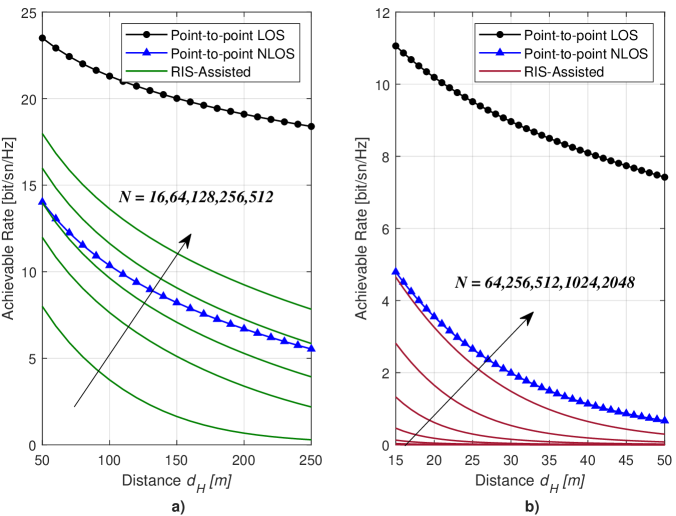
- 增加单个RIS上的反射单元数量可显著提升SNR并降低BER,从而实现信号的相位相长合并。
- RIS辅助系统相比非选择的多RIS系统,可实现高达30%的可实现数据速率增益,尤其当用户靠近最优RIS位置时更为明显。
- 基于SNR的RIS选择优于固定路径传输,在用户位于RIS附近时(如仿真中x = 5 m和25 m处)性能达到峰值。
- 即使在非理想RIS硬件条件下(相位范围受限:−150°至140°),误码性能仍接近理想RIS,表明对实际实现约束具有强鲁棒性。
- 相位估计误差会降低系统性能,但随着反射单元数量(N)增加和估计精度提高(κ值更高),其负面影响可被有效缓解。
- 路径损耗是RIS选择中的主导因素,在相似衰落条件下,路径越短性能越好。
更好的研究,从现在开始
从阅读论文到最终审阅,大幅缩短您的研究时间。
无需绑定信用卡
本解读由 AI 生成,并经人工编辑审核。