
[论文解读] Modeling Causal Mechanisms with Diffusion Models for Interventional and Counterfactual Queries
本文提出扩散因果模型(DCM),一种新颖的框架,利用去噪扩散模型从观测数据和已知因果图中学习结构因果模型。通过将潜在编码作为外生噪声的代理,以扩散过程建模每个节点的结构方程,DCM 实现了干预下的精确采样和反事实推理,在非加性噪声模型上的表现优于最先进方法一个数量级。
We consider the problem of answering observational, interventional, and counterfactual queries in a causally sufficient setting where only observational data and the causal graph are available. Utilizing the recent developments in diffusion models, we introduce diffusion-based causal models (DCM) to learn causal mechanisms, that generate unique latent encodings. These encodings enable us to directly sample under interventions and perform abduction for counterfactuals. Diffusion models are a natural fit here, since they can encode each node to a latent representation that acts as a proxy for exogenous noise. Our empirical evaluations demonstrate significant improvements over existing state-of-the-art methods for answering causal queries. Furthermore, we provide theoretical results that offer a methodology for analyzing counterfactual estimation in general encoder-decoder models, which could be useful in settings beyond our proposed approach.
研究动机与目标
- 开发一种灵活且可扩展的框架,仅使用观测数据和因果图即可回答结构因果模型中的观测、干预和反事实查询。
- 利用扩散模型的表达能力,通过将潜在码视为未观测到的外生噪声的代理,学习因果机制。
- 通过一种确定性的、自编码器风格的扩散过程(DDIM),为干预和反事实推理提供统一方法。
- 理论上分析编码器-解码器模型中反事实估计的准确性,其边界条件可推广至非扩散模型。
- 通过多样化结构方程类型和真实世界数据,实证验证 DCM 在现有最先进方法上的优越性。
提出的方法
- 将因果图中的每个节点建模为一个条件扩散模型,以父节点值作为输入,学习将观测结果编码到潜在空间并从潜在空间解码回变量空间。
- 采用去噪扩散隐式模型(DDIM)作为基础扩散架构,通过学习到的逆过程实现确定性采样和高效推理。
- 按拓扑顺序训练 DCM,确保每个节点的扩散模型基于其父节点的值进行条件化,以模拟结构方程模型(SCM)的生成过程。
- 对于干预查询,通过固定干预变量的值并从对应扩散模型中采样来应用 do-干预。
- 对于反事实查询,通过编码观测结果至潜在空间(即“归因”),然后执行操作(对潜在空间的干预)和预测(重构)步骤。
- 利用潜在表征作为外生噪声的代理,使模型能够捕捉复杂、非参数化的结构方程。
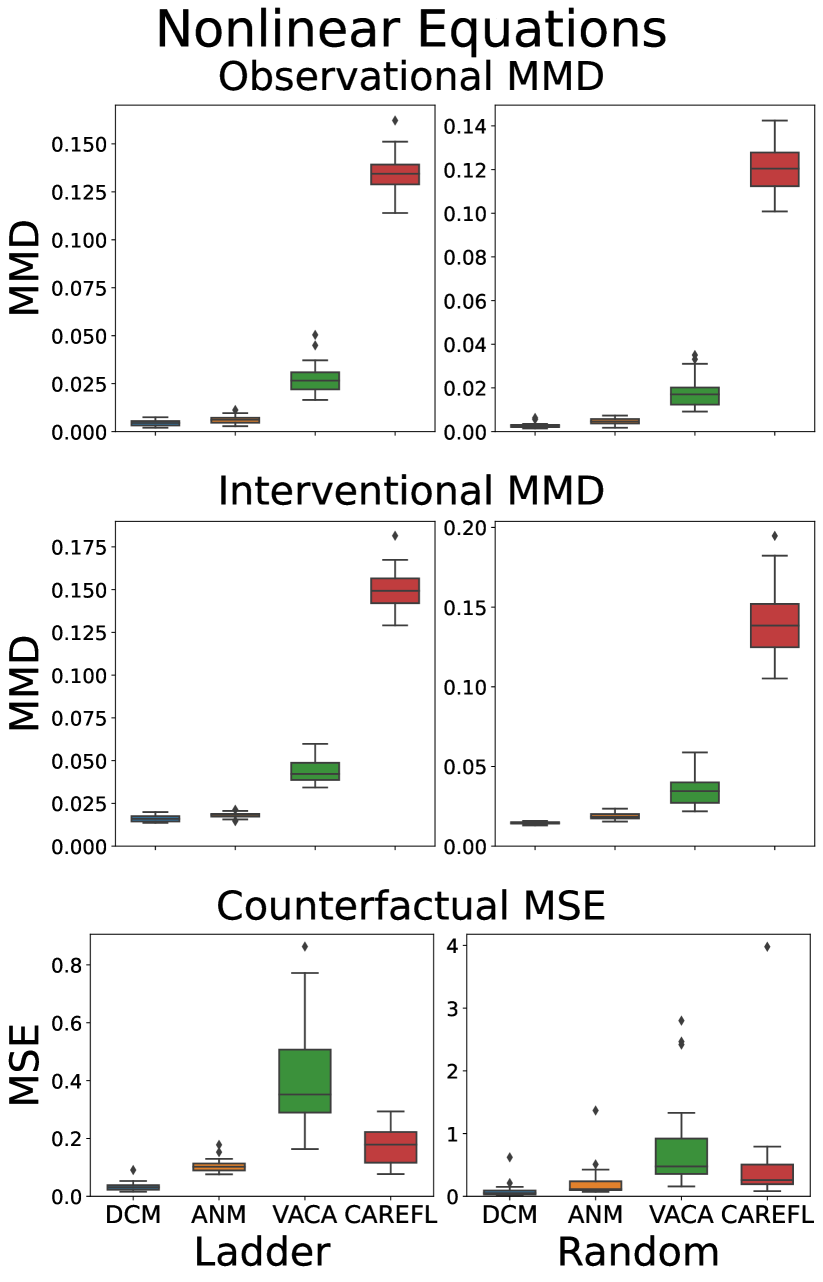
实验结果
研究问题
- RQ1扩散模型能否有效从观测数据和因果图中学习因果机制,以支持所有三类因果查询?
- RQ2DCM 在干预和反事实推理中的性能与现有最先进方法相比如何,特别是在非加性噪声条件下?
- RQ3对于编码器-解码器模型(如 DCM),反事实估计可提供哪些理论保证?
- RQ4DCM 能否泛化至真实世界数据(如具有复杂非线性依赖关系的 fMRI 数据)?
- RQ5DCM 中的潜在空间是否可作为外生噪声的有效代理,从而实现准确的归因和反事实推理?
主要发现
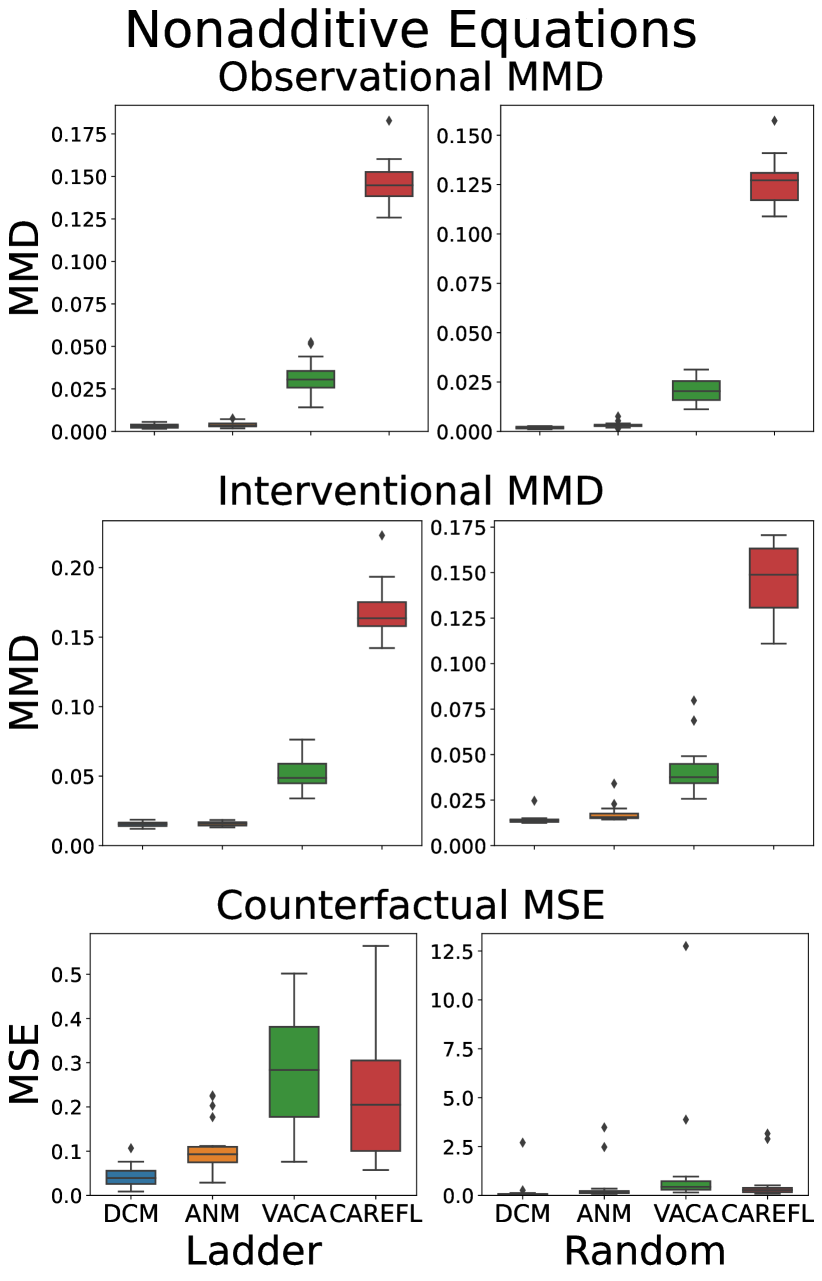
- 在 NADD 设置下,DCM 在 Y 图上的反事实和干预查询中,MSE 达到 10.42 ± 2.77,优于现有最先进方法一个数量级。
- 在半合成的 Sachs 数据集上,DCM 在 NLIN 设置下的反事实 MSE 为 0.72 ± 0.19 × 10⁻²,显著优于 VACA(17.71 ± 9.23 × 10⁻²)和 CAREFL(7.30 ± 0.95 × 10⁻²)。
- 在 Sachs 数据集的 NADD 设置下,DCM 的反事实 MSE 为 1.99 ± 2.49 × 10⁻²,优于 VACA(7.30 ± 11.57 × 10⁻²)和 CAREFL(8.30 ± 8.34 × 10⁻²)。
- 在 NLIN 设置下的 Ladder 图上,DCM 的观测 MMD 达到最低值 0.16 ± 0.11,表明其具有出色的分布保真度。
- 理论分析表明,在合理假设下,DCM 中反事实估计误差可被界定,为其他编码器-解码器模型提供通用框架。
- 在包含多种结构方程类型(线性、非线性、非加性)的合成数据集上,实证结果一致表明 DCM 在所有测试图结构中均显著优于现有方法,尤其在干预和反事实查询方面。
更好的研究,从现在开始
从阅读论文到最终审阅,大幅缩短您的研究时间。
无需绑定信用卡
本解读由 AI 生成,并经人工编辑审核。