
[论文解读] Modeling complex species-environment relationships through spatially-varying coefficient occupancy models
本文提出了一种基于层次贝叶斯推断的单物种与多物种空间可变系数(SVC)占用模型,结合最近邻高斯过程(Nearest Neighbor Gaussian Processes)与Pólya-Gamma数据增广技术,以提升计算效率。该方法揭示了美国范围内草甸鸟类对最大繁殖季节气温响应的显著空间非平稳性,相较于标准模型,在捕捉复杂、位置特异性的响应方面表现更优。
Occupancy models are frequently used by ecologists to quantify spatial variation in species distributions while accounting for observational biases in the collection of detection-nondetection data. However, the common assumption that a single set of regression coefficients can adequately explain species-environment relationships is often unrealistic, especially across large spatial domains. Here we develop single-species (i.e., univariate) and multi-species (i.e., multivariate) spatially-varying coefficient (SVC) occupancy models to account for spatially-varying species-environment relationships. We employ Nearest Neighbor Gaussian Processes and Polya-Gamma data augmentation in a hierarchical Bayesian framework to yield computationally efficient Gibbs samplers, which we implement in the spOccupancy R package. For multi-species models, we use spatial factor dimension reduction to efficiently model datasets with large numbers of species (e.g., > 10). The hierarchical Bayesian framework readily enables generation of posterior predictive maps of the SVCs, with fully propagated uncertainty. We apply our SVC models to quantify spatial variability in the relationships between maximum breeding season temperature and occurrence probability of 21 grassland bird species across the U.S. Jointly modeling species generally outperformed single-species models, which all revealed substantial spatial variability in species occurrence relationships with maximum temperatures. Our models are particularly relevant for quantifying species-environment relationships using detection-nondetection data from large-scale monitoring programs, which are becoming increasingly prevalent for answering macroscale ecological questions regarding wildlife responses to global change.
研究动机与目标
- 解决标准占用模型在大空间范围内假设物种-环境关系恒定的局限性。
- 考虑物种-环境关系中的空间非平稳性,该现象在宏观生态学研究中虽常见但常被忽略。
- 开发计算高效、可扩展的单物种与多物种占用模型,支持空间可变系数中完全传播的不确定性。
- 利用大规模监测数据,实现对广阔空间范围内物种种群对环境驱动因子响应的精确推断。
- 促进对环境驱动因子(如温度)如何在不同区域以不同方式影响物种种群出现概率的生态学洞察。
提出的方法
- 采用具有空间可变系数(SVCs)的层次贝叶斯框架,建模在空间上变化的物种-环境关系。
- 使用最近邻高斯过程(NNGP)以实现在大空间域中的可扩展计算。
- 应用Pólya-Gamma数据增广技术,以促进后验推断的高效吉布斯抽样。
- 通过空间因子降维方法实现多物种模型,以高效处理超过10个物种种群的数据集。
- 生成具有完全不确定性传播的SVC后验预测图,用于空间异质性环境效应的推断。
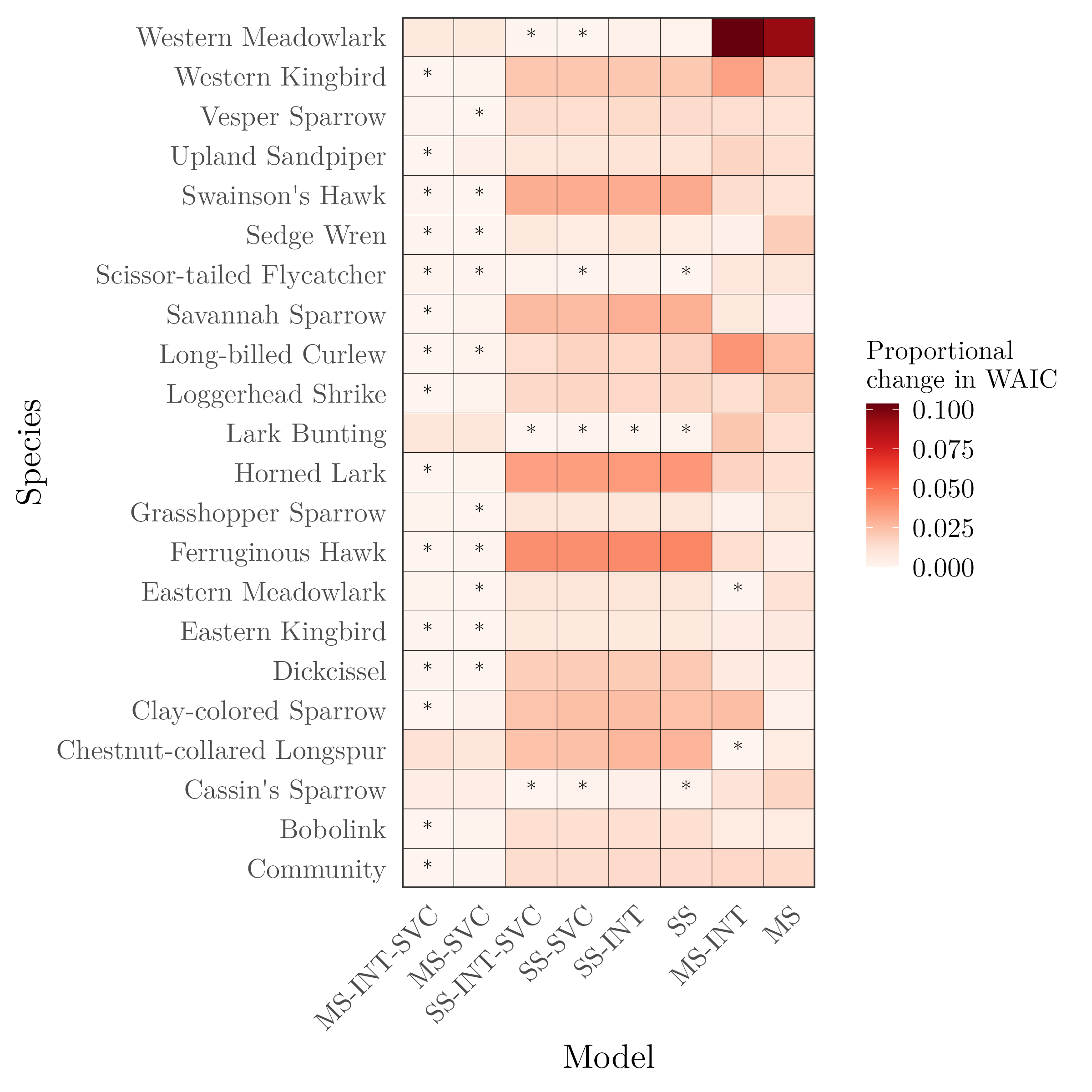
- 使用WAIC选择多物种模型中空间因子的最优数量,以在模型拟合与计算成本之间取得平衡。
实验结果
研究问题
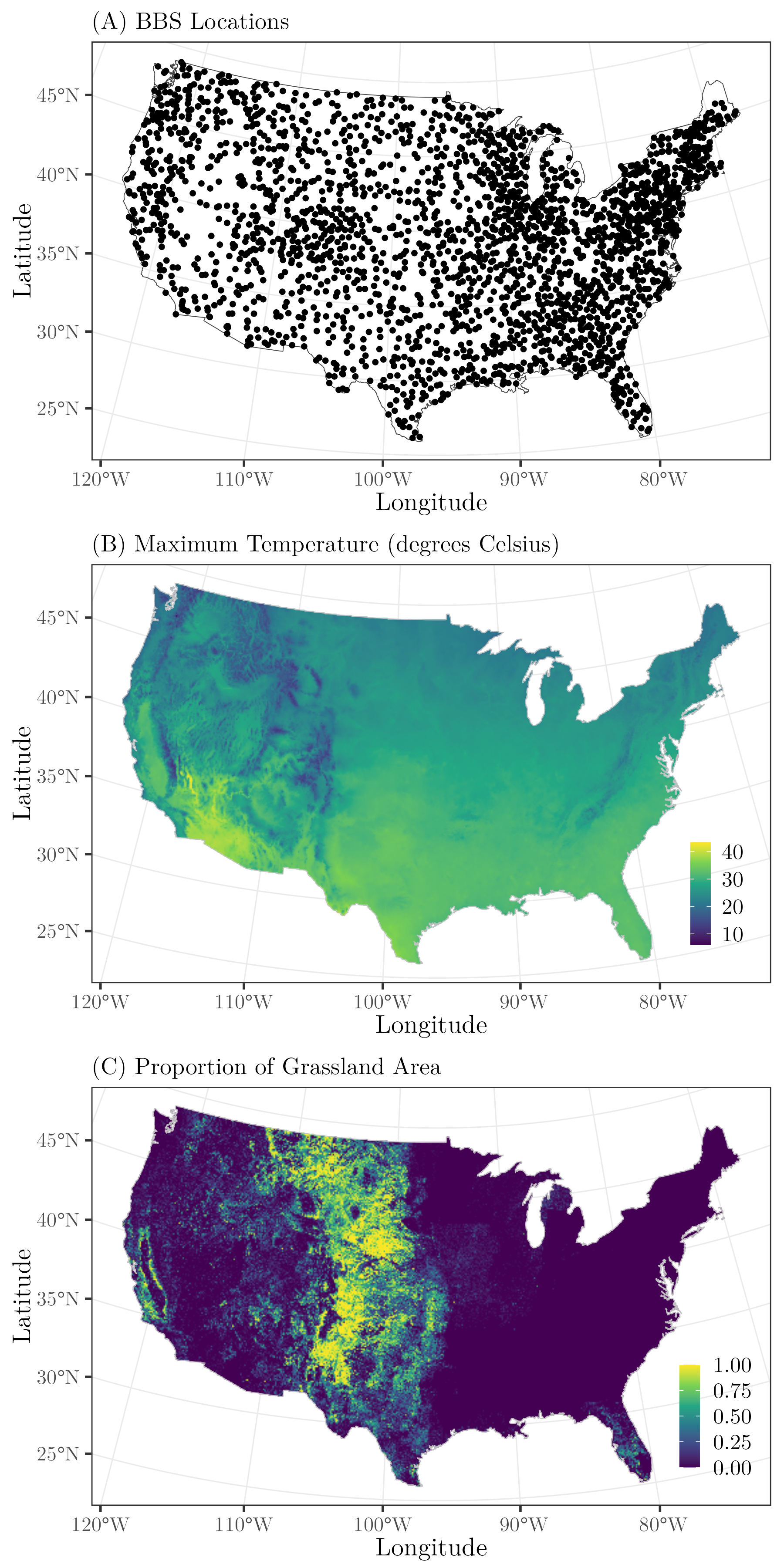
- RQ1在美国大陆范围内,草甸鸟类对最大繁殖季节气温的物种-环境关系如何在空间上变化?
- RQ2与单物种模型相比,联合建模多个物种种群在捕捉空间非平稳性方面能提升多少?
- RQ3空间可变系数占用模型能否检测并量化物种对气候变量响应的区域差异?
- RQ4在大规模数据集下,多物种SVC占用模型的计算可行性与收敛行为如何?
- RQ5如何在生态推断与决策制定中实现空间可变系数的完全不确定性传播?
主要发现
- 多物种SVC占用模型在捕捉物种-环境关系的空间变异性方面优于单物种模型。
- 所有单物种模型均揭示了最大繁殖季节气温与草甸鸟类出现概率之间存在显著的空间非平稳性。
- 模型生成了具有完全不确定性传播的空间可变系数后验预测图,支持在空间上进行概率推断。
- MCMC链的收敛需要最多500,000次迭代,且在3个核心上耗时约42小时,凸显了计算需求的强度。
- 通过WAIC选择空间因子数量(q)可优化模型性能,且在某一q值后模型性能提升趋于平缓。
- spOccupancy R包支持这些模型的便捷实现,为大规模生态监测数据提供可扩展的推断支持。
更好的研究,从现在开始
从阅读论文到最终审阅,大幅缩短您的研究时间。
无需绑定信用卡
本解读由 AI 生成,并经人工编辑审核。