
[论文解读] Money, Time, and Grant Design
本研究利用对美国学术研究人员的全国代表性调查,考察了资助设计——特别是资助金额和持续时间——如何影响研究策略与研究人员偏好。研究发现,尽管长期资助仅在终身教职人员中增加了风险承担行为,但研究人员普遍更偏好更高的资助金额而非更长的资助期限,表明资助设计主要通过选择效应而非对资助条款的行为响应来塑造科研资助结果。
The design of research grants has been hypothesized to be a useful tool for influencing researchers and their science. We test this by conducting two thought experiments in a nationally representative survey of academic researchers. First, we offer participants a hypothetical grant with randomized attributes and ask how the grant would influence their research strategy. Longer grants increase researchers' willingness to take risks, but only among tenured professors, which suggests that job security and grant duration are complements. Both longer and larger grants reduce researchers' focus on speed, which suggests a significant amount of racing in science is in pursuit of resources. But along these and other strategic dimensions, the effect of grant design is small. Second, we identify researchers' indifference between the two grant design parameters and find they are very unwilling to trade off the amount of funding a grant provides in order to extend the duration of the grant $\unicode{x2014}$ money is much more valuable than time. Heterogeneity in this preference can be explained with a straightforward model of researchers' utility. Overall, our results suggest that the design of research grants is more relevant to selection effects on the composition of researchers pursuing funding, as opposed to having large treatment effects on the strategies of researchers that receive funding.
研究动机与目标
- 理解资助设计的差异——特别是资助金额和持续时间——如何影响科研人员在科学领域中的战略决策。
- 通过思想实验框架,识别研究人员在资助金额与持续时间之间的权衡偏好。
- 评估资助设计是否能显著影响研究策略,如风险承担、研究速度或探索与利用之间的平衡。
- 评估选择效应(谁选择何种资助)是否比处理效应(资助如何改变行为)在塑造科学成果方面更为重要。
- 提供实证证据,以帮助资助方在设计资助项目时实现预期的科学影响。
提出的方法
- 通过在美国研究型高校中对1000多名活跃科研人员进行的全国代表性调查,开展两项思想实验。
- 在第一个实验中,研究人员被呈现随机组合的资助金额与持续时间的假设性资助项目,并被询问这些变化将如何影响其研究策略。
- 在第二个实验中,研究人员被要求确定其在资助金额与持续时间之间的无差异点,从而估算其在金钱与时间之间的替代意愿。
- 使用效用的结构模型解释偏好的异质性,以年龄作为贴现率的代理变量。
- 应用样本选择校正技术,并通过薪资比较验证调查的代表性。
- 使用一个参数($\gamma$)估算资金与时间的相对价值,该参数代表资助持续时间与资助金额之间的边际替代率。
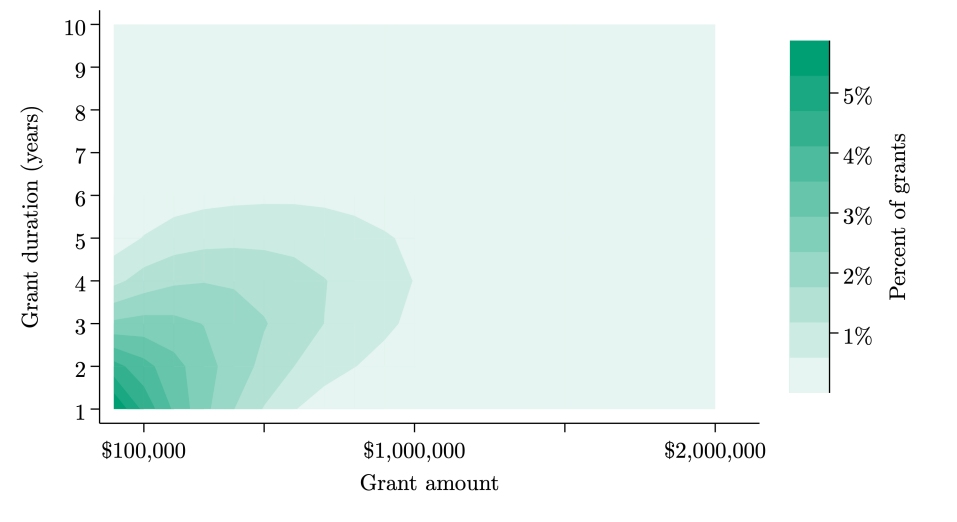
实验结果
研究问题
- RQ1资助持续时间与资助金额的变化在多大程度上影响研究人员的风险承担意愿、对速度的优先考虑,或向探索与利用策略的转变?
- RQ2研究人员对资助持续时间与资助金额的相对价值如何?这种价值在不同研究人员子群体中是否存在差异?
- RQ3资助设计参数在多大程度上影响实际研究行为(处理效应),又有多少是由于谁选择了何种资助(选择效应)?
- RQ4终身教职与非终身教职研究人员在面对更长或更大的资助时有何不同反应?
- RQ5调查中陈述的偏好在多大程度上能准确反映现实中的资助选择?该样本在多大程度上代表了更广泛的学术研究人群?
主要发现
- 长期资助仅在终身教职人员中增加了风险承担行为,表明职位安全与资助持续时间是互补的,共同促进大胆研究。
- 无论资助时间长短,更大的资助金额都会降低研究人员对研究速度的关注,表明科研中的‘竞赛’行为主要源于资源竞争,而非内在紧迫感。
- 研究人员愿意以四倍于其对时间的牺牲来换取更多资金,表明资金远比时间更受重视。
- 估算的边际替代率($\gamma$)显示,研究人员对资助金额1%的增加的重视程度,几乎相当于对资助持续时间1%增加的四倍。
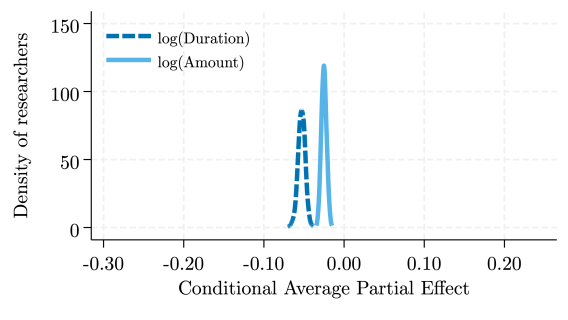
- 资助设计对研究策略的处理效应较小——将R01资助替换为MIRA风格资助,仅会使策略概率变化约1个百分点。
- 选择效应——即资助设计如何影响研究人员选择何种资助——可能比处理效应在决定资助资金对科学方向的整体影响方面更为重要。
更好的研究,从现在开始
从阅读论文到最终审阅,大幅缩短您的研究时间。
无需绑定信用卡
本解读由 AI 生成,并经人工编辑审核。