
[论文解读] MOPI-HFRS: A Multi-objective Personalized Health-aware Food Recommendation System with LLM-enhanced Interpretation
MOPI-HFRS 在图模型框架中联合优化用户偏好、个性化健康性和营养多样性,并使用一个由大语言模型增强的解释模块来提供解释。
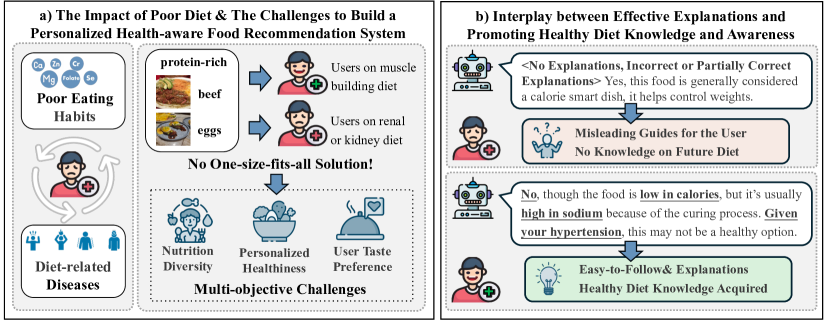
The prevalence of unhealthy eating habits has become an increasingly concerning issue in the United States. However, major food recommendation platforms (e.g., Yelp) continue to prioritize users' dietary preferences over the healthiness of their choices. Although efforts have been made to develop health-aware food recommendation systems, the personalization of such systems based on users' specific health conditions remains under-explored. In addition, few research focus on the interpretability of these systems, which hinders users from assessing the reliability of recommendations and impedes the practical deployment of these systems. In response to this gap, we first establish two large-scale personalized health-aware food recommendation benchmarks at the first attempt. We then develop a novel framework, Multi-Objective Personalized Interpretable Health-aware Food Recommendation System (MOPI-HFRS), which provides food recommendations by jointly optimizing the three objectives: user preference, personalized healthiness and nutritional diversity, along with an large language model (LLM)-enhanced reasoning module to promote healthy dietary knowledge through the interpretation of recommended results. Specifically, this holistic graph learning framework first utilizes two structure learning and a structure pooling modules to leverage both descriptive features and health data. Then it employs Pareto optimization to achieve designed multi-facet objectives. Finally, to further promote the healthy dietary knowledge and awareness, we exploit an LLM by utilizing knowledge-infusion, prompting the LLMs with knowledge obtained from the recommendation model for interpretation.
研究动机与目标
- Using NHANES 数据建立健康感知的个性化食品推荐的大规模基准。
- Develop a holistic framework that jointly optimizes user preference, personalized healthiness, and nutritional diversity.
- Incorporate health-aware graph structure learning to leverage health and descriptive features during training.
- Apply Pareto multi-objective optimization to balance competing goals.
- Introduce an LLM-enhanced interpretation module to provide explanations and health knowledge about recommendations.
提出的方法
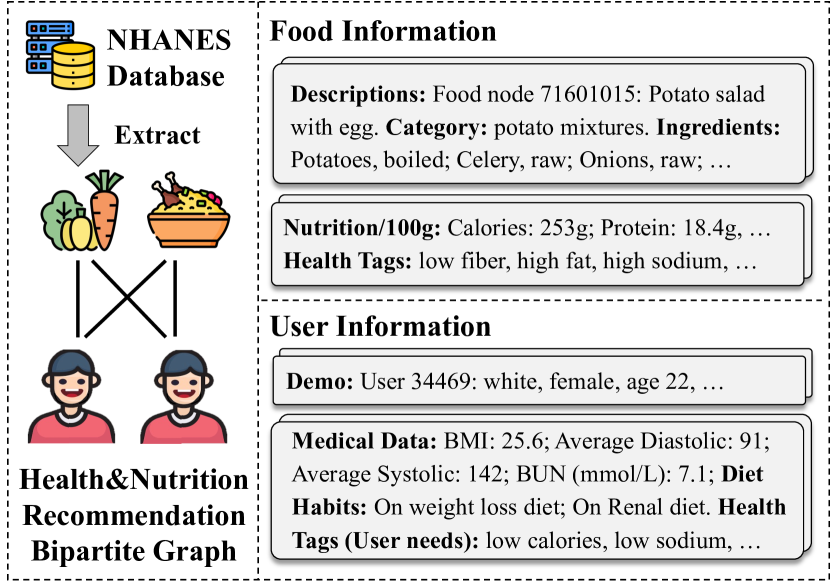
- 从 NHANES 数据构建健康与营养推荐 bipartite 图,以纳入健康信息与食品营养。
- Develop health-aware graph structure learning with feature-based structure learning and healthy edge structure learning.
- Employ graph structure pooling to fuse multiple graphs into a refined adjacency for downstream tasks.
- Use Pareto multi-objective optimization with a multi-loss objective (BPR for preference, health-based loss, diversity loss) to achieve Pareto optimality.
- Implement a knowledge-infused LLM reasoning module with domain-informed prompts to generate explanations for recommendations.
- Propose two domain-specific reasoning strategies (Refined Food Candidates, Attention on User Conditions) to improve LLM interpretation.
实验结果
研究问题
- RQ1Can a health-aware, personalized recommendation system be trained on NHANES-derived health data to balance user preferences, healthiness, and nutritional diversity?
- RQ2Does Pareto optimization improve trade-offs among competing objectives compared to weighted-sum approaches?
- RQ3Can an LLM provide reliable, domain-informed explanations for health-aware recommendations using knowledge-infusion from the model?
- RQ4Do health-aware graph structure learning and edge-sign information improve recommendation quality and health alignment?
主要发现
- MOPI-HFRS outperforms state-of-the-art baselines in multi-objective recommendation tasks on the proposed benchmarks.
- Incorporating health information and structured learning yields improvements in Recall@20, NDCG@20, H-Score, and diversity metrics across macro- and full-nutrient benchmarks.
- Pareto optimization with the proposed gradient-descent based updates achieves Pareto-optimal trade-offs among user preference, healthiness, and diversity.
- LLM-enhanced interpretation provides richer, domain-aware explanations for healthiness, aided by refined candidate sets and condition-focused prompts.
- Ablation studies indicate that both feature-based structure learning and healthy edge learning contribute to performance gains.
更好的研究,从现在开始
从阅读论文到最终审阅,大幅缩短您的研究时间。
无需绑定信用卡
本解读由 AI 生成,并经人工编辑审核。