
[论文解读] Multi-functional OFDM Signal Design for Integrated Sensing, Communications, and Power Transfer
本文提出了一种用于集成感知、通信与能量传输(ISCAP)的多功能OFDM信号设计,通过在子载波上优化非零均值非对称高斯输入分布,以在满足速率和感知性能约束的前提下最大化接收能量。所优化的波形在性能区域上优于传统的共存或对称信号设计,通过自适应的功率与均值分配,在三项功能之间实现了更优的权衡。
The wireless domain is witnessing a flourishing of integrated systems, e.g. (a) integrated sensing and communications, and (b) simultaneous wireless information and power transfer, due to their potential to use resources (spectrum, power) judiciously. Inspired by this trend, we investigate integrated sensing, communications and powering (ISCAP), through the design of a wideband OFDM signal to power a sensor while simultaneously performing target-sensing and communication. To characterize the ISCAP performance region, we assume symbols with non-zero mean asymmetric Gaussian distribution (i.e., the input distribution), and optimize its mean and variance at each subcarrier to maximize the harvested power, subject to constraints on the achievable rate (communications) and the average side-to-peak-lobe difference (sensing). The resulting input distribution, through simulations, achieves a larger performance region than that of (i) a symmetric complex Gaussian input distribution with identical mean and variance for the real and imaginary parts, (ii) a zero-mean symmetric complex Gaussian input distribution, and (iii) the superposed power-splitting communication and sensing signal (the coexisting solution). In particular, the optimized input distribution balances the three functions by exhibiting the following features: (a) symbols in subcarriers with strong communication channels have high variance to satisfy the rate constraint, while the other symbols are dominated by the mean, forming a relatively uniform sum of mean and variance across subcarriers for sensing; (b) with looser communication and sensing constraints, large absolute means appear on subcarriers with stronger powering channels for higher harvested power. As a final note, the results highlight the great potential of the co-designed ISCAP system for further efficiency enhancement.
研究动机与目标
- 设计一种统一的OFDM波形,同时实现高速通信、精确感知和高效的无线能量传输。
- 在数据速率和感知精度联合约束下,表征集成感知、通信与供电(ISCAP)的性能区域。
- 优化OFDM子载波上的输入信号分布(均值与方差),以在满足通信与感知要求的前提下最大化接收能量。
- 通过性能区域与权衡效率,证明联合设计的ISCAP优于共存或对称信号方案。
提出的方法
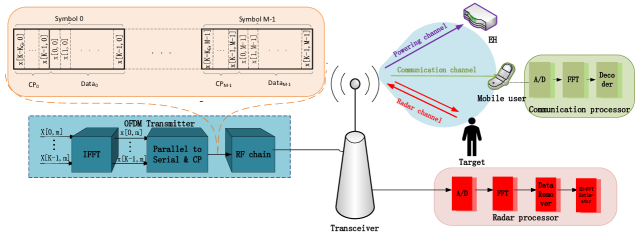
- 作者采用每子载波非零均值非对称高斯分布建模OFDM输入信号,实现均值与方差的独立优化。
- 建立凸优化问题以最大化接收能量,约束条件包括可实现的通信速率和平均旁瓣电平差(作为感知精度的代理指标)。
- 将问题转化为二次约束二次规划(QCQP)问题,通过拉格朗日松弛法与在感知约束乘子上进行二分搜索的交替优化求解。
- 直接计算功率协方差矩阵的非对角元素,而对角元素则通过求解与感知约束相关的对偶变量的迭代根查找法获得。
- 算法在更新信号协方差矩阵与精炼对偶变量之间交替进行,直至收敛。
- 通过仿真评估性能,将所提设计与三种基线方案进行对比:对称复高斯信号、零均值对称高斯信号以及叠加式功率分配信号。
实验结果
研究问题
- RQ1能否设计一种单一OFDM波形,使其同时支持高速通信、精确感知与高效无线能量传输?
- RQ2ISCAP的性能区域与共存或叠加式通信、感知与能量传输系统的性能区域相比如何?
- RQ3在子载波上,为平衡通信速率、感知精度与接收能量之间的权衡,最优输入分布(均值与方差)应如何配置?
- RQ4针对每项功能,均值与方差在子载波上的分配如何依赖于信道条件?
主要发现
- 所提出的非对称高斯输入分布实现的ISCAP性能区域大于对称复高斯输入、零均值输入以及叠加式功率分配方案。
- 在通信信道较强的子载波上分配更高的方差以满足速率约束,而在感知或能量传输信道较强的子载波上分配更大的均值以增强感知或能量采集性能。
- 通过在子载波上均匀分配均值与方差之和,优化设计实现了感知性能的一致性,表现出良好的平衡权衡。
- 在约束条件放宽时,能量传输信道更强的子载波被分配更大的绝对均值,以最大化接收能量。
- 结果证实,联合设计的ISCAP信号显著优于共存方案,凸显了未来无线网络中更高谱效率与能量效率的潜力。
更好的研究,从现在开始
从阅读论文到最终审阅,大幅缩短您的研究时间。
无需绑定信用卡
本解读由 AI 生成,并经人工编辑审核。