
[论文解读] Multimass modelling of Milky Way globular clusters -- II. present-day black hole populations
本研究利用多质量分布函数模型,基于多观测约束(运动学、密度、质量函数),推断34个银河系球状星团中当前的黑洞(BH)种群。结果发现,除ω Cen外,大多数星团的黑洞质量分数为0–1%,而ω Cen的黑洞质量分数约为5%。研究揭示了黑洞含量与质量分离之间的负相关性,以及残余质量分数与动力学年龄之间的相关性。
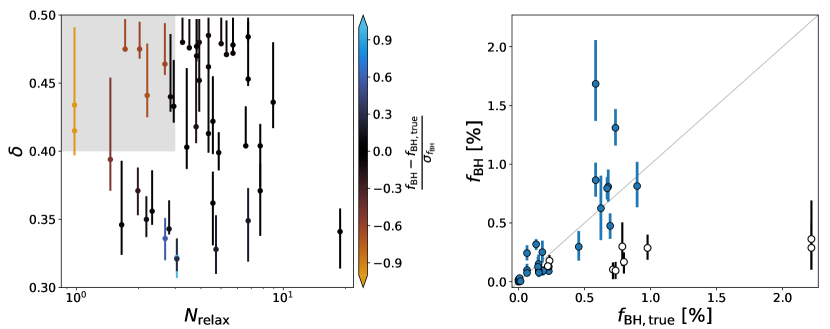
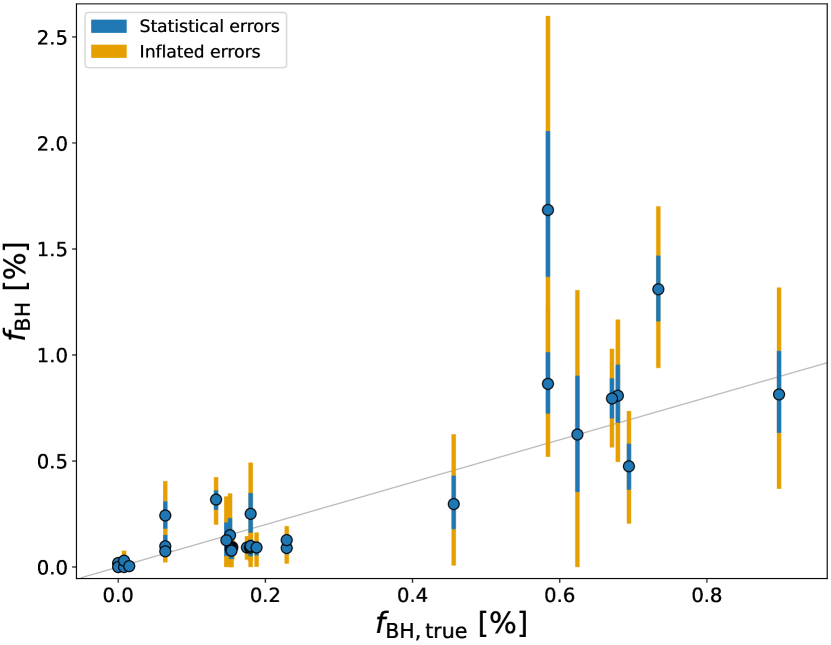
Populations of stellar-mass black holes (BHs) in globular clusters (GCs) influence their dynamical evolution and have important implications on one of the main formation channels for gravitational wave sources. Inferring the size of these populations remains difficult, however. In this work, multimass models of 34 Milky Way GCs, first presented in Dickson et al., are used to explore the present-day BH populations. Direct constraints on both the total and visible mass components provided by several observables allow these models to accurately determine the distribution of the dark mass (including BHs) within clusters, as we demonstrate in a proof-of-concept fitting of the models to mock observations extracted from Monte Carlo cluster models. New constraints on the BH population retained to the present-day in each cluster are inferred from our models. We find that BH mass fractions ranging from 0 to 1 per cent of the total mass are typically required to explain the observations, except for Omega Cen, for which we infer a mass fraction above 5 per cent, in agreement with previous works. Relationships between the dark remnant populations and other cluster parameters are examined, demonstrating a clear anti-correlation between the amount of BHs and mass segregation between visible stars, as well as a correlation between remnant mass fractions and the dynamical age of clusters. Our inferred BH populations are in good agreement overall with other recent studies using different methodologies, but with notable discrepancies for individual clusters.
研究动机与目标
- 利用多质量动力学模型推断大样本银河系球状星团(GCs)中当前的黑洞(BH)种群。
- 通过结合多种观测数据(包括自行、视线速度、表面密度和质量函数),约束暗质残余物(特别是恒星级黑洞)的分布与总质量。
- 研究黑洞含量与星团动力学特性(如质量分离和动力学生命周期)之间的关系。
- 检验先前声称存在中等质量黑洞(IMBHs)的星团中,观测到的运动学与结构数据是否需要IMBH的存在。
- 将模型推断的黑洞种群与其它方法的结果进行比较,并评估样本内的一致性。
提出的方法
- 采用多质量分布函数(DF)模型,同时拟合34个银河系球状星团的多个观测量——自行、视线速度、表面亮度轮廓和质量函数。
- 利用贝叶斯推断结合嵌套采样(通过dynesty实现),探索模型参数的后验概率分布,包括总黑洞质量、数量和质量分数。
- 对恒星初始质量函数(IMF)施加约束,特别是高质域(>1 M⊙)部分,并考虑金属丰度依赖性。
- 通过从蒙特卡洛星团模拟中提取的模拟观测数据验证建模框架,证明其在恢复暗质量分布方面的稳健性。
- 利用推断的暗质量分布,将黑洞、中子星和白矮星的贡献分离开来,其中黑洞被建模为一个独立的、大质量组分。
- 应用统计拟合技术,使模型预测与观测到的运动学和结构数据相一致,最小化所有数据集的残差。
实验结果
研究问题
- RQ1在所研究的34个银河系球状星团中,当前的黑洞质量分数分别是多少?
- RQ2黑洞的存在与可观测的动力学特性(如质量分离,以δ参数量化)和星团动力学生命周期之间存在何种关联?
- RQ3在先前声称存在中等质量黑洞(IMBHs)的星团中,观测到的运动学与结构数据在多大程度上需要IMBH的存在?
- RQ4与其它方法(如Jeans建模或N体/蒙特卡洛模拟)相比,推断出的黑洞种群有何异同?
- RQ5总残余质量分数与星团的演化状态(特别是动力学演化和质量分离)之间存在何种关系?
主要发现
- 在大多数银河系球状星团中,推断的黑洞质量分数占总星团质量的0%至1%,但ω Cen例外,其质量分数约为5%。
- 发现黑洞质量分数与δ参数之间存在明显的负相关性,表明黑洞种群越显著的星团,其可见恒星的质量分离程度越低。
- 样本中动力学演化最显著的星团,其残余质量分数(包括黑洞、中子星和白矮星)可高达约70%(按质量计),其中黑洞对这一暗质量有显著贡献。
- 模型结果与其他近期采用不同方法的研究结果总体一致,但个别星团存在显著差异,尤其在黑洞种群较少或较多的系统中。
- 在先前被认为可能拥有中等质量黑洞(IMBHs)的星团中,未发现IMBH存在的证据;数据完全可由恒星级黑洞种群解释。
- 模型的后验分布显示,M15中的总黑洞质量约为80 M⊙(90%可信区间为50–130 M⊙),与先前估计一致,略低于某些Jeans建模结果,但与匹配的CMC模拟结果一致。
更好的研究,从现在开始
从阅读论文到最终审阅,大幅缩短您的研究时间。
无需绑定信用卡
本解读由 AI 生成,并经人工编辑审核。