
[论文解读] Nanoscale engineering and dynamical stabilization of mesoscopic spin textures
该论文展示了一种新颖方法,通过利用热化动力学,在金刚石中的氮空位(NV)中心作为纳米尺度极化注入器和耗散源的前提下,实现并稳定了介观尺度的壳状自旋结构。通过在Floquet驱动的电子梯度场下实现预热化,系统实现了跨越数纳米和数百个自旋的长寿命、稳定自旋结构,其退相干时间超过一百万个自旋相互作用时间尺度,从而实现了无需逐个自旋操控的稳健非局域控制与读出。
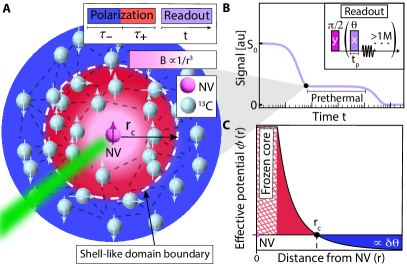
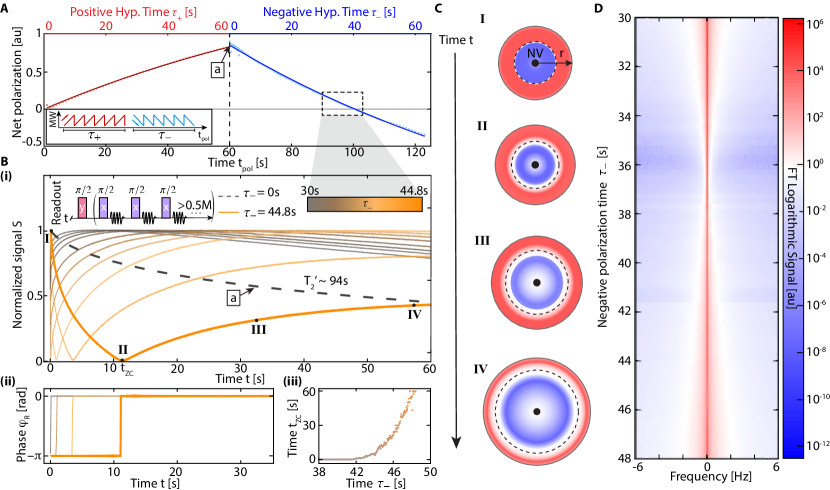
Thermalization phenomena, while ubiquitous in quantum systems, have traditionally been viewed as obstacles to be mitigated. In this study, we demonstrate the ability, instead, to harness thermalization to dynamically engineer and stabilize structured quantum states in a mesoscopically large ensemble of spins. Specifically, we showcase the capacity to generate, control, stabilize, and read out 'shell-like' spin texture with interacting $ {}^{ 13}\mathrm{C}$ nuclear spins in diamond, wherein spins are polarized oppositely on either side of a critical radius. The texture spans several nanometers and encompasses many hundred spins. We capitalize on the thermalization process to impose a quasi-equilibrium upon the generated texture; as a result, it is highly stable, immune to spin diffusion, and endures over multiple-minute long periods -- over a million times longer than the intrinsic interaction scale of the spins. Additionally, the texture is created and interrogated without locally controlling or probing the nuclear spins. These features are accomplished using an electron spin as a nanoscale injector of spin polarization, and employing it as a source of spatially varying dissipation, allowing for serial readout of the emergent spin texture. Long-time stabilization is achieved via prethermalization to a Floquet-induced Hamiltonian under the electronic gradient field. Our work presents a new approach to robust nanoscale spin state engineering and paves the way for new applications in quantum simulation, quantum information science, and nanoscale imaging.
研究动机与目标
- 通过利用热化过程而非抑制其影响,突破传统认为热化对量子系统具有破坏性的观点,实现对结构化自旋态的稳定。
- 在无需局域控制或读出的高温核自旋系综中,实现长寿命、介观尺度扩展的自旋结构。
- 展示一种可扩展的、非侵入式方法,利用单个NV中心作为纳米尺度探针与注入器,实现复杂自旋结构的创建与监测。
- 建立一种通过工程化耗散与预热化在长程自旋相互作用系统中实现鲁棒量子态工程的框架。
提出的方法
- 利用金刚石中的NV中心作为自旋极化的纳米尺度源以及空间可变耗散源,实现自旋结构的注入与形貌调控。
- 通过时间周期性(Floquet)驱动NV电子自旋,诱导出一种预热化的有效哈密顿量,从而稳定自旋结构。
- 利用NV磁偶极场产生的空间依赖有效局域势,使周围13C核自旋形成径向极化梯度。
- 通过NV中心进行串行读出,实现实时监测自旋结构的形成,而无需对单个核自旋进行局域操控。
- 采用粗粒度格点模型的经典模拟方法验证长时间动力学行为,忽略最小自旋间距2a以下的短时涨落。
- 通过对多种格点构型与初始态取平均,模拟NV环境的统计行为,与实验中的系综平均一致。
实验结果
研究问题
- RQ1是否可以利用热化动力学来稳定复杂、介观尺度的自旋结构,而非将其抑制?
- RQ2单个NV中心是否能够实现对大群核自旋的非局域、串行读出与控制,而无需对单个自旋进行地址识别?
- RQ3在Floquet驱动下,预热化在多大程度上能够使自旋结构抵抗自旋扩散与退相干?
- RQ4NV产生的有效势的空间非均匀性在壳状极化分布形成过程中起何种作用?
- RQ5长程偶极相互作用在高温系统中如何促成宏观、稳定的自旋结构?
主要发现
- 系统稳定形成了一种壳状自旋结构,临界半径两侧自旋极化方向相反,结构跨度达数纳米,包含数百个13C核自旋。
- 该自旋结构持续时间超过三分钟,比自旋-自旋相互作用的本征时间尺度长逾一百万倍,展现出极高的稳定性。
- 该结构通过预热化至Floquet诱导的有效哈密顿量实现动态稳定,使其对自旋扩散与控制误差具有强鲁棒性。
- 晚期时间的极化分布与NV产生的空间可变有效势相匹配,证实系统已达到由ETH(本征态热化假说)支配的准平衡态。
- 该方法仅通过NV中心即可实现自旋结构的连续串行读出,无需对单个核自旋进行局域操控或探测。
- 经典模拟证实了稳定、非均匀极化分布的形成,与实验观测结果一致,验证了在粗粒度动力学下的理论模型。
更好的研究,从现在开始
从阅读论文到最终审阅,大幅缩短您的研究时间。
无需绑定信用卡
本解读由 AI 生成,并经人工编辑审核。