
[论文解读] NAPA: Intermediate-level Variational Native-pulse Ansatz for Variational Quantum Algorithms
NAPA 提出了一种原生脉冲变分量子算法的变分态生成器,直接优化脉冲幅度和频率,而非依赖门分解,从而在 VQE 任务中平均将电路延迟降低 86%,准确率最高达 99.895%。通过使用非梯度优化器和渐进式变分态增长策略,它提升了希尔伯特空间的探索能力,并增强了 NISQ 设备上的噪声鲁棒性。
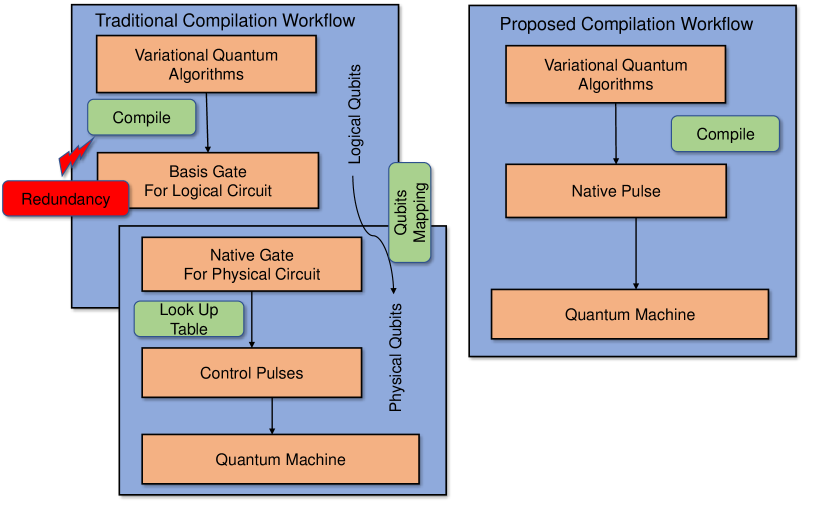
Variational quantum algorithms (VQAs) have demonstrated great potentials in the Noisy Intermediate Scale Quantum (NISQ) era. In the workflow of VQA, the parameters of ansatz are iteratively updated to approximate the desired quantum states. We have seen various efforts to draft better ansatz with less gates. Some works consider the physical meaning of the underlying circuits, while others adopt the ideas of neural architecture search (NAS) for ansatz generator. However, these designs do not exploit the full advantages of VQAs. Because most techniques target gate ansatz, and the parameters are usually rotation angles of the gates. In quantum computers, the gate ansatz will eventually be transformed into control signals such as microwave pulses on superconducting qubits. These control pulses need elaborate calibrations to minimize the errors such as over-rotation and under-rotation. In the case of VQAs, this procedure will introduce redundancy, but the variational properties of VQAs can naturally handle problems of over-rotation and under-rotation by updating the amplitude and frequency parameters. Therefore, we propose NAPA, a native-pulse ansatz generator framework for VQAs. We generate native-pulse ansatz with trainable parameters for amplitudes and frequencies. In our proposed NAPA, we are tuning parametric pulses, which are natively supported on NISQ computers. Given the limited availability of gradient-based optimizers for pulse-level quantum programs, we choose to deploy non-gradient optimizers in our framework. To constrain the number of parameters sent to the optimizer, we adopt a progressive way to generate our native-pulse ansatz. Experiments are conducted on both simulators and quantum devices for Variational Quantum Eigensolver (VQE) tasks to evaluate our methods.
研究动机与目标
- 解决在 NISQ 设备上基于门的编译为变分量子算法引入的延迟和冗余问题。
- 通过直接调节脉冲级参数(幅度和频率)而非门角度,利用变分量子算法固有的噪声鲁棒性。
- 通过渐进式变分态生成策略,减少发送给优化器的参数数量。
- 在真实 NISQ 硬件上,针对量子化学和优化任务,展示改进的性能和更短的电路持续时间。
- 实现脉冲级控制在 VQA 工作流中的直接集成,绕过门抽象层。
提出的方法
- 提出 NAPA 框架,可在 NISQ 硬件上直接生成具有可训练幅度和频率参数的原生脉冲变分态。
- 由于脉冲级程序中梯度方法可用性有限,采用非梯度优化器。
- 采用渐进式学习策略逐步构建变分态,以提升优化稳定性并扩大希尔伯特空间覆盖范围。
- 将变分参数直接映射到超导量子比特的微波脉冲控制信号上,消除门分解的开销。
- 在模拟器和真实量子设备(如 ibmq_montreal、ibmq_jakarta)上对 VQE 和 maxcut 任务的变分态进行了验证。
- 通过脉冲失谐实验验证,参数变化覆盖了完整的能量景观,确保收敛至基态。
实验结果
研究问题
- RQ1在 NISQ 设备上,直接优化脉冲级参数(幅度和频率)是否能在 VQA 性能和延迟方面优于基于门的变分态?
- RQ2渐进式变分态生成在基于脉冲的 VQA 中如何改善优化收敛性和希尔伯特空间探索?
- RQ3在真实硬件上,原生脉冲变分态在量子化学和优化任务中能在多大程度上减少电路持续时间并提高准确率?
- RQ4通过变分学习,脉冲级调节能否自然缓解 NISQ 设备中的过旋转和欠旋转误差?
- RQ5在真实噪声条件下,NAPA 是否能泛化至包括 VQE 和 maxcut 在内的多样化 VQA 应用?
主要发现
- 与基于门的对应方法相比,NAPA 在 NISQ 设备上平均将电路延迟降低了 86%。
- 对于 H2 分子,NAPA 在 VQE 任务中实现了 96.482% 的准确率,而 HeH+ 达到了 99.336% 的准确率。
- 在中等规模的量子化学任务(CO2、H2O、NaH)中,NAPA 实现了平均 97.27% 的准确率。
- 对于三正则六节点 maxcut 问题,与基于门的 TwoLocal 变分态相比,NAPA 将近似比提高了 3.4%。
- 在脉冲失谐实验中,能量估计表现出广泛且灵敏的变化,证实了对希尔伯特空间的有效覆盖。
- 渐进式学习方法平均使与 FCI 能量值的偏差降低了约 40%,其中 H2 和 HeH+ 分别实现了 24% 和 48% 的改进。
更好的研究,从现在开始
从阅读论文到最终审阅,大幅缩短您的研究时间。
无需绑定信用卡
本解读由 AI 生成,并经人工编辑审核。