
[论文解读] NeuroGraph: Benchmarks for Graph Machine Learning in Brain Connectomics
NeuroGraph 创建静态和动态脑图基准,探索 35 个数据集和 15 个基线,用于对基于 fMRI 推导的连接组的图神经网络在人口统计学、任务和认知特征预测上的基准评测。
Machine learning provides a valuable tool for analyzing high-dimensional functional neuroimaging data, and is proving effective in predicting various neurological conditions, psychiatric disorders, and cognitive patterns. In functional magnetic resonance imaging (MRI) research, interactions between brain regions are commonly modeled using graph-based representations. The potency of graph machine learning methods has been established across myriad domains, marking a transformative step in data interpretation and predictive modeling. Yet, despite their promise, the transposition of these techniques to the neuroimaging domain has been challenging due to the expansive number of potential preprocessing pipelines and the large parameter search space for graph-based dataset construction. In this paper, we introduce NeuroGraph, a collection of graph-based neuroimaging datasets, and demonstrated its utility for predicting multiple categories of behavioral and cognitive traits. We delve deeply into the dataset generation search space by crafting 35 datasets that encompass static and dynamic brain connectivity, running in excess of 15 baseline methods for benchmarking. Additionally, we provide generic frameworks for learning on both static and dynamic graphs. Our extensive experiments lead to several key observations. Notably, using correlation vectors as node features, incorporating larger number of regions of interest, and employing sparser graphs lead to improved performance. To foster further advancements in graph-based data driven neuroimaging analysis, we offer a comprehensive open-source Python package that includes the benchmark datasets, baseline implementations, model training, and standard evaluation.
研究动机与目标
- 探索将 fMRI 数据的图表示用于机器学习任务。
- 创建一个包含静态和动态脑图的大型基准套件(NeuroGraph)。
- 评估多样的 GNN 和基线,找出有效的流程。
- 提供一个包含数据集、模型和评估协议的开源工具包。
提出的方法
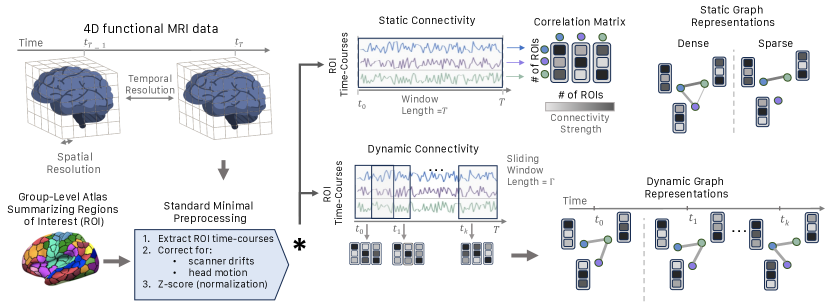
- 使用感兴趣区域(ROIs)和基于相关性的边将 fMRI 数据转换为图表示。
- 构建具有不同 ROIs 和稀疏度的静态和动态图脑图。
- 在 35 个数据集上评估包括 10 个 GNN 在内的 15 个基线模型和 5 个非 GNN 的基线。
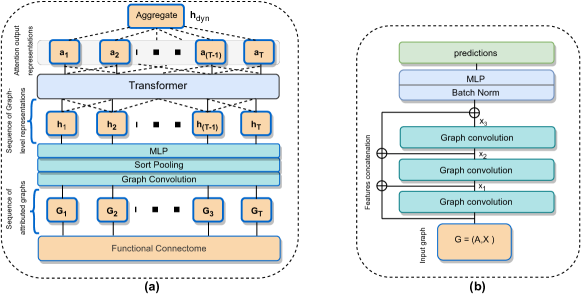
- 提出一个带残差连接和拼接多层表示的 GNN∗ 架构。
- 集成一个将 GNN 与 transformer 结合的动态图处理模块以获得整体表示。
实验结果
研究问题
- RQ1哪些节点特征配置(CORR、BOLD,或两者)能够获得最佳预测性能?
- RQ2ROI 数量(100、400、1000)如何影响模型精度和泛化能力?
- RQ3边缘稀疏阈值(前 5%、10%、20%)如何在信号与稀疏度之间取得最优平衡?
- RQ4在各任务中,哪些图卷积方法对脑图最有效?
主要发现
- 基于相关性的节点特征在不同 ROI 和任务中一致提升性能。
- 使用 1000 个 ROIs 且图稀疏通常在各数据集上取得较好结果。
- 具有残差连接和 MLP 融合的 GNN∗ 在静态数据集上通常优于其他基线。
- 动态图表现具有竞争力,但有时由于数据集约束表现较低;UniMP 仍然稳健。
- 大 ROI 与带相关特征的稀疏度在基准中成为有利设置。
- 研究提供了一个开源的 NeuroGraph 工具包,包含数据集、基线,以及训练/评估流程。
更好的研究,从现在开始
从阅读论文到最终审阅,大幅缩短您的研究时间。
无需绑定信用卡
本解读由 AI 生成,并经人工编辑审核。