
[论文解读] Neurosymbolic AI -- Why, What, and How
论文将 Neurosymbolic AI 呈现为一种混合方法,将神经网络与符号知识结合,以提升认知、可解释性和 AI 系统的安全性。
Humans interact with the environment using a combination of perception - transforming sensory inputs from their environment into symbols, and cognition - mapping symbols to knowledge about the environment for supporting abstraction, reasoning by analogy, and long-term planning. Human perception-inspired machine perception, in the context of AI, refers to large-scale pattern recognition from raw data using neural networks trained using self-supervised learning objectives such as next-word prediction or object recognition. On the other hand, machine cognition encompasses more complex computations, such as using knowledge of the environment to guide reasoning, analogy, and long-term planning. Humans can also control and explain their cognitive functions. This seems to require the retention of symbolic mappings from perception outputs to knowledge about their environment. For example, humans can follow and explain the guidelines and safety constraints driving their decision-making in safety-critical applications such as healthcare, criminal justice, and autonomous driving. This article introduces the rapidly emerging paradigm of Neurosymbolic AI combines neural networks and knowledge-guided symbolic approaches to create more capable and flexible AI systems. These systems have immense potential to advance both algorithm-level (e.g., abstraction, analogy, reasoning) and application-level (e.g., explainable and safety-constrained decision-making) capabilities of AI systems.
研究动机与目标
- 说明结合基于感知的神经网络与基于知识的符号推理的必要性。
- 解释神经符号 AI 如何支持抽象、类比、推理和长期规划。
- 强调应用层面的好处,如可解释性、可理解性、安全性以及对 AI 系统的信任。
- 调查架构类别及对算法层面和应用层面性能的实际影响。
提出的方法
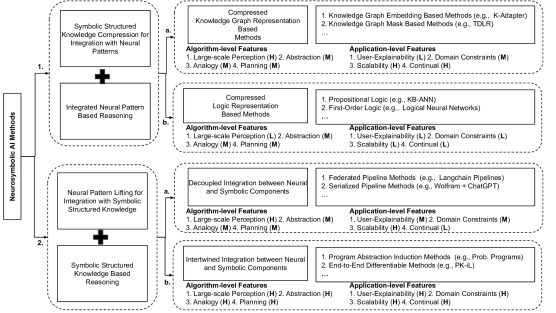
- 将神经符号方法分为两大类:下放(将符号知识压缩以与神经模式集成)和上升(从神经模式提取信息以映射到符号知识)。
- 进一步将类别1细分为 (a) 压缩知识图谱和 (b) 压缩形式逻辑表示,类别2细分为 (a) 具有端到端学习的联邦管道和 (b) 完全可微分的端到端管道。
- 分析认知与感知在低、中、高尺度上的算法层面结果,以及在可解释性、约束、可扩展性和持续适应方面的应用层面结果。
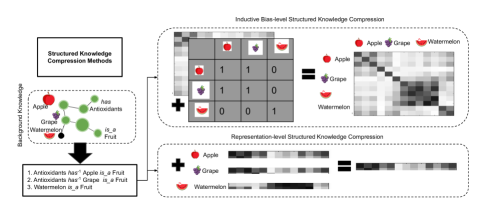
- 提供架构图和示例,说明知识图谱和逻辑如何与神经网络集成,包括注意力偏置和掩蔽技术。
- 讨论不同集成方法在可解释性、可扩展性和用户采用方面的挑战。
实验结果
研究问题
- RQ1将神经与符号 AI 系统结合的主要动机是什么?
- RQ2神经符号方法的主要类别和子类别是什么?它们在算法层面和应用层面上的表现如何?
- RQ3压缩和提升(lifting)技术如何影响神经符号系统的认知、感知、可解释性和安全性?
- RQ4联邦式管道与完全端到端可微分管道在可扩展性和持续学习方面可能带来哪些影响?
- RQ5神经符号 AI 的未来方向和安全性考量是什么?
主要发现
- 神经符号 AI 将神经感知与符号认知融合,以实现抽象、类比和规划。
- 通过嵌入或掩蔽进行的知识图谱压缩使其能够与神经管道集成,尽管语义存在损失但获得了适度的认知提升。
- 对形式逻辑表示的压缩在计算上效率低下,并且在大规模感知方面的适用性有限。
- 带有语言模型和插件的联邦管道实现了强感知能力,但其认知能力受限于模型理解程度。
- 完全可微分的端到端管道(类别2b)在所有应用层面都显示出很高的潜力,在精神健康诊断辅助方面有前景。
- 未来的知识图谱和高容量神经网络可能在算法级和应用级上提供高效用,安全性和可解释性通过符号护栏得到增强。
更好的研究,从现在开始
从论文设计到论文写作,大幅缩短您的研究时间。
无需绑定信用卡
本解读由 AI 生成,并经人工编辑审核。