
[论文解读] Neutral material around the B[e] supergiant star LHA 115-S 65: An outflowing disk or a detached Keplerian rotating disk?
本研究利用高分辨率和低分辨率的光学光谱,调查了小麦哲伦云中快速旋转的B[e]超巨星LHA 115-S 65的原行星环境。研究发现,[O i]发射线和双峰[Ca ii]线表明存在一个高密度、中性、边缘朝向的盘状结构。对谱线光度和轮廓的建模支持一个分离的开普勒旋转盘,而非喷流盘,表明S 65可能处于前LBV阶段,其特征与大质量蓝变星(LBVs)相似。
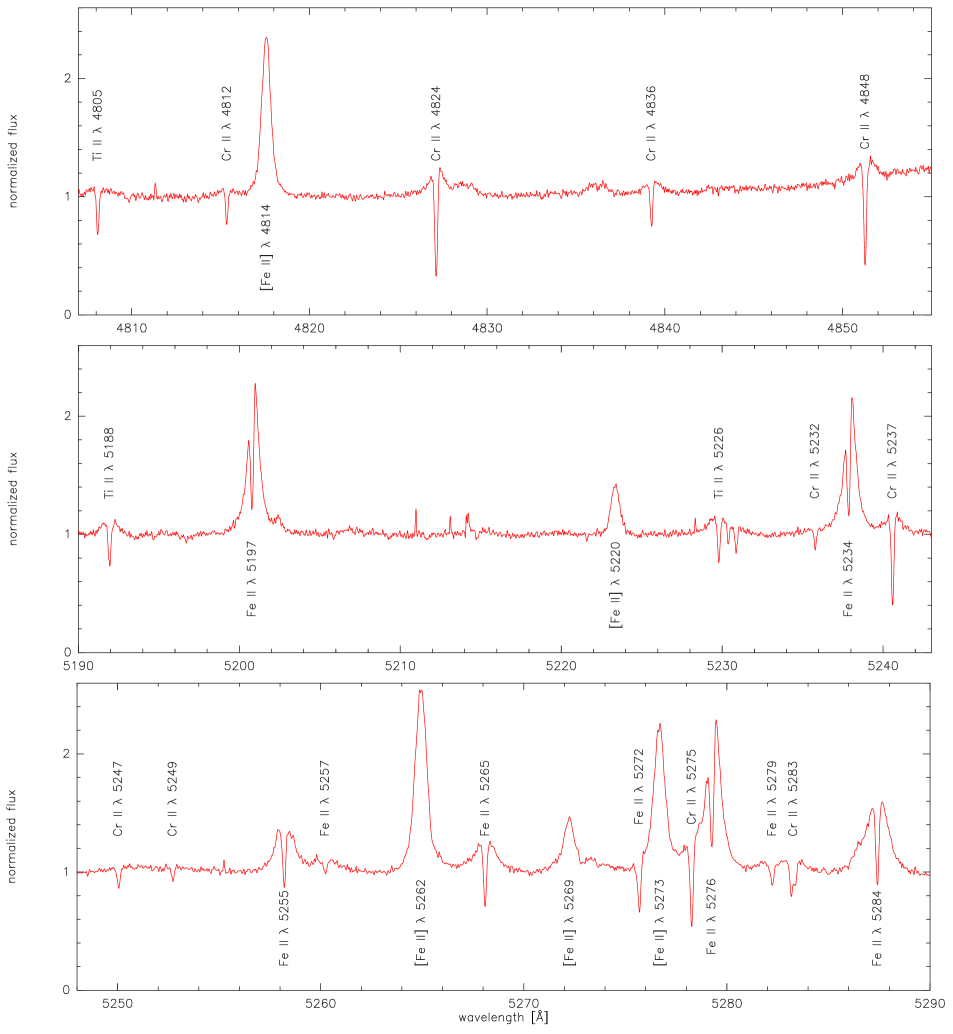
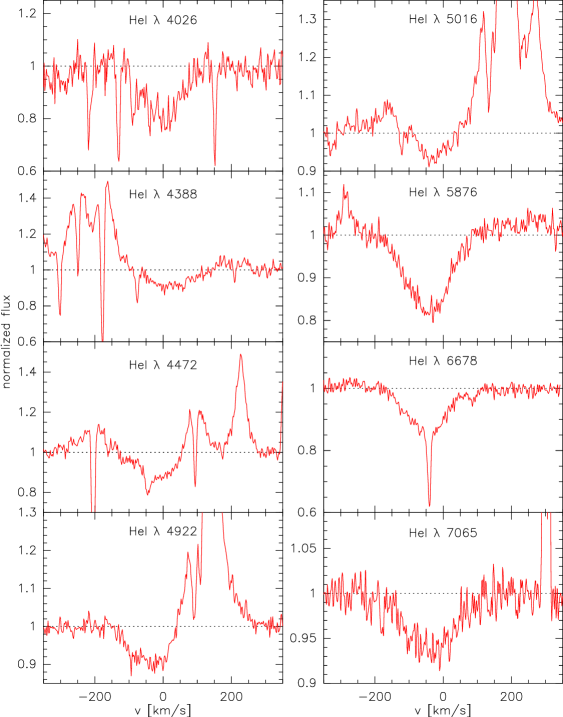
B[e] supergiants are surrounded by large amounts of hydrogen neutral material, traced by the emission in the optical [OI] lines. This neutral material is most plausibly located within their dense, cool circumstellar disks, which are formed from the (probably non-spherically symmetric) wind material released by the star. Neither the formation mechanism nor the resulting structure and internal kinematics of these disks (or disk-like outflows) are well known. However, rapid rotation, lifting the material from the equatorial surface region, seems to play a fundamental role. The B[e] supergiant LHA 115-S 65 (S65) in the SMC is one of the two most rapidly rotating B[e] stars known. Its almost edge-on orientation allows a detailed kinematical study of its optically thin forbidden emission lines. With a focus on the [OI] lines, we test the two plausible disk scenarios: the outflowing and the Keplerian rotating disk. Based on high- and low-resolution optical spectra, we investigate the density and temperature structure in those disk regions that are traced by the [OI] emission to constrain the disk sizes and mass fluxes needed to explain the observed [OI] line luminosities. In addition, we compute the emerging line profiles expected for either an outflowing disk or a Keplerian rotating disk, which can directly be compared to the observed profiles. Both disk scenarios deliver reasonably good fits to the line luminosities and profiles of the [OI] lines. Nevertheless, the Keplerian disk model seems to be the more realistic one, because it also agrees with the kinematics derived from the large number of additional lines in the spectrum. As additional support for the presence of a high-density, gaseous disk, the spectrum shows two very intense and clearly double-peaked [CaII] lines. We discuss a possible disk-formation mechanism, and similarities between S65 and the group of LBVs.
研究动机与目标
- 确定B[e]超巨星LHA 115-S 65周围中性原行星物质的动力学结构。
- 检验观测到的[O i]发射是否源于喷流盘或开普勒旋转盘。
- 利用[O i]谱线光度和轮廓,约束盘的物理特性,包括质量、尺寸和质量流率。
- 评估S 65是否与大质量蓝变星(LBVs)具有相似特征,特别是在自转、质量损失和盘状结构方面。
- 研究快速自转在大质量恒星中形成高密度、赤道原行星盘中的作用。
提出的方法
- 利用欧洲南方天文台(ESO)拉西拉天文台的1.52米和2.2米望远镜,获取了LHA 115-S 65的高分辨率和低分辨率光学光谱。
- 通过分析[O i] λ6300发射线的光度,估算盘形成区域中中性氢的总质量。
- 为两种盘状情景(喷流盘与分离的开普勒旋转盘)建模出射谱线轮廓。
- 利用观测到的双峰[Ca ii]线作为高密度、边缘朝向盘几何结构的独立证据。
- 将两种模型预测的谱线轮廓与实际观测轮廓进行比较,以确定最佳拟合的动力学结构。
- 评估开普勒盘模型与光谱中大量其他发射线所推导出的动力学的一致性。
实验结果
研究问题
- RQ1LHA 115-S 65周围的原行星物质最宜被描述为喷流盘还是开普勒旋转盘?
- RQ2由[O i]发射线追踪的盘区域中,中性氢的总质量是多少?
- RQ3[O i]和[Ca ii]的观测谱线轮廓如何约束原行星盘的几何结构和动力学?
- RQ4结合LHA 115-S 65在赫罗图中的位置及其高自转速度,是否暗示其与大质量蓝变星(LBVs)存在演化联系?
- RQ5盘的形成机制是否可由自转诱导的质量损失来解释,特别是接近临界自转速度时?
主要发现
- [O i]谱线光度表明,发射线所追踪区域的总气体质量约为1.5 × 10⁻² M☉。
- 盘中电离氢的分数小于0.1%,证实盘中氢主要为中性。
- 双峰[Ca ii]线提供了强有力的独立证据,表明存在一个高密度、边缘朝向的原行星盘。
- 谱线轮廓的建模支持分离的开普勒旋转盘而非喷流盘,因为开普勒模型更符合观测动力学。
- 该恒星在赫罗图中的位置接近LBV最小不稳定性带,且其自转速度超过临界极限的75%,暗示其可能与LBVs存在演化联系。
- S 65的盘质量与喷流速度与LBV星云中观测到的值一致,进一步支持其潜在的演化关联。
更好的研究,从现在开始
从论文设计到论文写作,大幅缩短您的研究时间。
无需绑定信用卡
本解读由 AI 生成,并经人工编辑审核。