
[论文解读] New Resonances of Supernova Neutrinos in Twisting Magnetic Fields
本文提出,在超新星中,扭曲的磁场通过几何(Berry)相位诱导狄拉克中微子发生一种新型的共振自旋转换,显著改变中子化爆发期间的中微子味组成。即使磁矩小至 $10^{-15}\mu_B$,该效应也可能在未来实验(如 DUNE 和 Hyper-Kamiokande)中产生可测量的通量调制,为探测超出当前实验室灵敏度的非零中微子磁矩提供可能。
We investigate the effect of resonant spin conversion of the neutrinos induced by the geometrical phase in a twisting magnetic field. We find that the geometrical phase originating from the rotation of the transverse magnetic field along the neutrino trajectory can trigger a new resonant spin conversion of Dirac neutrinos inside the supernova, even if there were no such transitions in the fixed-direction field case. We have shown that even though resonant spin conversion is too weak to affect solar neutrinos, it could have a remarkable consequence on supernova neutronization bursts where very intense magnetic fields are quite likely. We demonstrate how the flavor composition at Earth can be used as a probe to establish the presence of non-negligible magnetic moments, potentially down to $10^{-15}~μ_B$ in upcoming neutrino experiments like the Deep Underground Neutrino Experiment (DUNE), and the Hyper-Kamiokande (HK). Possible implications are analyzed.
研究动机与目标
- 研究旋转横向磁场对超新星中微子自旋-味转换的影响。
- 确定磁场旋转引起的几何相位是否能在固定磁场构型下不存在共振的情况下,触发狄拉克中微子的共振自旋转换。
- 评估通过超新星中子化爆发期间的时间依赖通量变化,探测非零中微子磁矩下限至 $10^{-15}\mu_B$ 的可探测性。
- 评估未来实验(如 DUNE 和 Hyper-Kamiokande)对这些新共振的灵敏度,作为探测标准模型之外物理现象的探针。
提出的方法
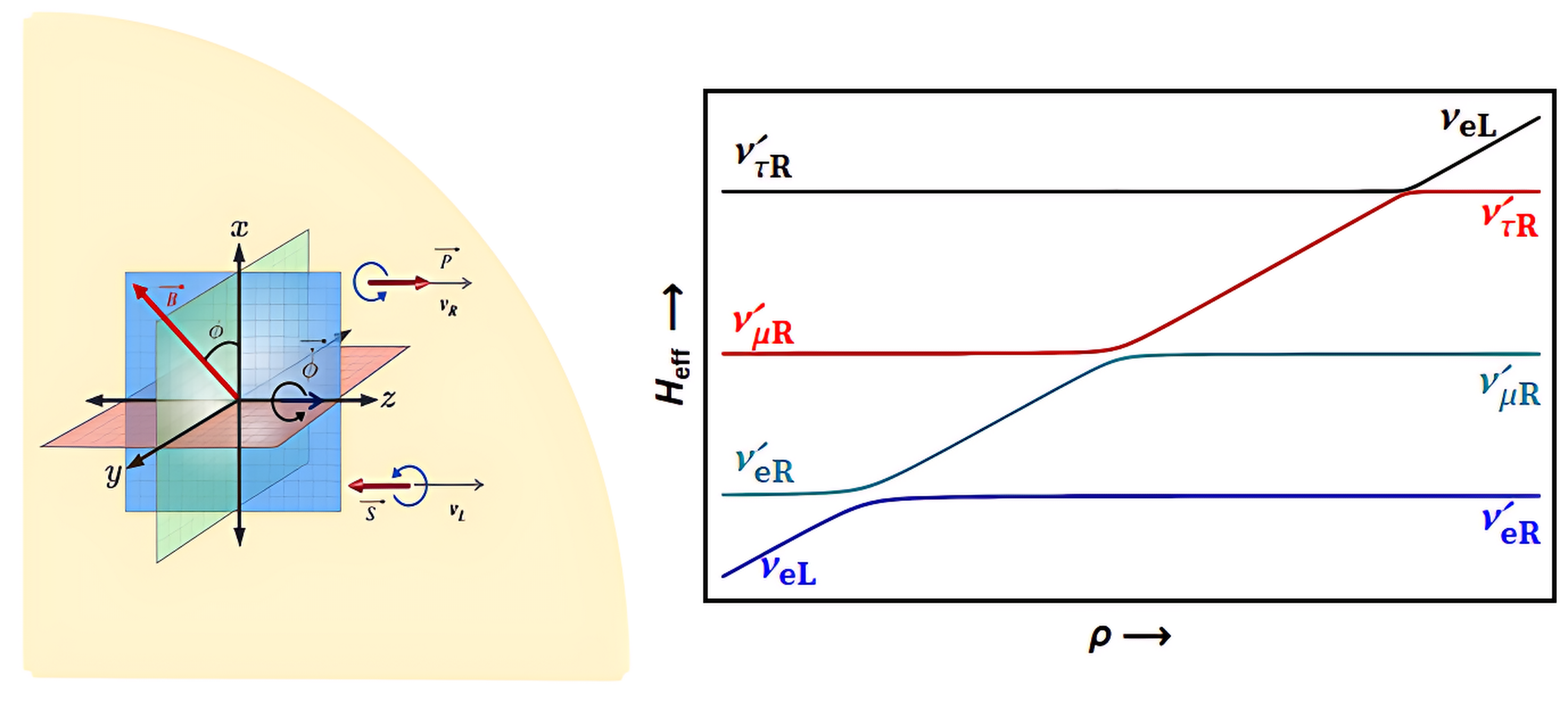
- 使用包含磁场旋转引起的动力学相和几何相的哈密顿量,对扭曲磁场中的中微子演化进行建模。
- 推导在旋转横向磁场中中微子自旋进动的有效哈密顿量,通过旋转角 $\phi(r)$ 引入贝里相位。
- 模拟超新星中子化爆发阶段 $\nu_e$、$\bar{\nu}_e$ 及其他味的中微子时间依赖通量。
- 使用带有冗余参数 $\xi$ 的 $\chi^2$ 估计器评估对磁矩的灵敏度,考虑归一化不确定性与时间窗变化。
- 应用 DUNE(液氩 TPC)和 Hyper-Kamiokande(水切伦科夫)的探测器特异性响应函数,计算每个能量区间的可探测事例率。
- 评估不同磁场扭转速率 ($\dot{\phi} = \pm 0.9\,\text{m}^{-1}$) 对不同中微子种类和质量顺序情形下通量抑制的影响。
实验结果
研究问题
- RQ1旋转横向磁场是否能通过几何相位在狄拉克中微子中诱导一种新型共振自旋转换,即使在固定方向磁场构型下不存在此类共振?
- RQ2这种新共振导致的超新星中微子通量最大抑制程度是多少?其随磁场扭转速率和中微子质量顺序如何变化?
- RQ3未来实验(如 DUNE 和 Hyper-Kamiokande)在多大程度上可通过时间依赖的通量调制探测到小至 $10^{-15}\mu_B$ 的非零中微子磁矩?
- RQ4扭曲磁场的存在如何影响中子化爆发中微子的味组成?这种影响能否与标准振荡效应区分开来?
主要发现
- 扭曲磁场通过几何(Berry)相位在狄拉克中微子中诱导了一种新型共振自旋转换,该效应在固定方向磁场情况下不存在。
- 对于反常中微子质量顺序(IO),在前 20 ms 内,该新共振可使 $\nu_e$ 中子化峰抑制高达 81%,具体取决于磁场扭转速率。
- 在 $\dot{\phi} = +0.9\,\text{m}^{-1}$ 的情形(情况 2)中,几乎所有探测通道和时间窗的抑制均超过 70%,是最优观测情形。
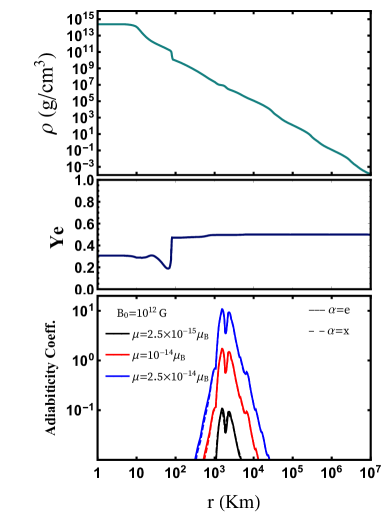
- 在假设 $B_0 = 10^{12}\,\text{G}$ 的前提下,DUNE 和 Hyper-Kamiokande 可在 90% 置信水平下探测到低至 $4-8 \times 10^{-15}\mu_B$ 的非零中微子磁矩。
- 时间上的通量变化是关键可观测量,因为星际磁场不会影响时间结构,从而隔离出共振信号。
- 结果处于自然性边界的临界区域,因为磁矩超过 $10^{-15}\mu_B$ 可能在圈修正中导致不可接受大的中微子质量,使其成为关键可检验窗口。
更好的研究,从现在开始
从阅读论文到最终审阅,大幅缩短您的研究时间。
无需绑定信用卡
本解读由 AI 生成,并经人工编辑审核。