
[论文解读] Non-Intrusive Adaptation: Input-Centric Parameter-efficient Fine-Tuning for Versatile Multimodal Modeling
本文提出AdaLink,一种非侵入式、以输入为中心的参数高效微调方法,通过在输入嵌入与Transformer模块之间插入一个轻量级、低秩的MLP模块,实现在不改变模型架构的前提下,以极低参数量实现与全量微调相当的性能。AdaLink在文本和多模态任务上均达到当前最先进水平,参数更新量不足模型参数的0.02%。
Large language models (LLMs) and vision language models (VLMs) demonstrate excellent performance on a wide range of tasks by scaling up parameter counts from O(10^9) to O(10^{12}) levels and further beyond. These large scales make it impossible to adapt and deploy fully specialized models given a task of interest. Parameter-efficient fine-tuning (PEFT) emerges as a promising direction to tackle the adaptation and serving challenges for such large models. We categorize PEFT techniques into two types: intrusive and non-intrusive. Intrusive PEFT techniques directly change a model's internal architecture. Though more flexible, they introduce significant complexities for training and serving. Non-intrusive PEFT techniques leave the internal architecture unchanged and only adapt model-external parameters, such as embeddings for input. In this work, we describe AdaLink as a non-intrusive PEFT technique that achieves competitive performance compared to SoTA intrusive PEFT (LoRA) and full model fine-tuning (FT) on various tasks. We evaluate using both text-only and multimodal tasks, with experiments that account for both parameter-count scaling and training regime (with and without instruction tuning).
研究动机与目标
- 为解决在不修改内部架构的前提下高效微调大规模视觉-语言模型的挑战。
- 克服现有非侵入式PEFT方法(如提示微调)在复杂和多模态任务中面临的优化困难与性能局限。
- 开发一种参数高效、模块化且可部署的适配技术,确保在不同任务和模型规模间保持兼容性。
- 评估AdaLink在原始和指令微调的大语言模型上的有效性,特别是在多模态和多任务设置下的表现。
提出的方法
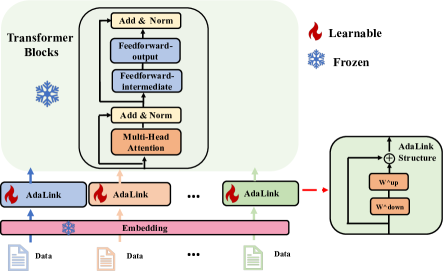
- AdaLink在输入嵌入与主Transformer模块之间引入一个轻量级、低秩的MLP模块,作为可学习的适配层。
- 采用‘零初始化’策略初始化适配器权重,以稳定训练过程,避免提示方法中常见的初始优化问题。
- 通过选择性地仅修改特定输入嵌入,实现部分输入适配,最大限度减少跨模态或任务的干扰。
- 适配器的计算成本随嵌入维度线性增长,避免了提示微调因序列长度增加而产生的二次方增长。
- 该方法为非侵入式:核心Transformer架构与预训练权重保持冻结,保留模型兼容性并提升实现简洁性。
- 支持可配置的推理服务与模块化部署,允许根据不同任务动态加载不同的适配模块。
实验结果
研究问题
- RQ1非侵入式、以输入为中心的PEFT方法是否能在多模态和纯文本任务上实现与全量微调相当的性能?
- RQ2与LoRA和提示微调等侵入式PEFT方法相比,AdaLink在优化稳定性与最终性能方面表现如何?
- RQ3结合指令微调后,AdaLink是否能进一步减少所需适配参数数量并提升泛化能力?
- RQ4AdaLink能否在不同模型规模和参数量下保持强大性能?
- RQ5AdaLink中的部分输入适配如何影响多模态设置下的模态对齐与任务泛化?
主要发现
- AdaLink在文本和多模态任务上均实现与全量微调相当或更优的性能,参数更新量不足模型参数的0.02%。
- 该方法在优化稳定性和最终性能方面优于提示微调,尤其在复杂和多任务设置中表现更优。
- 使用AdaLink微调的指令微调模型所需适配参数更少,收敛更快,结果更优。
- AdaLink保持了与嵌入维度的线性计算复杂度,避免了提示微调的二次方计算成本。
- 模块化与非侵入式设计使得其在无需修改架构的前提下,能够灵活、可扩展且可靠地部署于多种任务。
- 实证结果表明,AdaLink能有效保留视觉标记的位置信息,并在VQA和图像字幕等视觉-语言任务中实现优异性能。
更好的研究,从现在开始
从阅读论文到最终审阅,大幅缩短您的研究时间。
无需绑定信用卡
本解读由 AI 生成,并经人工编辑审核。