
[论文解读] Observation of four top quark production in proton-proton collisions at $\sqrt{s}$ = 13 TeV
本论文报告了在 LHC 的 CMS 实验中,利用 138 fb$^{-1}$ 的积分 luminosity,在 $√s} = 13$ TeV 的质子-质子碰撞中首次观测到四顶夸克产生。通过采用先进的轻子和 b-夸克喷流识别技术,并结合基于机器学习的优化多变量分析,该分析达到了 5.6 个标准差的显著性,测得截面为 $17.7^{+3.7}_{-3.5}\text{ stat}^{+2.3}_{-1.9}\text{ syst}$ fb,与标准模型预测一致。
The observation of the production of four top quarks in proton-proton collisions is reported, based on a data sample collected by the CMS experiment at a center-of-mass energy of 13 TeV in 2016-2018 at the CERN LHC and corresponding to an integrated luminosity of 138 fb$^{-1}$. Events with two same-sign, three, or four charged leptons (electrons and muons) and additional jets are analyzed. Compared to previous results in these channels, updated identification techniques for charged leptons and jets originating from the hadronization of b quarks, as well as a revised multivariate analysis strategy to distinguish the signal process from the main backgrounds, lead to an improved expected signal significance of 4.9 standard deviations above the background-only hypothesis. Four top quark production is observed with a significance of 5.6 standard deviations, and its cross section is measured to be 17.7 $^{+3.7}_{-3.5}$ (stat) $^{+2.3}_{-1.9}$ (syst) fb, in agreement with the available standard model predictions.
研究动机与目标
- 在 $√s} = 13$ TeV 的质子-质子碰撞中观测稀有四顶夸克产生过程 ($\ttbar\ttbar$)。
- 通过改进轻子和 b-夸克喷流识别技术,提高对 $\ttbar\ttbar$ 产生的探测灵敏度。
- 通过基于机器学习的改进多变量分析策略,减少背景贡献并提升信号区分能力。
- 以高精度测量 $\ttbar\ttbar$ 产生截面,检验标准模型预测并探测新物理。
- 提供对顶夸克杨-米哈伊洛夫耦合的互补测量,并对标准模型之外的物理提供约束。
提出的方法
- 本分析使用了 CMS 实验在 2016 至 2018 年间,在 $√s} = 13$ TeV 下收集的 138 fb$^{-1}$ 质子-质子碰撞数据。
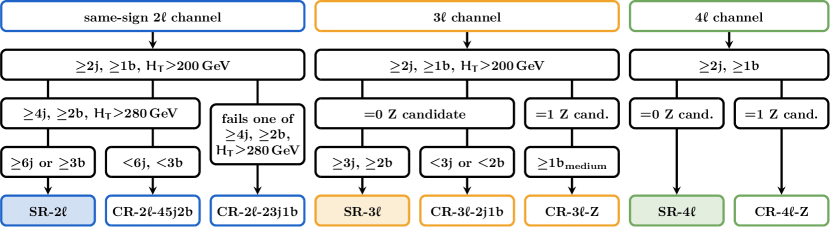
- 选择包含两个同号、三个或四个带电轻子(电子和μ子)以及额外喷流的事件,以增强信号敏感度。
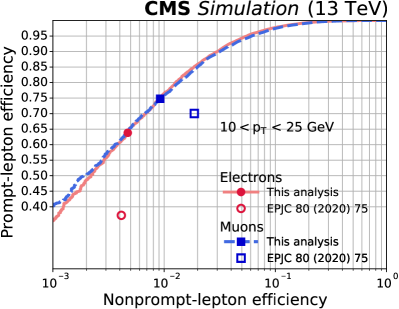
- 应用更新的带电轻子和 b-夸克喷流识别算法,以提高信号效率并减少误识别。
- 实施基于机器学习技术的多变量分析策略,以区分 $\ttbar\ttbar$ 信号与主要背景(如 $\ttbar\PW$ 和 $\ttbar\PZ$)。
- 通过针对信号与背景分离优化的运动学分布进行轮廓似然拟合,提取信号截面。
- 在拟合中对背景使用自由归一化参数,允许对 $\ttbar\PW$ 和 $\ttbar\PZ$ 贡献进行数据驱动估计。
实验结果
研究问题
- RQ1在 $√s} = 13$ TeV 的 $π\Pp$ 碰撞中,观测到四顶夸克产生的统计显著性是多少?
- RQ2改进的轻子和 b-夸克喷流识别技术如何影响对 $\ttbar\ttbar$ 信号的探测灵敏度?
- RQ3经过修订的多变量分析策略在多大程度上提升了信号与背景的分离能力?
- RQ4测得的 $\ttbar\ttbar$ 产生截面是多少?与标准模型预测相比如何?
- RQ5该测量是否能对新物理场景(如扩展的希格斯玻色子结构或超对称性)提供约束?
主要发现
- $\ttbar\ttbar$ 产生过程以 5.6 个标准差的显著性被观测到,超过 5σ 的观测阈值。
- 测得的截面为 $17.7^{+3.7}_{-3.5}\text{ stat}^{+2.3}_{-1.9}\text{ syst}$ fb,与标准模型预测的 $13.4^{+1.0}_{-1.8}$ fb 一致。
- 改进的分析策略(包括先进的轻子和 b-夸克喷流识别)使预期信号显著性提升至 4.9 个标准差,从而实现观测。
- 通过在分析中采用基于机器学习的多变量技术,显著增强了信号与背景的分离能力。
- 该结果提供了对顶夸克杨-米哈伊洛夫耦合的精确测量,并作为探测标准模型之外新物理的敏感探针。
- 观测结果与标准模型一致,支持了量子色动力学和电弱理论在下一阶微扰计算下的当前理论预测的一致性。
更好的研究,从现在开始
从阅读论文到最终审阅,大幅缩短您的研究时间。
无需绑定信用卡
本解读由 AI 生成,并经人工编辑审核。