
[论文解读] Observation of non-Hermitian edge burst in quantum dynamics
该论文实验观测到非厄米边界脉冲——一种在耗散量子行走中出现的动力学现象,其中光子损耗在系统边界处急剧累积,违背经典直觉。通过光子量子行走平台,作者证明了边界处的损耗局域化程度随初始位置与边界的距离增加而增强,揭示了一种根植于非厄米拓扑与能隙的新型体-边标度关系。
The non-Hermitian skin effect, by which the eigenstates of Hamiltonian are predominantly localized at the boundary, has revealed a strong sensitivity of non-Hermitian systems to the boundary condition. Here we experimentally observe a striking boundary-induced dynamical phenomenon known as the non-Hermitian edge burst, which is characterized by a sharp boundary accumulation of loss in non-Hermitian time evolutions. In contrast to the eigenstate localization, the edge burst represents a generic non-Hermitian dynamical phenomenon that occurs in real time. Our experiment, based on photonic quantum walks, not only confirms the prediction of the phenomenon, but also unveils its complete space-time dynamics. Our observation of edge burst paves the way for studying the rich real-time dynamics in non-Hermitian topological systems.
研究动机与目标
- 实验观测一种非厄米动力学现象——边界脉冲,即在时间演化过程中损耗在边界处急剧累积。
- 通过识别虚能隙在该现象中所起的附加作用,将边界脉冲与非厄米皮肤效应区分开来。
- 利用光子量子行走平台,表征非厄米系统中损耗的实时时空动力学行为。
- 验证一种理论上的体-边标度关系,该关系将边界脉冲强度与初始位置到边界的距离关联起来。
提出的方法
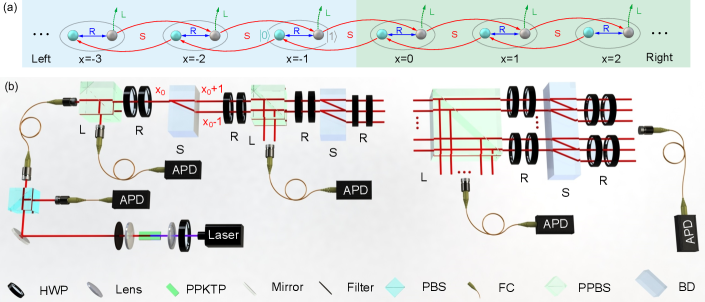
- 实验采用具有弗洛凯哈密顿量的离散时间光子量子行走,通过部分偏振分束器引入非厄米损耗。
- 通过在特定角度设置的四分之一波片实现比特操作,控制旋转角 θ₁/₂ 和 γ,以调节非厄米参数。
- 系统初始化为单个光子处于空间模式 x₀ 和比特态 |0⟩,并选择性地对 |1⟩ 态施加损耗。
- 通过赫尔德光子与触发光子之间的符合计数,测量空间-时间分辨的损耗概率 p(x,t)。
- 从光子计数中计算出存活概率 |ψ(x,t)|²,以追踪每个位置和时间步的损耗动力学。
- 相对边界脉冲强度通过 P_domain / P_min 定义,其中 P_domain 为在畴壁处的损耗,P_min 为从 x₀ 到 x = -1 区间内的最小损耗。
实验结果
研究问题
- RQ1非厄米系统是否表现出一种动态边界效应,即尽管初始局域化远离边界,损耗仍会在边界处累积?
- RQ2除了非厄米皮肤效应外,边界脉冲出现还需满足哪些额外条件?
- RQ3边界脉冲的强度如何随初始位置与边界的距离变化?
- RQ4一种新型体-边标度关系是否能够解释随着初始距离增加而观测到的边界损耗增强现象?
主要发现
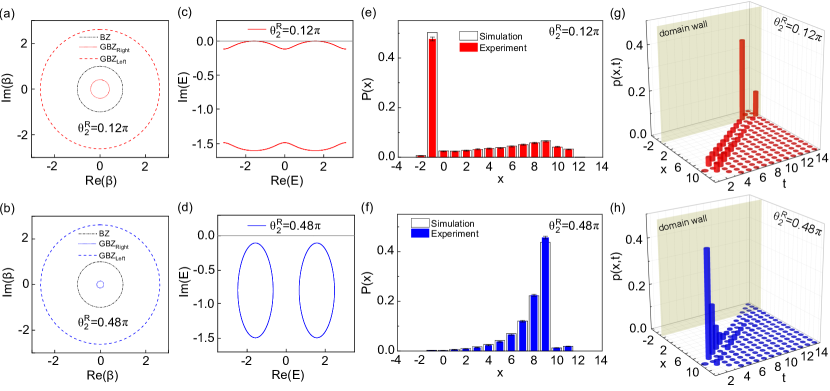
- 在光子量子行走中实验观测到边界脉冲,边界处(x = -1)的损耗概率显著高于其他位置。
- 当 θ₂ᴿ = 0.12π 时,相对边界脉冲强度 P_domain / P_min 随初始位置 x₀ 线性增加,符合 P_domain / P_min ∼ x₀ 的关系。
- 当虚能隙关闭时(θ₂ᴿ = 0.48π),边界脉冲消失,P_domain / P_min 保持在接近单位值,证实了耗散能隙的必要性。
- 在边界脉冲期间,|ψ(x = -1, t)|² 显著升高,表明损耗在边界处的局域化增强。
- 边界脉冲在不同初始位置下均持续存在,表现出鲁棒性及对系统参数的非平凡依赖性。
- 实验数据与数值模拟高度吻合,验证了理论预测的动态体-边标度关系。
更好的研究,从现在开始
从阅读论文到最终审阅,大幅缩短您的研究时间。
无需绑定信用卡
本解读由 AI 生成,并经人工编辑审核。