
[论文解读] Observing neutrinos from failed Supernovae at LNGS
本文提出将意大利大萨索国家实验室(LNGS)中暗物质与无中微子双贝塔衰变实验的水 veto 区域,作为免费的分布式小型水切伦科夫探测器网络,用于探测失败型核心坍缩超新星的中微子。研究表明,该网络可将黑洞形成时间的测量精度控制在约 4 毫秒以内,为 VIRGO 和爱因斯坦望远镜等引力波探测器提供关键的实时触发信号,即使在缺乏电磁信号的情况下亦可实现。
We discuss the possibility to observe neutrinos emitted from a failed core collapse Supernova in the various experiments at Laboratori Nazionali del Gran Sasso. We show that the veto regions of dark matter and neutrinoless double beta decay experiments can be used as a network of small detectors to measure Supernova neutrinos. In addition we show that this network can measure very precisely the moment of black hole formation, which can be then used in the nearby VIRGO detector and future Einstein Telescope to look for the gravitational wave counterpart to the neutrino signal.
研究动机与目标
- 探索将 LNGS 实验中现有 veto 区域重新用于探测超新星中微子的可行性。
- 确定该网络是否能够精确测量失败型超新星中黑洞形成的时间,这一事件对引力波探测至关重要。
- 评估该方法作为模型无关、实时触发引力波天文台(如 VIRGO 和爱因斯坦望远镜)的潜力。
- 预测当前及未来 LNGS 探测器对来自大、小麦哲伦云的失败型超新星中微子信号的探测灵敏度。
提出的方法
- 利用三个 LNGS 实验——COSINUS、LEGEND-200 和 XENONnT 的水 veto 区域,构建一个小型水切伦科夫探测器网络,用于中微子探测。
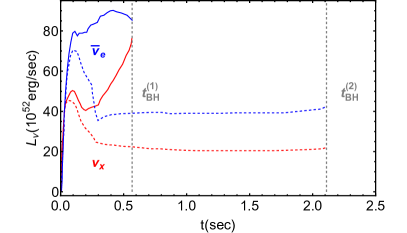
- 采用两种不同的理论模型(模型 1 和模型 2)模拟失败型超新星的中微子发射,其黑洞形成时间分别为原爆后 0.568 秒和 2.113 秒。
- 使用中微子通量公式计算事件率:$ \frac{d\Phi_{\alpha}^{0}}{dE_{\nu_{\alpha}}dt} = \frac{1}{4\pi d^{2}} \frac{L_{\nu_{\alpha}}(t)}{\langle E_{\nu_{\alpha}}(t)\rangle} \phi_{\alpha}(E_{\nu_{\alpha}},t) $,其中能量谱通过参数化形式 $ \phi_{\alpha}(E_{\nu_{\alpha}},t) = \langle E_{\nu_{\alpha}}(t)\rangle \frac{1+\xi_{\alpha}}{\Gamma(1+\xi_{\alpha})} \left( \frac{E_{\nu_{\alpha}}}{\langle E_{\nu_{\alpha}}(t)\rangle} \right)^{\xi_{\alpha}} e^{-\frac{E_{\nu_{\alpha}}}{\langle E_{\nu_{\alpha}}(t)\rangle}} $ 表示。
- 通过探测器网络的时间分辨率和中微子飞行至引力波探测器的时间,估算黑洞形成探测的时间不确定性。
- 评估时间不确定性 $ \delta T^{\text{GW}}_{\text{BH}} = \delta T^{\text{LNGS}}_{\text{BH}} + \delta t_{\text{fly}} $,其中由于 LNGS 与 VIRGO 距离极近,$ \delta t_{\text{fly}} \leq 1 $ 毫秒。
- 基于未来探测器的预期性能,预测灵敏度提升,假设统计精度提高且时间不确定性降低。
实验结果
研究问题
- RQ1现有 LNGS 实验的水 veto 区域能否有效用作探测失败型超新星中微子信号的小型中微子探测器网络?
- RQ2利用该探测器网络探测失败型超新星中黑洞形成时间,可实现的定时精度是多少?
- RQ3LNGS 所得的时间不确定性与大型探测器(如超级神冈)相比如何,后者在触发引力波搜寻时表现如何?
- RQ4该方法能否在不预先知晓源方向的情况下,为引力波探测器提供实时、模型无关的触发?
- RQ5通过引入 IBD 之外的其他探测通道(如弹性散射或液态闪烁体),灵敏度是否可进一步提升?
主要发现
- LNGS 水 veto 网络可探测到来自大、小麦哲伦云的失败型超新星中微子,其灵敏度仅受限于 IBD 探测通道和 veto 区域尺寸。
- 对于最慢的黑洞形成模型(模型 2),该网络可将黑洞形成时间的测量不确定性控制在 4 毫秒以内,其中探测器网络贡献 3 毫秒,飞行时间贡献 ≤1 毫秒。
- 该时间精度显著优于超级神冈探测器,后者即使具备更小的本征时间不确定性,由于飞向 VIRGO 的飞行时间更长,总不确定性仍达 28.3 毫秒。
- 该方法可为引力波探测器提供实时、模型无关的触发,尤其在缺乏电磁对应体的情况下至关重要。
- 分析结果保守,仅考虑了 IBD 和 veto 区域;若纳入内探测器区域及其他探测通道(如弹性散射或液态闪烁体),灵敏度有望进一步提升。
- 该方法具有时效性,因 COSINUS 和 LEGEND-200 尚未最终确定其 veto 区域配置,可立即实施此探测策略。
更好的研究,从现在开始
从阅读论文到最终审阅,大幅缩短您的研究时间。
无需绑定信用卡
本解读由 AI 生成,并经人工编辑审核。