
[论文解读] On constraining Cosmology and the Halo Mass Function with Weak Gravitational Lensing
本研究探讨了在弱引力透镜分析中允许晕质量函数(HMF)变化的影响,表明通过调整HMF可解决普朗克(Planck)与DES-y3/KiDS-1000数据之间的S₈张力。通过同时释放HMF参数与宇宙学参数,该模型在k ~ 1 h/Mpc处将物质功率谱的功率降低了约25%,使普朗克宇宙学与透镜数据一致,而无需引入新物理。
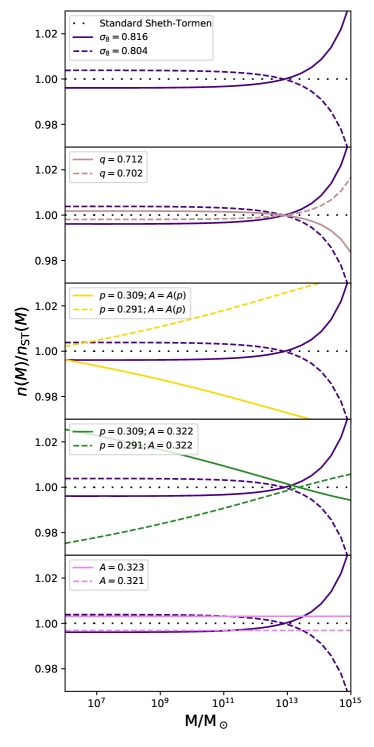
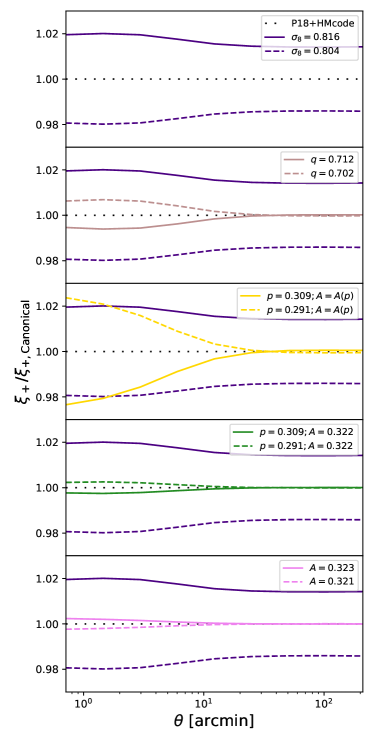
The discrepancy between the weak lensing (WL) and the {\it Planck} measurements of $S_8$ has been a subject of several studies. These studies tend to show that a suppression of the amplitude of the mass power spectrum $P(k)$ at high $k$ could resolve it. The WL signal at small-scale is sensitive to various effects, such as baryonic effects and intrinsic alignment. The accuracy of $P(k)$ depends on the modelling precision of these effects. A common approach for calculating $P(k)$ relies on a halo model. Amongst the various components necessary for the construction of $P(k)$, the halo mass function (HMF) is an important one. Traditionally, the HMF has been assumed to follow a fixed model. Recent literature shows that baryonic physics, amongst several other factors, could affect the HMF. In this study, we investigate the impact of allowing the HMF to vary. This provides a way of testing the validity of the halo model-HMF calibration using data. We find that the {\it Planck} cosmology is not compatible with the vanilla HMF for both the DES-y3 and the KiDS-1000 data. When the cosmology and the HMF parameters are allowed to vary, the {\it Planck} cosmology is no longer in tension. The modified HMF predicts a matter power spectrum with a $\sim 25\%$ power loss at $k\sim 1~{ m h/Mpc}$, in agreement with the recent studies. We show that Stage IV surveys will be able to measure the HMF parameters with a few percent accuracy.
研究动机与目标
- 调查在弱透镜巡天(DES-y3、KiDS-1000)与普朗克CMB测量之间,释放晕质量函数(HMF)参数是否能缓解S₈张力。
- 评估在宇宙学参数同时自由变化的情况下,标准Sheth-Tormen HMF模型是否与当前弱透镜数据一致。
- 评估未来第四阶段巡天在几近百分比精度下约束HMF参数的潜力。
- 探讨P(k)建模中的差异(尤其是重子效应与固有对齐)是否可能源于HMF校准的不准确,而非系统误差。
- 检验HMF是否能吸收未建模的非线性效应,从而减少对物质功率谱的任意修改的依赖。
提出的方法
- 作者修改了HMcode软件,以实现Sheth-Tormen HMF模型中宇宙学参数与HMF参数(p, q)的联合推断。
- 采用DES-y3与KiDS-1000合作方相同的分析流程,以确保与现有数据产品和方法的一致性。
- 在晕模型框架内计算物质功率谱P(k),将HMF作为自由参数,并将其投影为剪切相关函数ξ₊与ξ₋。
- 使用MultiNest采样后验分布,约束基于弱透镜剪切功率谱与角功率谱的联合数据。
- 对比固定HMF(Sheth-Tormen)与自由HMF情景,检验其与Planck18、DES-y3与KiDS-1000宇宙学的一致性。
- 通过HMF参数空间隐式吸收了对重子效应与固有对齐的敏感性,避免了对这些效应的直接建模。
实验结果
研究问题
- RQ1允许晕质量函数变化是否能缓解普朗克与DES-y3、KiDS-1000等弱透镜巡天之间的S₈张力?
- RQ2当宇宙学参数也自由变化时,标准Sheth-Tormen HMF模型是否与当前弱透镜数据一致?
- RQ3HMF在多大程度上能吸收未建模的非线性效应(如重子反馈与固有对齐)?
- RQ4未来第四阶段弱透镜巡天在多大程度上可实现对HMF参数的几近百分比精度约束?
- RQ5观测到的S₈差异是否源于HMF校准的不准确,而非新物理或系统误差?
主要发现
- 当拟合DES-y3与KiDS-1000数据时,标准Sheth-Tormen HMF与Planck18宇宙学不相容,表明存在模型不匹配。
- 当同时释放宇宙学参数与HMF参数(p, q)时,与Planck18的S₈张力得以缓解,后验S₈值与Planck18一致。
- 修改后的HMF在k ~ 1 h/Mpc处将物质功率谱抑制约25%,与通过P(k)修正尝试缓解S₈张力的其他研究结果一致。
- 从数据中推断出的HMF参数(p, q)强烈排除标准Sheth-Tormen取值(p=0.3, q=0.707),表明当前HMF校准可能存在缺陷。
- 预计第四阶段弱透镜巡天可实现对HMF参数的几近百分比精度测量,从而支持对HMF模型的稳健检验。
- 结果表明,未建模的非线性效应可能被HMF吸收,暗示当前模拟可能遗漏了影响晕形成与分布的关键组分。
更好的研究,从现在开始
从阅读论文到最终审阅,大幅缩短您的研究时间。
无需绑定信用卡
本解读由 AI 生成,并经人工编辑审核。