
[论文解读] On Controllability and Persistency of Excitation in Data-Driven Control: Extensions of Willems' Fundamental Lemma
本文通过放松Willems基本引理中关于完全可控性和高阶持续激励的经典假设,将其扩展至数据驱动控制。研究表明,若初始状态位于可控制子空间、不可观测子空间与数据诱导子空间之和中,则轨迹可利用测量数据进行参数化,且所需持续激励阶数从 $n+L$ 降低至 $ \delta_{\text{min}}+L $,其中 $\delta_{\text{min}}$ 为系统矩阵 $A$ 的最小多项式次数。该方法使不可控系统也能实现数据驱动预测控制,并显著减少多智能体系统中的数据需求。
Willems' fundamental lemma asserts that all trajectories of a linear time-invariant system can be obtained from a finite number of measured ones, assuming that controllability and a persistency of excitation condition hold. We show that these two conditions can be relaxed. First, we prove that the controllability condition can be replaced by a condition on the controllable subspace, unobservable subspace, and a certain subspace associated with the measured trajectories. Second, we prove that the persistency of excitation requirement can be relaxed if the degree of a certain minimal polynomial is tightly bounded. Our results show that data-driven predictive control using online data is equivalent to model predictive control, even for uncontrollable systems. Moreover, our results significantly reduce the amount of data needed in identifying homogeneous multi-agent systems.
研究动机与目标
- 探究Willems基本引理中经典假设(可控性与高阶持续激励)是否对数据驱动轨迹参数化是必要的。
- 确定所有对应轨迹均可表示为测量输入-输出轨迹线性组合的初始状态最小子空间。
- 降低数据驱动控制中所需的持续激励阶数,尤其适用于大规模或多智能体系统。
- 建立即使在不可控系统中,数据驱动预测控制与模型预测控制之间的等价性。
提出的方法
- 提出广义子空间条件:若初始状态位于可控制子空间 $\mathcal{R}$、不可观测子空间 $\mathcal{O}$ 与依赖于数据的子空间 $\mathcal{K}[x_0^1, \dots, x_0^\tau]$ 之和中,则轨迹可基于测量数据进行参数化。
- 利用Cayley-Hamilton定理证明可观测性矩阵 $O_L$ 可消去不可观测子空间,从而实现初始状态在可控制与不可观测分量间的分解。
- 通过测量数据的Hankel矩阵结构,推导出输入-输出轨迹的线性参数化形式,其表达式为 $\begin{bmatrix} H_L(u) \ H_L(y) \end{bmatrix} = \begin{bmatrix} 0 & I \\ O_L & T_L \end{bmatrix} \begin{bmatrix} x_0^a + x_0^b \\ u \end{bmatrix}$。
- 将所需持续激励阶数从 $n+L$ 降低至 $\delta_{\text{min}} + L$,其中 $\delta_{\text{min}}$ 为系统矩阵 $A$ 的最小多项式次数,利用系统动态由该多项式决定的性质。
- 将结果应用于同质多智能体系统,通过求解Hankel矩阵上结构化线性系统,计算系统的Markov参数。
![Figure 1: Output trajectory for Online DeePC. The blue and red curves denote $y_{[0,T-1]}$ and $y_{[T,K-1]}$ , respectively. The dashed lines denote the output reference values.](https://ar5iv.labs.arxiv.org/html/2102.02953/assets/application/online.png)
实验结果
研究问题
- RQ1数据驱动轨迹参数化能否扩展至不可控系统?
- RQ2对于所有可表示为测量轨迹线性组合的轨迹,其初始状态的精确子空间是什么?
- RQ3能否将所需持续激励阶数降低至 $n+L$ 以下?
- RQ4对于不可控系统,数据驱动预测控制是否与模型预测控制等价?
主要发现
- 即使系统不可控,只要初始状态位于 $\mathcal{R} + \mathcal{O} + \mathcal{K}[x_0^1, \dots, x_0^\tau]$ 中,其轨迹仍可基于测量数据进行参数化。
- 持续激励要求已从 $n+L$ 降低至 $\delta_{\text{min}} + L$,其中 $\delta_{\text{min}}$ 为系统矩阵 $A$ 的最小多项式次数,显著减少了数据需求。
- 数据驱动预测控制与模型预测控制在可控与不可控系统中均保持等价,扩展了先前结果。
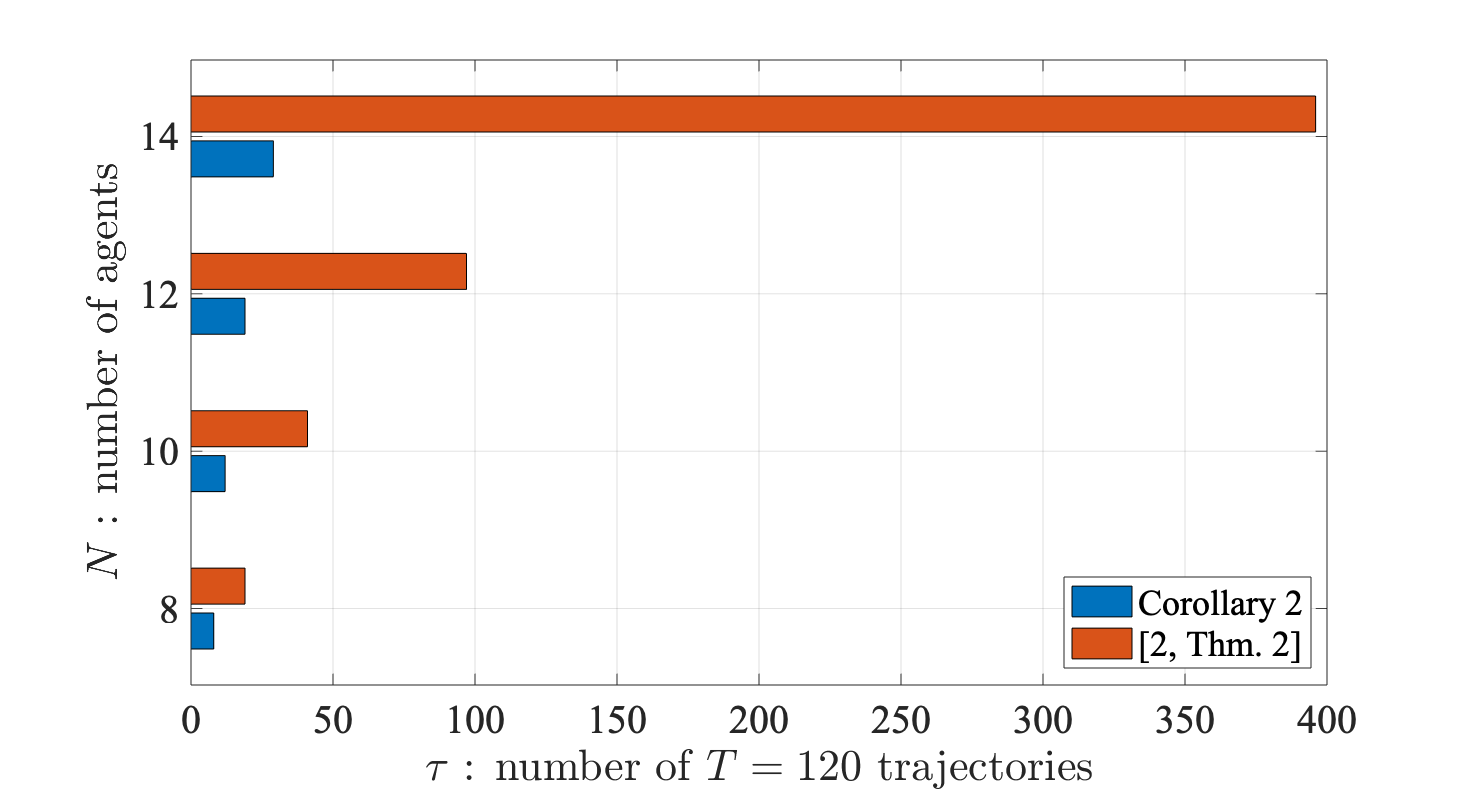
- 对于同质多智能体系统,与依赖于 $n+L$ 持续激励的先前方法相比,数据需求降低了整整一个数量级。
- 即使整个系统不可控,只要输入-输出数据满足集体持续激励阶数为 $(N+1)\widebar{n}+1$,仍可唯一计算出系统的Markov参数。
更好的研究,从现在开始
从阅读论文到最终审阅,大幅缩短您的研究时间。
无需绑定信用卡
本解读由 AI 生成,并经人工编辑审核。