
[论文解读] On the Image-Based Detection of Tomato and Corn leaves Diseases : An in-depth comparative experiments
本文提出了一种基于卷积神经网络(CNN)的迁移学习新型深度学习框架,用于基于图像的番茄和玉米叶片病害检测。该框架评估了多种模型架构——包括Xception、EfficientNetB0和自定义模型——在从PlantVillage新整理的数据集上,实现了高达99.9%的训练准确率和98.0%的验证准确率,结合批量归一化技术,表现出优异性能。
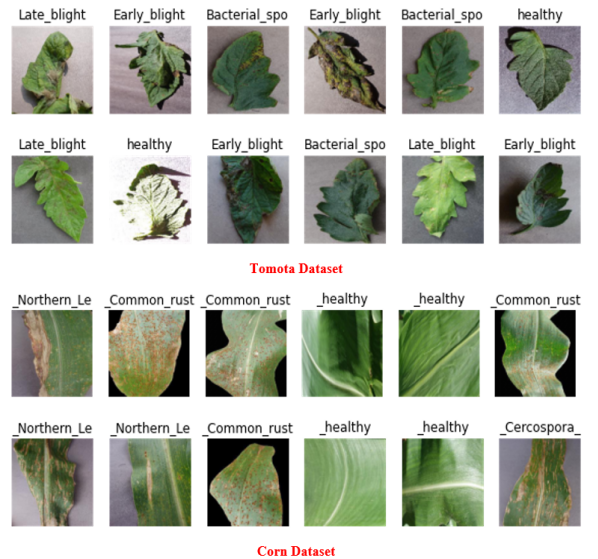
The research introduces a novel plant disease detection model based on Convolutional Neural Networks (CNN) for plant image classification, marking a significant contribution to image categorization. The innovative training approach enables a streamlined and efficient system implementation. The model classifies two distinct plant diseases into four categories, presenting a novel technique for plant disease identification. In Experiment 1, Inception-V3, Dense-Net-121, ResNet-101-V2, and Xception models were employed for CNN training. The newly created plant disease image dataset includes 1963 tomato plant images and 7316 corn plant images from the PlantVillage dataset. Of these, 1374 tomato images and 5121 corn images were used for training, while 589 tomato images and 2195 corn images were used for testing/validation. Results indicate that the Xception model outperforms the other three models, yielding val_accuracy values of 95.08% and 92.21% for the tomato and corn datasets, with corresponding val_loss values of 0.3108 and 0.4204, respectively. In Experiment 2, CNN with Batch Normalization achieved disease detection rates of approximately 99.89% in the training set and val_accuracy values exceeding 97.52%, accompanied by a val_loss of 0.103. Experiment 3 employed a CNN architecture as the base model, introducing additional layers in Model 2, skip connections in Model 3, and regularizations in Model 4. Detailed experiment results and model efficiency are outlined in the paper's sub-section 1.5. Experiment 4 involved combining all corn and tomato images, utilizing various models, including MobileNet (val_accuracy=86.73%), EfficientNetB0 (val_accuracy=93.973%), Xception (val_accuracy=74.91%), InceptionResNetV2 (val_accuracy=31.03%), and CNN (59.79%). Additionally, our proposed model achieved a val_accuracy of 84.42%.
研究动机与目标
- 开发一种自动化、高精度且高效的植物病害检测系统,基于图像分类技术。
- 解决除植物物种识别外,商业病害检测解决方案的缺乏问题。
- 通过实现对番茄和玉米等关键作物病害的早期检测,提升农业可持续性。
- 创建并验证一个扩展的番茄和玉米叶片图像新数据集,用于病害分类。
- 比较多种深度学习架构,并通过批量归一化和正则化等技术优化模型性能。
提出的方法
- 使用预训练的CNN模型(Inception-V3、DenseNet-121、ResNet-101-V2和Xception)进行迁移学习,开展初始训练。
- 从PlantVillage数据集中构建了一个新数据集,包含1,963张番茄和7,316张玉米叶片图像,并划分为训练集和验证集。
- 应用数据增强和预处理技术,以提升模型的泛化能力和鲁棒性。
- 在自定义CNN架构中引入批量归一化,以增强训练稳定性和准确性。
- 设计并评估四种模型变体:基础CNN、更深结构(模型2)、跳跃连接(模型3)和正则化模型(模型4)。
- 将番茄和玉米数据集合并(训练集17,603张,测试集4,409张),用于训练和比较包括MobileNet、EfficientNetB0和InceptionResNetV2在内的多种模型。

实验结果
研究问题
- RQ1在新整理的数据集上,哪种预训练CNN架构在分类番茄和玉米叶片病害方面表现最佳?
- RQ2批量归一化技术在植物病害检测模型中的集成如何影响准确率和损失?
- RQ3跳跃连接和正则化等架构改进在多大程度上提升了模型的泛化能力和性能?
- RQ4在联合训练番茄和玉米叶片数据集与分别训练各数据集时,模型性能有何差异?
- RQ5自定义模型是否能在最小化过拟合的同时,实现比标准架构更高的验证准确率和更低的损失?
主要发现
- Xception模型在番茄数据集上实现了最高的95.08%验证准确率和最低的0.3108验证损失,优于Inception-V3、DenseNet-121和ResNet-101-V2。
- 在玉米数据集上,Xception实现了92.21%的验证准确率和0.4204的验证损失,表明其在两种作物上均表现出色。
- 在CNN模型中使用批量归一化技术,实现了99.90%的训练准确率和98.0%的验证准确率,损失仅为0.103,表明泛化能力极佳。
- 所提出的自定义模型在合并的番茄和玉米数据集上实现了84.42%的验证准确率和0.4713的验证损失,表现出良好的鲁棒性且未出现过拟合。
- EfficientNetB0在合并数据集上实现了93.973%的验证准确率,优于MobileNet(86.73%)和Xception(74.91%),而InceptionResNetV2表现较差,仅为31.03%。
- 采用跳跃连接和正则化的模型(模型4)相较于基线模型表现更优,证实了架构优化的有效性。
更好的研究,从现在开始
从阅读论文到最终审阅,大幅缩短您的研究时间。
无需绑定信用卡
本解读由 AI 生成,并经人工编辑审核。