
[论文解读] On the Significance of the Thick Disks of Disk Galaxies
本研究利用高分辨率的NewHorizon与NewHorizon2宇宙学模拟,探究大质量盘星系中厚盘的起源及其质量分数。结果表明,厚盘贡献了星系盘总恒星质量的48±13%,以及r波段光度的34±15%;动力学与轮廓分析方法所得结果一致,挑战了以往认为其作用微小的假设,强调了多组分动力学与化学分析在准确识别厚盘中的重要性。
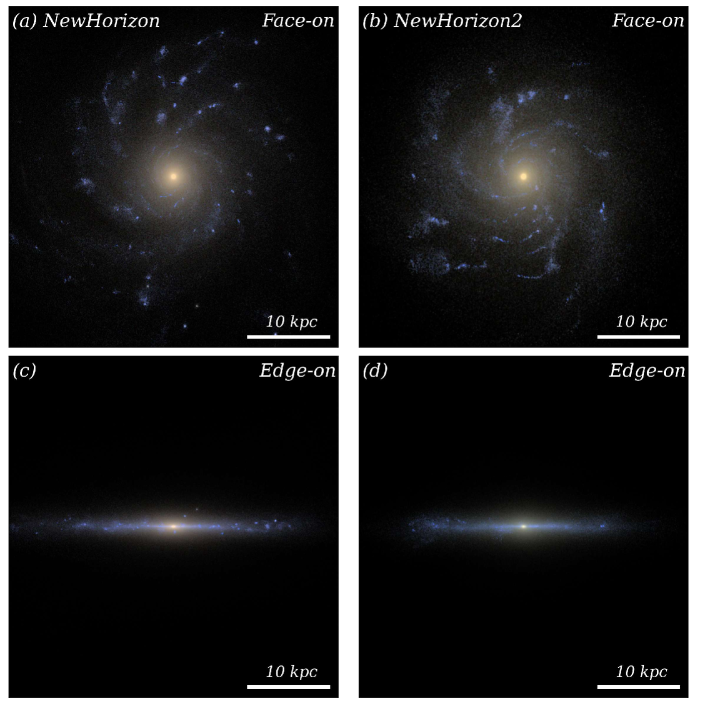
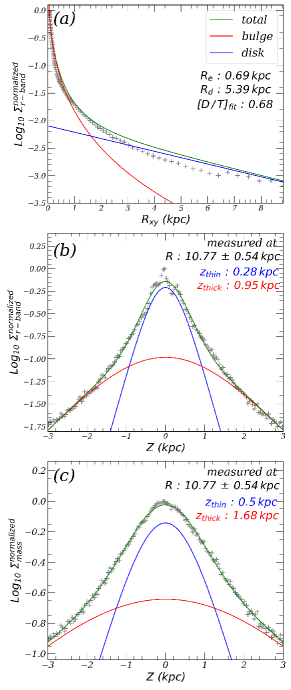
Thick disks are a prevalent feature observed in numerous disk galaxies including our own Milky Way. Their significance has been reported to vary widely, ranging from a few to 100% of the disk mass, depending on the galaxy and the measurement method. We use the NewHorizon simulation which has high spatial and stellar mass resolutions to investigate the issue of thick disk mass fraction. We also use the NewHorizon2 simulation that was run on the same initial conditions but additionally traced nine chemical elements. Based on a sample of 27 massive disk galaxies with M* > 10^10 M_{\odot} in NewHorizon, the contribution of the thick disk was found to be 34 \pm 15% in r-band luminosity or 48 \pm 13% in mass to the overall galactic disk, which seems in agreement with observational data. The vertical profiles of 0, 22, and 5 galaxies are best fitted by 1, 2, or 3 sech2 components, respectively. The NewHorizon2 data show that the selection of thick disk stars based on a single [α/Fe] cut is severely contaminated by stars of different kinematic properties while missing a bulk of kinematically thick disk stars. Vertical luminosity profile fits recover the key properties of thick disks reasonably well. The majority of stars are born near the galactic mid-plane with high circularity and get heated with time via fluctuation in the force field. Depending on the star formation and merger histories, galaxies may naturally develop thick disks with significantly different properties.
研究动机与目标
- 利用高分辨率宇宙学模拟,确定大质量盘星系中厚盘的真实质量分数与光度分数。
- 解决基于垂直轮廓拟合与化学丰度(如[α/Fe])截断所得观测估计值之间的差异。
- 评估动力学与化学判据在识别厚盘恒星中的可靠性,并评估缓慢加热与并合事件在厚盘形成中的作用。
- 比较基于高斯混合模型(GMM)的动力学分解与结构轮廓拟合,以验证厚盘识别方法的可靠性。
提出的方法
- 采用NewHorizon与NewHorizon2代码进行模拟,具备高空间与恒星质量分辨率,并对九种元素进行完整的化学演化追踪。
- 利用能量与角动量上的高斯混合模型(GMM)进行动力学分解,以识别不同恒星族,避免依赖单一数值截断。
- 通过一个、两个或三个sech²组件拟合垂直光度轮廓,以表征厚盘的结构特性。
- 测试化学丰度截断(如[α/Fe])在分离动力学上厚盘恒星方面的有效性,并与GMM及轮廓分类结果进行对比。
- 追踪恒星形成历史、由力波动引起的轨道加热以及并合历史,以建立厚盘特性与形成机制之间的关联。
- 提出未来在3+1维相空间与化学空间中对轨道扩散进行集合平均,以建模吸积事件的集体效应。
实验结果
研究问题
- RQ1在大质量盘星系中,厚盘的真实质量分数是多少?与基于垂直轮廓拟合及化学丰度截断的观测估计值相比如何?
- RQ2[α/Fe]双峰性在多大程度上是识别厚盘恒星的可靠指标?与基于动力学的方法相比表现如何?
- RQ3缓慢加热与并合事件在多大程度上塑造了厚盘的形成?它们是否能产生多个厚盘成分?
- RQ4基于高斯混合模型(GMM)的动力学分解是否能比单一阈值的化学截断更准确、更稳健地识别厚盘恒星?
- RQ5厚盘成分数量(1、2或3个sech²轮廓)与星系的并合或恒星形成历史之间存在何种关系?
主要发现
- 在NewHorizon模拟中,厚盘贡献了大质量盘星系总恒星质量的48±13%,以及r波段光度的34±15%。
- 垂直光度轮廓分别以一个、两个或三个sech²组件拟合得最好的星系数量为20、5和2个,表明其结构多样性。
- 单一[α/Fe]截断会严重污染厚盘识别,导致大量动力学上厚的恒星被遗漏,同时将具有不同动力学特性的恒星错误纳入。
- 基于GMM的动力学分解与基于轮廓的分解具有良好一致性,证实了在一致应用下两种方法的可靠性。
- 恒星主要在星系中平面附近形成,具有高圆形度,随后随时间逐渐被引力势波动加热,从而形成厚盘。
- 具有不同恒星形成与并合历史的星系自然发展出性质显著不同的厚盘,表明其起源复杂且具有多阶段特征。
更好的研究,从现在开始
从阅读论文到最终审阅,大幅缩短您的研究时间。
无需绑定信用卡
本解读由 AI 生成,并经人工编辑审核。