
[论文解读] On the Skew-Symmetric Binary Sequences and the Merit Factor Problem
该论文提出一种轻量级随机算法,通过利用翻转操作的数学特性,将优化斜对称二元序列的内存复杂度从 O(n²) 降低至 O(n)。该算法在序列长度达 10⁵+1 时,实现了超过 5 的优值因子,运行时间随序列长度呈二次方增长。
The merit factor problem is of practical importance to manifold domains, such as digital communications engineering, radars, system modulation, system testing, information theory, physics, chemistry. However, the merit factor problem is referenced as one of the most difficult optimization problems and it was further conjectured that stochastic search procedures will not yield merit factors higher than 5 for long binary sequences (sequences with lengths greater than 200). Some useful mathematical properties related to the flip operation of the skew-symmetric binary sequences are presented in this work. By exploiting those properties, the memory complexity of state-of-the-art stochastic merit factor optimization algorithms could be reduced from $O(n^2)$ to $O(n)$. As a proof of concept, a lightweight stochastic algorithm was constructed, which can optimize pseudo-randomly generated skew-symmetric binary sequences with long lengths (up to ${10}^5+1$) to skew-symmetric binary sequences with a merit factor greater than 5. An approximation of the required time is also provided. The numerical experiments suggest that the algorithm is universal and could be applied to skew-symmetric binary sequences with arbitrary lengths.
研究动机与目标
- 解决高内存需求的随机算法在优化斜对称二元序列时的计算不可行性问题。
- 利用斜对称结构的数学洞察,将翻转操作的内存复杂度从 O(n²) 降低至 O(n)。
- 开发一种轻量级随机算法,能够在长序列(最长达 10⁵+1)中找到优值因子 >5 的斜对称二元序列。
- 为在不同序列长度下实现高优值因子所需的时间提供经验与分析近似。
提出的方法
- 利用斜对称二元序列的数学特性,推导出一种 O(n) 替代方案,以取代传统优值因子计算中使用的 tau 表(τ(S))。
- 设计一种随机优化算法,采用局部(L)和全局(G)改进启发式方法来引导搜索步骤。
- 实现一个“Quake”函数,随机翻转 Q 个位以逃离局部极小值,其中 Q 根据序列长度动态调整。
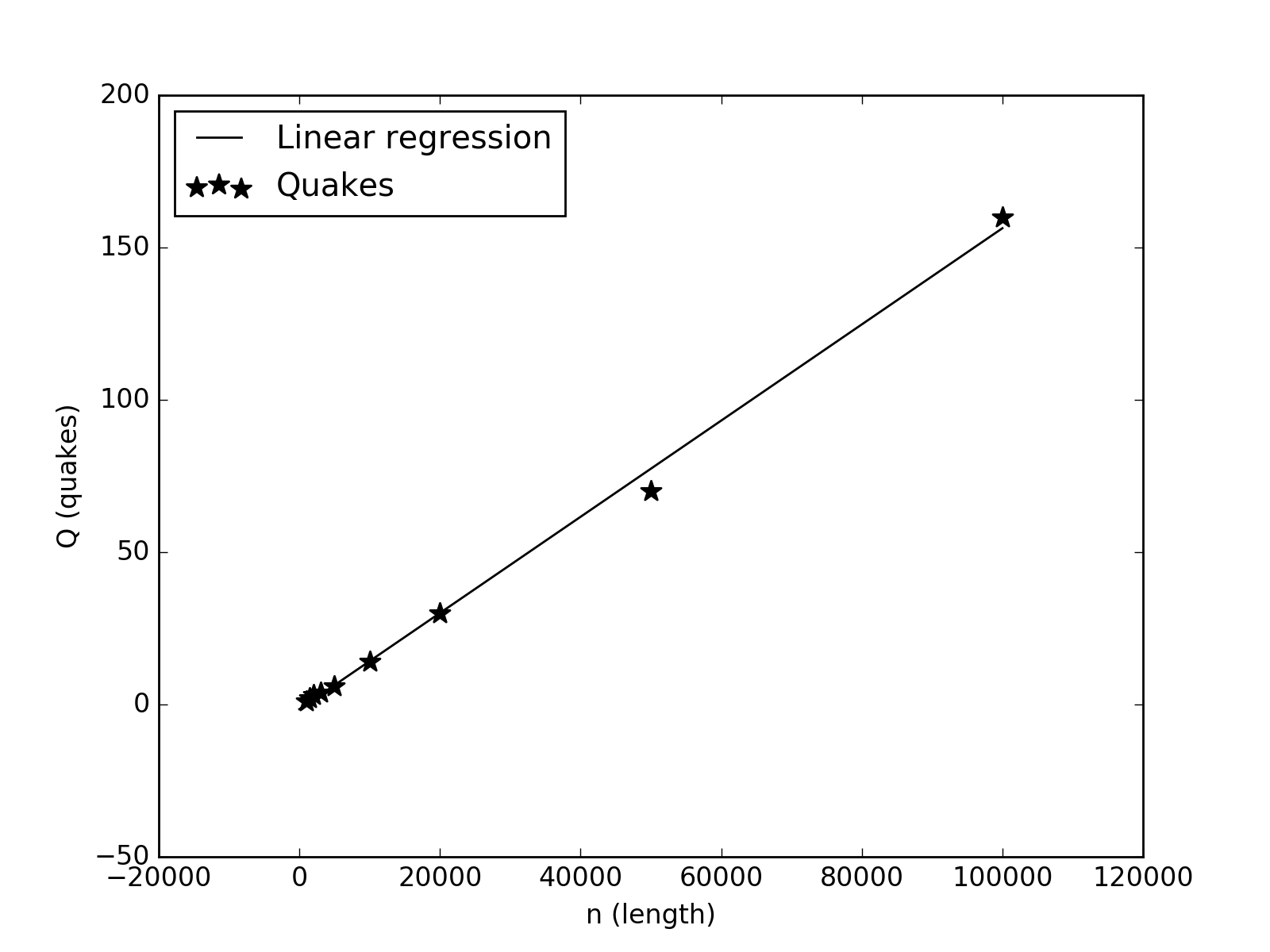
- 对实验获得的 (n, Q) 数据对进行线性回归,建立所需震动力次数的模型:Q ≈ 0.001578787n − 1.546093。
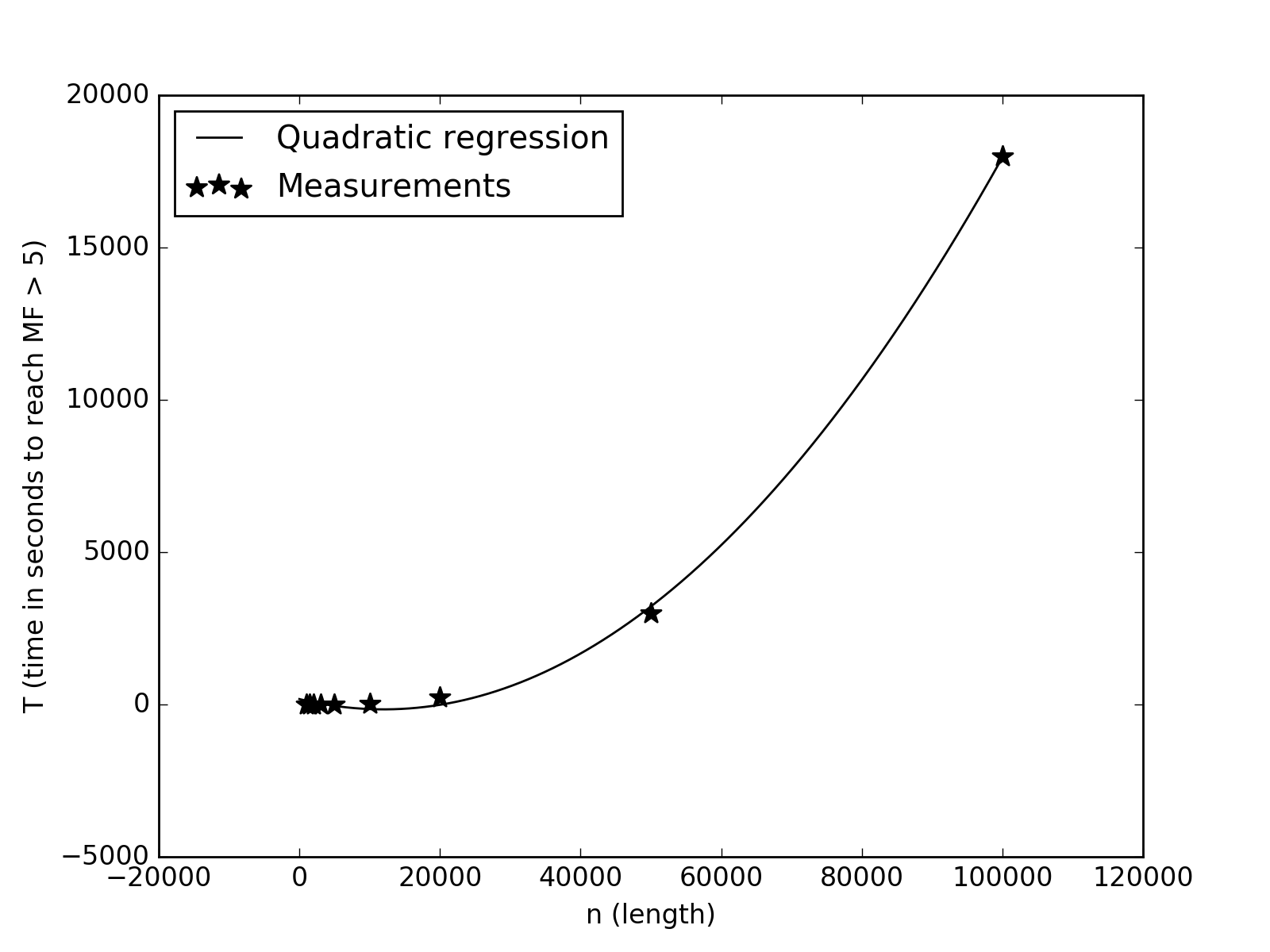
- 对 (n, T) 测量值进行二次回归,估计运行时间 T ≈ 177.2867 − 0.0562043n + 0.000002340029n² 秒。
- 在序列长度从 999 到 100,001 的范围内验证该算法,使用 C++ 在 12 核系统上实现,各次运行性能一致。
实验结果
研究问题
- RQ1能否利用结构特性,将斜对称二元序列随机优值因子优化的内存复杂度从 O(n²) 降低至 O(n)?
- RQ2对于长斜对称序列,实现优值因子 >5 所需的最少随机位翻转次数(Q)是多少?
- RQ3随着序列长度 n 增加,实现优值因子 >5 所需的运行时间如何变化?
- RQ4是否存在一种通用的、轻量级的随机算法,能持续在任意奇数长度(最长达 10⁵+1)下生成高优值因子的斜对称序列?
- RQ5序列长度与达到高优值因子所需震动力操作次数之间是否存在可预测的关系?
主要发现
- 所提出的算法通过用数学推导出的 O(n) 替代方案取代 tau 表,将翻转操作的内存复杂度从 O(n²) 降低至 O(n)。
- 对于长度为 10,001 的序列,使用 Q = 14 次震动力,约 1 分钟内实现了优值因子 >5。
- 在长度为 20,001 时,算法约需 4 分钟达到优值因子 >5,使用 Q = 30 次震动力。
- 在长度为 50,001 时,运行时间约为 40 分钟,使用 Q = 70 次震动力。
- 在长度为 100,001 时,算法约 5 小时内达到优值因子 >5,使用 Q = 160 次震动力。
- 所需震动力次数 Q 随 n 呈线性增长,拟合模型为 Q ≈ 0.001578787n − 1.546093。
更好的研究,从现在开始
从阅读论文到最终审阅,大幅缩短您的研究时间。
无需绑定信用卡
本解读由 AI 生成,并经人工编辑审核。