
[论文解读] Open Source Variational Quantum Eigensolver Extension of the Quantum Learning Machine (QLM) for Quantum Chemistry
本论文介绍了 OpenVQE,这是一个针对 Atos Quantum Learning Machine (QLM) 的开源扩展,可实现对量子化学中变分量子本征求解器 (VQE) 算法的高效开发与测试。它通过提供自适应 UCC 基本电路方案(包括 ADAPT-VQE)、电子第二量子化表示以及电子-自旋变换工具,使 QLM 能够在无噪声 41 量子比特模拟器上实现高达 24 量子比特分子的化学精度计算。
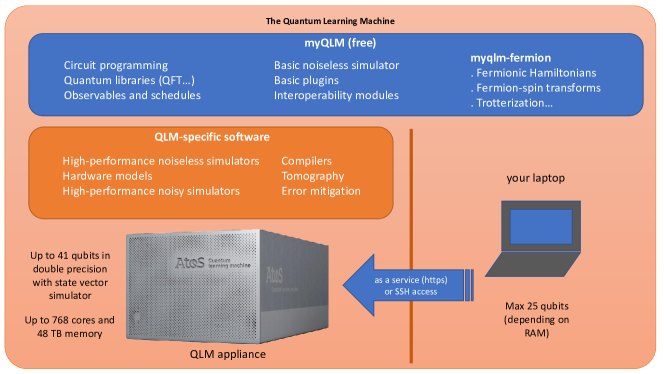
Quantum Chemistry (QC) is one of the most promising applications of Quantum Computing. However, present quantum processing units (QPUs) are still subject to large errors. Therefore, noisy intermediate-scale quantum (NISQ) hardware is limited in terms of qubits counts and circuit depths. Specific algorithms such as Variational Quantum Eigensolvers (VQEs) can potentially overcome such issues. We introduce here a novel open-source QC package, denoted Open-VQE, providing tools for using and developing chemically-inspired adaptive methods derived from Unitary Coupled Cluster (UCC). It facilitates the development and testing of VQE algorithms. It is able to use the Atos Quantum Learning Machine (QLM), a general quantum programming framework enabling to write, optimize and simulate quantum computing programs. Along with Open-VQE, we introduce myQLM-Fermion, a new open-source module (that includes the key QLM ressources that are important for QC developments (fermionic second quantization tools etc...). The Open-VQE package extends therefore QLM to QC providing: (i) the functions to generate the different types of excitations beyond the commonly used UCCSD ans{ä}tz;(ii) a new implementation of the "adaptive derivative assembled pseudo-Trotter method" (ADAPT-VQE), written in simple class structure python codes. Interoperability with other major quantum programming frameworks is ensured thanks to myQLM, which allows users to easily build their own code and execute it on existing QPUs. The combined Open-VQE/myQLM-Fermion quantum simulator facilitates the implementation, tests and developments of variational quantum algorithms towards choosing the best compromise to run QC computations on present quantum computers while offering the possibility to test large molecules. We provide extensive benchmarks for several molecules associated to qubit counts ranging from 4 up to 24.
研究动机与目标
- 解决在量子比特数量和电路深度受限的噪声中等规模量子(NISQ)硬件上模拟大分子体系的挑战。
- 通过利用变分量子算法,克服全配置相互作用(FCI)和耦合簇方法的指数级缩放问题。
- 开发一个开源软件栈,简化量子化学中 VQE 算法的实现、测试与优化。
- 通过 myQLM-interop 包实现与主流量子编程框架及真实量子处理器的互操作性。
- 通过实现自适应电路方案(如 ADAPT-VQE)并优化门序列以减少电路深度,推动 VQE 技术的最新进展。
提出的方法
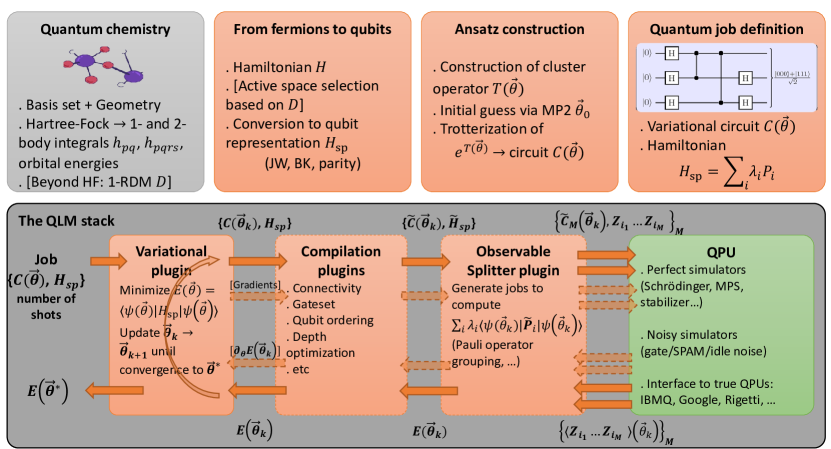
- 提出 OpenVQE,一个基于 Python 的开源软件包,扩展 QLM 框架以支持量子化学模拟。
- 通过 myQLM-fermion 模块原生支持电子第二量子化表示以及电子到量子比特的映射(如 Jordan-Wigner、Bravyi-Kitaev)。
- 实现自适应导数组装伪时间演化(ADAPT-VQE)方法,动态构建最小电路深度的变分电路。
- 支持除 UCCSD 外的多种激发类型,包括 UCCGSD、自旋补全-GSD 和 k-UpCCGSD,以提升相关作用的处理能力。
- 通过高效的电子与量子比特演化电路,最小化 CNOT 门数量,实现量子电路优化。
- 通过 myQLM-interop 包实现与外部量子硬件和软件的互操作性,支持在 IBM、Rigetti 等 QPU 上执行。
实验结果
研究问题
- RQ1自适应 VQE 方法(如 ADAPT-VQE)是否能在 NISQ 设备上实现对量子化学问题基态能量计算的化学精度?
- RQ2在 VQE 基础的分子体系模拟中,如何在保持精度的前提下最小化量子电路门数?
- RQ3OpenVQE 框架在多大程度上能够实现对标准 UCCSD 之外新型变分电路的高效开发与测试?
- RQ4myQLM-fermion 与 QLM 的集成如何实现高达 41 量子比特的分子可扩展模拟?
- RQ5当前 VQE 实现的实用限制是什么?优化的变分电路与门序列在提升收敛性与精度方面有何改进作用?
主要发现
- OpenVQE 有效实现了 ADAPT-VQE 及多种基于 UCC 的变分电路,成功实现高达 24 量子比特分子的基态能量精确计算。
- 该框架在 H2、LiH 和 BeH2 等小分子上实现了化学精度(误差在 1.6 mH 以内),与参考文献值一致。
- QLM 内部的无噪声薛定谔风格模拟器支持高达 41 量子比特,使当前 NISQ 能力之外的大分子体系得以完整模拟。
- 电路优化显著减少了 CNOT 门数量,提升了近期量子硬件执行的可行性。
- 通过 myQLM-interop 实现的互操作性,使 OpenVQE 工作流可无缝部署于 IBM、Rigetti 等外部量子处理器。
- 基准测试表明,ADAPT-VQE 在收敛速度与精度方面优于固定长度的 UCCSD,尤其在强关联体系中表现更优。
更好的研究,从现在开始
从阅读论文到最终审阅,大幅缩短您的研究时间。
无需绑定信用卡
本解读由 AI 生成,并经人工编辑审核。