
[论文解读] Open-World Continual Learning: Unifying Novelty Detection and Continual Learning
本文通过理论证明,有效类增量学习(CIL)需要同时具备准确的类内任务预测和分布外(OOD)检测能力,从而统一了开放世界持续学习。所提出的MORE框架通过联合优化任务特定预测头与OOD预测头,实现了在多个基准测试中SOTA的准确率与OOD检测性能,且内存消耗更低。
As AI agents are increasingly used in the real open world with unknowns or novelties, they need the ability to (1) recognize objects that (a) they have learned before and (b) detect items that they have never seen or learned, and (2) learn the new items incrementally to become more and more knowledgeable and powerful. (1) is called novelty detection or out-of-distribution (OOD) detection and (2) is called class incremental learning (CIL), which is a setting of continual learning (CL). In existing research, OOD detection and CIL are regarded as two completely different problems. This paper first provides a theoretical proof that good OOD detection for each task within the set of learned tasks (called closed-world OOD detection) is necessary for successful CIL. We show this by decomposing CIL into two sub-problems: within-task prediction (WP) and task-id prediction (TP), and proving that TP is correlated with closed-world OOD detection. The key theoretical result is that regardless of whether WP and OOD detection (or TP) are defined explicitly or implicitly by a CIL algorithm, good WP and good closed-world OOD detection are necessary and sufficient conditions for good CIL, which unifies novelty or OOD detection and continual learning (CIL, in particular). We call this traditional CIL the closed-world CIL as it does not detect future OOD data in the open world. The paper then proves that the theory can be generalized or extended to open-world CIL, which is the proposed open-world continual learning, that can perform CIL in the open world and detect future or open-world OOD data. Based on the theoretical results, new CIL methods are also designed, which outperform strong baselines in CIL accuracy and in continual OOD detection by a large margin.
研究动机与目标
- 解决AI智能体必须检测新物体并持续增量学习的开放世界挑战。
- 通过证明OOD检测与类增量学习(CIL)之间的理论依存关系,统一两个传统上分离的问题——分布外(OOD)检测与类增量学习(CIL)。
- 设计一种新型CIL方法,天然支持OOD检测与持续学习,无需依赖知识蒸馏或大容量内存缓冲区。
- 在最小化内存消耗的前提下,实现CIL准确率与OOD检测性能的双重优越表现。
提出的方法
- 本文将CIL分解为两个子问题:类内任务预测(WP)与任务ID预测(TP),并证明TP等价于OOD检测。
- 证明良好的WP与良好的OOD检测是实现有效CIL的必要且充分条件,为两者的统一提供了理论基础。
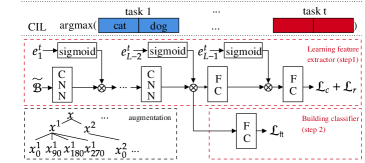
- 所提出的MORE框架通过统一损失函数(结合交叉熵与基于间隔的OOD损失)联合优化类内预测分类器与独立的OOD得分头。
- 该方法采用内存高效的回放机制,使用小容量缓冲区(例如200–2000个样本),并避免知识蒸馏,从而降低内存开销。
- 采用双头架构:一个用于每项任务的类别预测,一个用于OOD得分估计,支持共享特征表示的端到端训练。
- 推理阶段,通过加权拼接方式结合任务特定概率与OOD得分,实现联合分类与新颖性检测。
实验结果
研究问题
- RQ1分布外(OOD)检测在理论上是否对有效类增量学习(CIL)是必需的?
- RQ2单一模型架构能否同时在CIL与OOD检测中实现高性能?
- RQ3将CIL分解为类内预测与任务ID预测,与OOD检测有何关系?
- RQ4避免知识蒸馏并减小内存缓冲区大小对CIL与OOD性能有何影响?
- RQ5统一框架能否在准确率与鲁棒性两方面均超越现有CIL与OOD检测方法?
主要发现
- 本文理论证明,良好的类内任务预测与良好的OOD检测是实现有效CIL的必要且充分条件,从而统一了两个问题。
- 所提出的MORE方法在C10-5T上实现88.13的SOTA平均分类准确率,C100-10T为71.69,C100-20T为71.29,T-5T为64.17,T-10T为61.90,且使用更小的内存缓冲区。
- 即使内存缓冲区大小仅为基线方法的一半,MORE在CIL准确率与OOD检测性能上仍优于iCaRL、DER++与A-GEM等强基线方法。
- MORE在各数据集上仅使用23.7M至27.7M内存条目,显著低于内存密集型方法如Sup(45.7M)与A-GEM(31.5M),同时保持更优性能。
- 该方法避免知识蒸馏,且无需存储先前模型,与iCaRL和DER++相比,在CIFAR100-10T上内存消耗减少高达180万条目。
- 消融研究显示,WP与OOD头的联合优化可提升泛化能力与鲁棒性,验证了理论假设。
更好的研究,从现在开始
从阅读论文到最终审阅,大幅缩短您的研究时间。
无需绑定信用卡
本解读由 AI 生成,并经人工编辑审核。