
[论文解读] OpenCDA:An Open Cooperative Driving Automation Framework Integrated with Co-Simulation
OpenCDA 是一个开源的协同仿真框架,整合了 CARLA 和 SUMO,用于实现协作式驾驶自动化(CDA)系统的端到端仿真。它提供了一个模块化、全栈式平台,包含经过基准测试的算法与场景,使研究人员能够轻松替换组件并评估新型 CDA 算法——通过成功的队列行驶与汇入应用得到验证,显著提升了安全性和效率。
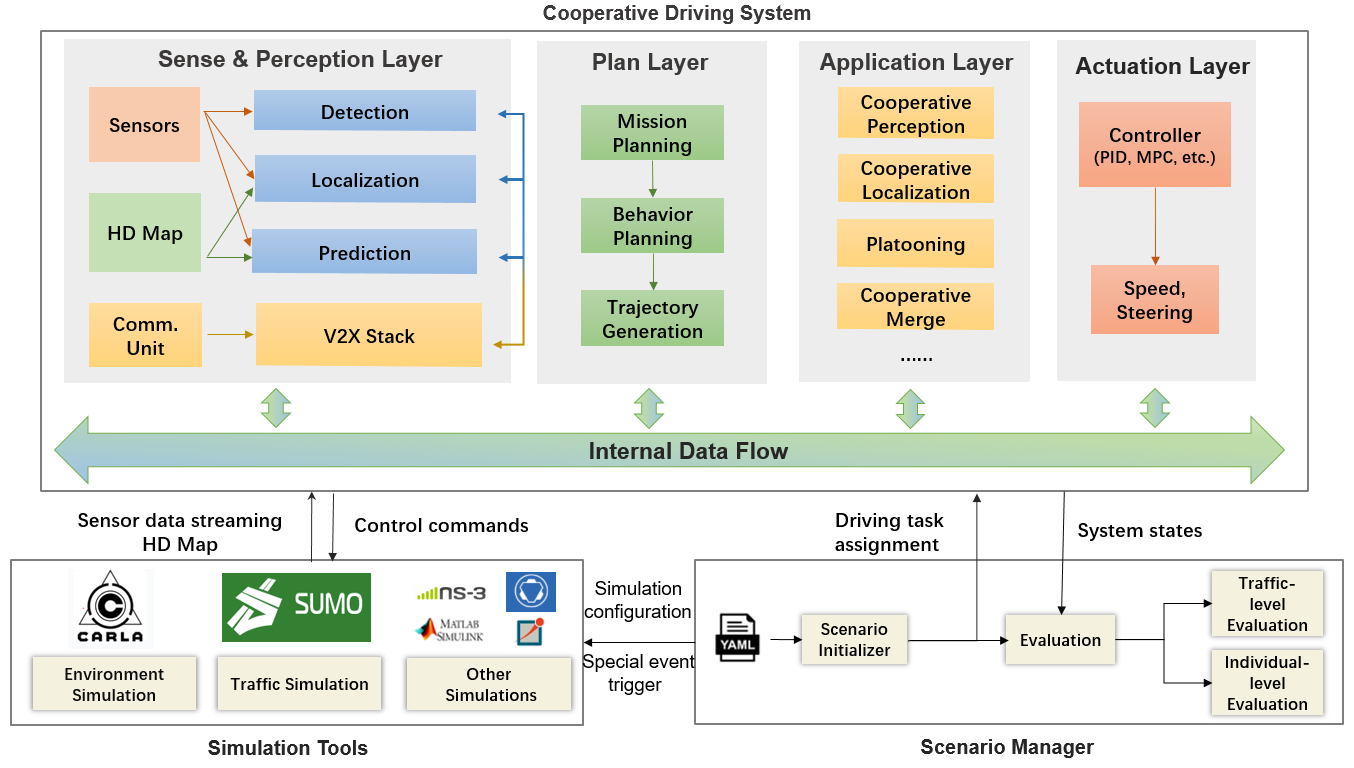
Although Cooperative Driving Automation (CDA) has attracted considerable attention in recent years, there remain numerous open challenges in this field. The gap between existing simulation platforms that mainly concentrate on single-vehicle intelligence and CDA development is one of the critical barriers, as it inhibits researchers from validating and comparing different CDA algorithms conveniently. To this end, we propose OpenCDA, a generalized framework and tool for developing and testing CDA systems. Specifically, OpenCDA is composed of three major components: a co-simulation platform with simulators of different purposes and resolutions, a full-stack cooperative driving system, and a scenario manager. Through the interactions of these three components, our framework offers a straightforward way for researchers to test different CDA algorithms at both levels of traffic and individual autonomy. More importantly, OpenCDA is highly modularized and installed with benchmark algorithms and test cases. Users can conveniently replace any default module with customized algorithms and use other default modules of the CDA platform to perform evaluations of the effectiveness of new functionalities in enhancing the overall CDA performance. An example of platooning implementation is used to illustrate the framework's capability for CDA research. The codes of OpenCDA are available in the https://github.com/ucla-mobility/OpenCDA.
研究动机与目标
- 解决协作式驾驶自动化(CDA)研究中缺乏集成化、开源仿真平台的问题。
- 弥合单体车辆自动驾驶仿真器与多主体 CDA 系统之间的差距。
- 为研究人员提供一个灵活、模块化的框架,以高效地原型设计、测试和比较 CDA 算法。
- 通过标准化场景、评估指标和参考实现,支持 CDA 算法的基准测试。
- 支持与额外仿真器(如 ns-3、CARSim)的可扩展性集成,以及核心模块的自定义。
提出的方法
- 整合 CARLA 以实现高保真度的车辆与场景仿真,同时使用 SUMO 实现宏观交通流与道路网络建模。
- 使用 Python 实现全栈式 CDA 软件流水线,包含感知、定位、规划、控制及 V2X 通信模块。
- 设计模块化架构,支持默认算法与用户自定义算法的即插即用式替换。
- 开发场景管理器,包含预设的基准场景(如队列行驶、汇入)及用于自定义场景创建的 API。
- 采用协同仿真技术,同步各仿真器中车辆动力学、交通流与通信行为。
- 支持与外部仿真器(如 ns-3)的互操作性,用于 V2X 通信建模,以及与 CARSim 的集成,用于高保真度车辆动力学仿真。
实验结果
研究问题
- RQ1如何设计一个统一的仿真框架,以同时支持单车辆自主驾驶与协作式驾驶自动化?
- RQ2CDA 仿真平台中的模块化设计在多大程度上能够实现高效算法替换与性能对比?
- RQ3不同的汇入策略(如启发式方法与 GFS)在协作式队列行驶场景中对安全性和效率有何影响?
- RQ4全栈式、开源的 CDA 仿真平台是否能在队列行驶与汇入等基准场景中实现稳定且安全的性能表现?
- RQ5在多仿真器 CDA 协同仿真环境中,实现可扩展性与互操作性的关键设计原则是什么?
主要发现
- 队列行驶算法在动态前车行为下成功维持了 0.6 秒的时间头距,证明了系统的稳定性与安全性。
- 在协作式汇入场景中,基于 GFS 的汇入策略保持了超过 0.6 秒的安全头距,而启发式方法降至 0.2 秒以下,表明存在显著安全风险。
- 基于 GFS 的汇入方法在 9.9 秒内完成操作,优于启发式方法的 13.1 秒,显示出更高的效率。
- 通过单行代码更改,框架即可无缝替换核心模块(如汇入逻辑),同时保持系统功能与精度。
- OpenCDA 中基准化的算法在多样化场景中表现出可靠性能,验证了全栈式 CDA 软件流水线的完整性和正确性。
- OpenCDA 支持异构仿真器(CARLA、SUMO 及可扩展的 V2X 仿真器)的实时协同仿真,实现了可扩展且逼真的 CDA 测试。

更好的研究,从现在开始
从阅读论文到最终审阅,大幅缩短您的研究时间。
无需绑定信用卡
本解读由 AI 生成,并经人工编辑审核。