
[论文解读] Optimal ANN-SNN Conversion for High-accuracy and Ultra-low-latency Spiking Neural Networks
这篇论文提出一种量化裁剪-平移激活,以训练人工神经网络,从而在超低延迟(仅4个时间步)下实现ANN-SNN转换的零估计转换误差,并在CIFAR-10/100和ImageNet上达到最先进的准确性。
Spiking Neural Networks (SNNs) have gained great attraction due to their distinctive properties of low power consumption and fast inference on neuromorphic hardware. As the most effective method to get deep SNNs, ANN-SNN conversion has achieved comparable performance as ANNs on large-scale datasets. Despite this, it requires long time-steps to match the firing rates of SNNs to the activation of ANNs. As a result, the converted SNN suffers severe performance degradation problems with short time-steps, which hamper the practical application of SNNs. In this paper, we theoretically analyze ANN-SNN conversion error and derive the estimated activation function of SNNs. Then we propose the quantization clip-floor-shift activation function to replace the ReLU activation function in source ANNs, which can better approximate the activation function of SNNs. We prove that the expected conversion error between SNNs and ANNs is zero, enabling us to achieve high-accuracy and ultra-low-latency SNNs. We evaluate our method on CIFAR-10/100 and ImageNet datasets, and show that it outperforms the state-of-the-art ANN-SNN and directly trained SNNs in both accuracy and time-steps. To the best of our knowledge, this is the first time to explore high-performance ANN-SNN conversion with ultra-low latency (4 time-steps). Code is available at https://github.com/putshua/SNN\_conversion\_QCFS
研究动机与目标
- 理解并建模ANN-SNN转换误差的三个主要来源(裁剪、量化、不均匀性)。
- 提出一种激活函数替代(量化裁剪-平移)以使ANN的激活与SNN的发放行为对齐。
- 证明在超低延迟下期望转换误差可为零,并在标准基准数据集上展示最先进的结果。
- 就在选择量化步长L以在超低延迟与峰值准确性之间取得平衡给出指导。
提出的方法
- 从Integrate-and-Fire SNN与基于ReLU的ANN推导ANN-SNN转换框架。
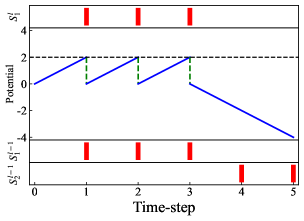
- 将转换误差分解为裁剪误差、量化误差和不均匀性误差。
- 引入量化裁剪激活(及平移变体)以训练ANNS,使转换后的SNN在时间步T上匹配激活;在特定条件下证明零期望误差。
- 定理1:当T = L且θ = λ时,使用量化裁剪平移激活时零估计转换误差。
- 定理2:当平移φ = 1/2时,对于任意T与L,零期望转换误差。
- 使用直通估计器训练带有floor运算符的激活以实现所提出的激活。)
实验结果
研究问题
- RQ1ANN-SNN转换是否能在极低时间步下实现零转换误差?
- RQ2应如何修改ANN的激活以在低延迟下更好地近似SNN的发放率?
- RQ3量化步长L和位移φ对不同数据集和体系结构的转换精度有何影响?
主要发现
- 在CIFAR-10/100和ImageNet上以超低延迟实现多种体系结构的最先进准确性。
- 当T = L且φ = 0时,每层的零估计转换误差;实际结果在低时间步近乎零或为零。
- 使用量化裁剪-平移激活训练的ANN在L≥4时保持接近基于ReLU的ANN的性能。
- 对于CIFAR-10,他们报告4时间步结果,超过若干先前的ANN-SNN方法。
- 在ImageNet上,该方法以较少的时间步实现领先结果(如在T = 16–32时的显著提升)。
- 量化步长L=4或8在超低延迟和峰值准确性之间取得平衡。
更好的研究,从现在开始
从阅读论文到最终审阅,大幅缩短您的研究时间。
无需绑定信用卡
本解读由 AI 生成,并经人工编辑审核。