
[论文解读] Optimal Resource Allocation Design for Large IRS-Assisted SWIPT Systems: A Scalable Optimization Framework
该论文提出了一种用于大规模智能反射面(IRS)辅助同时无线信息与能量传输(SWIPT)系统的可扩展优化框架,通过将IRS划分为多个子区域(tiles),并离线预计算最优相位移配置(传输模式)。通过联合优化波束成形与模式选择,采用分支定界法(branch-and-bound)和基于惩罚的连续凸逼近方法,该框架在保持非线性能量采集模型下高效在线运行的同时,显著降低了能耗。
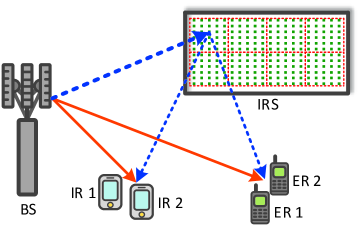
In this paper, we study the optimal resource allocation algorithm design for large intelligent reflecting surface (IRS)-assisted simultaneous wireless information and power transfer (SWIPT) systems. To facilitate efficient system design for large IRSs, instead of jointly optimizing all the IRS elements, we partition the IRS into several tiles and employ a scalable optimization framework comprising an offline design stage and an online optimization stage. In the offline stage, the IRS elements of each tile are jointly designed to support a set of different phase shift configurations, referred to as transmission modes, while the best transmission mode is selected from the set for each tile in the online stage. Given a transmission mode set, we aim to minimize the total base station (BS) transmit power by jointly optimizing the beamforming and the transmission mode selection policy taking into account the quality-of-service requirements of information decoding and non-linear energy harvesting receivers, respectively. Although the resource allocation algorithm design is formulated as a non-convex combinatorial optimization problem, we solve it optimally by applying the branch-and-bound (BnB) approach which entails a high computational complexity. To strike a balance between optimality and computational complexity, we also develop an efficient suboptimal algorithm capitalizing on the penalty method and successive convex approximation. Our simulation results show that the proposed designs enable considerable power savings compared to several baseline schemes. Moreover, our results reveal that by properly adjusting the numbers of tiles and transmission modes, the proposed scalable optimization framework indeed facilitates online design for large IRSs.
研究动机与目标
- 解决在具有非线性能量采集(EH)模型的SWIPT系统中,大规模IRS优化带来的高计算复杂度问题。
- 克服逐元素IRS优化方法在IRS规模增大时性能下降的局限性。
- 通过将离线设计与在线选择解耦,实现在大规模IRS上高效在线资源分配。
- 在满足信息解码与非线性能量采集接收机服务质量(QoS)要求的前提下,最小化基站总发射功率。
- 通过可调的子区域数量与模式数量,提供性能与复杂度之间的灵活权衡。
提出的方法
- 将大规模IRS划分为多个子区域,以降低优化复杂度。
- 引入离线阶段,预先计算每个子区域的最优相位移配置(传输模式)。
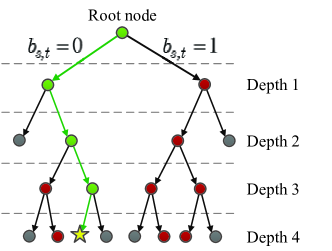
- 采用分支定界法(BnB)求解非凸组合优化问题,实现最优解。
- 开发一种基于惩罚法与连续凸逼近的次优算法,以降低计算复杂度。
- 采用基于物理的非线性能量采集模型,以提高相比线性近似的准确性。
- 在信息与能量接收机的QoS约束下,联合优化波束成形向量与传输模式选择。
实验结果
研究问题
- RQ1如何在不牺牲最优性的情况下,使大规模IRS辅助SWIPT系统的资源分配实现可扩展性?
- RQ2与线性模型相比,使用非线性能量采集模型对系统性能与功率效率有何影响?
- RQ3所提出的基于子区域划分与传输模式选择的框架如何影响在线优化的复杂度与性能?
- RQ4在大规模IRS部署中,子区域数量、传输模式数量与系统性能之间存在何种权衡?
- RQ5与基准方案相比,所提出的框架是否能在保持大规模IRS计算可行性的同时实现显著的能耗降低?
主要发现
- 所提出的可扩展优化框架相比基准方案实现了显著的能耗降低,尤其在采用非线性能量采集模型时更为明显。
- 基于惩罚法与连续凸逼近的次优算法在计算复杂度显著降低的同时,实现了接近最优的性能。
- 合理调节子区域数量与传输模式数量,可在大规模IRS系统中灵活实现性能与复杂度的权衡。
- 基于物理的非线性EH模型相比线性模型能提供更精确、更实用的系统设计,尤其在瑞利衰落等信道条件下表现更优。
- 最优波束成形矩阵被证明为秩一矩阵,有利于高效实现并简化信号处理。
更好的研究,从现在开始
从阅读论文到最终审阅,大幅缩短您的研究时间。
无需绑定信用卡
本解读由 AI 生成,并经人工编辑审核。