
[论文解读] Optimization of the geometrical stability in square ring laser gyroscopes
本文提出了一种控制策略,通过测量并锁定两个对角线和周长至绝对长度,以增强方形环形激光陀螺仪的几何稳定性,从而实现对地球自转的高精度探测,用于检验广义相对论。该方法实现了对尺度因子变化的二次抑制,使异质外延(非单晶)腔体能够满足 GINGER 项目所需的 $10^{-14}$ rad/s 灵敏度要求。
Ultra sensitive ring laser gyroscopes are regarded as potential detectors of the general relativistic frame-dragging effect due to the rotation of the Earth: the project name is GINGER (Gyroscopes IN GEneral Relativity), a ground-based triaxial array of ring lasers aiming at measuring the Earth rotation rate with an accuracy of 10^-14 rad/s. Such ambitious goal is now within reach as large area ring lasers are very close to the necessary sensitivity and stability. However, demanding constraints on the geometrical stability of the laser optical path inside the ring cavity are required. Thus we have started a detailed study of the geometry of an optical cavity, in order to find a control strategy for its geometry which could meet the specifications of the GINGER project. As the cavity perimeter has a stationary point for the square configuration, we identify a set of transformations on the mirror positions which allows us to adjust the laser beam steering to the shape of a square. We show that the geometrical stability of a square cavity strongly increases by implementing a suitable system to measure the mirror distances, and that the geometry stabilization can be achieved by measuring the absolute lengths of the two diagonals and the perimeter of the ring.
研究动机与目标
- 为解决在大面积环形激光陀螺仪中维持极端几何稳定性的挑战,以探测 Lense-Thirring 效应。
- 通过开发主动镜面位置控制,使异质外延(非单晶)腔体结构能够使用常规材料。
- 识别一种控制策略,以最小化因腔体形变导致的 Sagnac 尺度因子 $\mathbf{k}_S$ 变化。
- 证明方形腔体几何结构在周长和尺度因子上存在稳定点,可在形变下保持稳定运行。
- 基于费马原理建立形式化模型,用于描述光路并按其对光程长度和尺度因子的影响对形变进行分类。
提出的方法
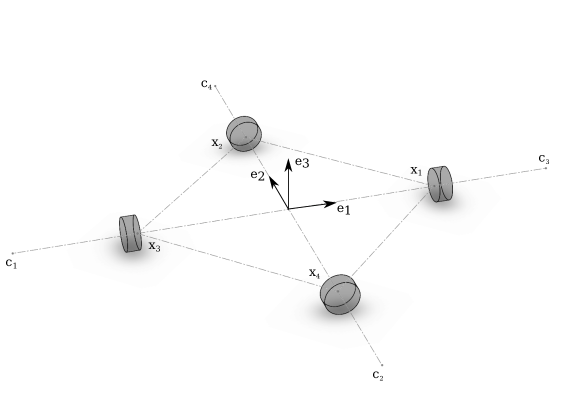
- 使用费马原理对光学腔体几何结构进行建模,光路由镜面曲率中心位置决定。
- 定义形变参数 $\tau_\alpha$ 以对腔体的刚体运动和残余形变进行分类。
- 推导出归一化周长 $\widehat{p}^*$ 和归一化尺度因子 $\widehat{k}^*$ 的表达式,其为归一化形变参数 $\widetilde{\tau}_\alpha = \tau_\alpha / d_0$ 的二次型,其中 $d_0$ 为标称对角线长度。
- 施加约束条件:两对角线长度相等($||\mathbf{c}_3 - \mathbf{c}_1|| = ||\mathbf{c}_4 - \mathbf{c}_2|| = d_0$),以实现对称性并使系统稳定在规则方形几何构型附近。
- 证明在对角线锁定条件下,$\mathbf{k}_S$ 和周长的变化仅依赖于 $\widetilde{\tau}_\alpha$ 的二次项,从而实现高精度控制。
- 识别出大镜面曲率半径(避免 $h = L/r \approx 1/\sqrt{2}$)可最小化对形变的敏感性,同时保持腔体稳定性。
实验结果
研究问题
- RQ1如何对方形环形激光腔体的几何形变进行建模与分类,以评估其对 Sagnac 尺度因子 $\mathbf{k}_S$ 的影响?
- RQ2何种控制策略可稳定腔体几何结构,以实现广义相对论测试中 $10^{-14}$ rad/s 的灵敏度?
- RQ3为何方形腔体几何结构在形变下特别有利于最小化尺度因子变化?
- RQ4对角线长度测量与周长控制如何共同作用,以实现腔体周长和尺度因子的稳定点?
- RQ5镜面曲率半径在最小化对残余形变的敏感性方面起何种作用?
主要发现
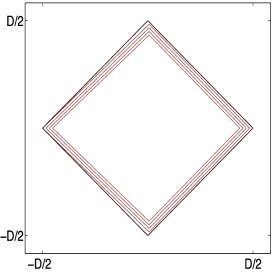
- 将两条对角线均锁定至相同的绝对长度 $d_0$,可在腔体周长上形成稳定点,对应于规则方形几何构型。
- 在对角线锁定条件下,尺度因子 $\mathbf{k}_S$ 和周长的变化仅依赖于形变参数 $\widetilde{\tau}_\alpha$ 的二次项,从而实现高度稳定。
- 在周长和尺度因子表达式中,$\widetilde{\tau}_5^2$ 的系数完全相同,表明对角线长度波动会直接同时影响这两个量。
- 最优设计应避免 $h = L/r \approx 1/\sqrt{2}$ 的情况,因为在该条件下,腔体在矢状面内表现出共焦行为,导致不稳定。
- 在镜面位置控制精度达到几微米的条件下,可实现 $\mathbf{k}_S$ 几何稳定性达 $10^{-10}$ 量级,满足 GINGER 项目的要求。
- 该形式化方法支持使用超稳光学频率参考对异质外延腔体进行主动控制,从而实现用于基础物理研究的大规模环形激光阵列。
更好的研究,从现在开始
从论文设计到论文写作,大幅缩短您的研究时间。
无需绑定信用卡
本解读由 AI 生成,并经人工编辑审核。