
[论文解读] Optimizing Energy-Harvesting Hybrid VLC/RF Networks with Random Receiver Orientation
本文提出在能量采集中继的混合VLC/RF网络中联合优化直流偏置(DC bias)与时隙分配,考虑接收机随机方向的影响。通过将非凸优化问题分解为循环子问题,并推导出在均匀方向分布下的平均数据速率闭式表达式,该方案在长中继距离和大光束宽度条件下,相比仅优化直流偏置的方案,实现了更高的数据速率。
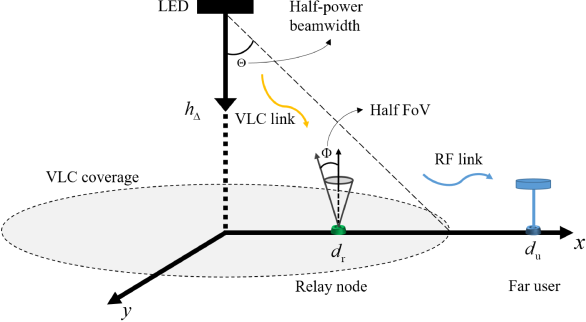
This paper investigates an indoor hybrid visible light communication (VLC) and radio frequency (RF) scenario with two-hop downlink transmission. A light emitting diode (LED) transmits both data and energy via VLC to an energy-harvesting relay node, which then uses the harvested energy to retransmit the decoded information to an RF user in the second phase. The design parameters include the direct current (DC) bias and the time allocation for VLC transmission. We formulate an optimization problem to maximize the data rate under decode-and-forward relaying with fixed receiver orientation. The non-convex problem is decomposed into two sub-problems, solved iteratively by fixing one parameter while optimizing the other. Additionally, we analyze the impact of random receiver orientation on the data rate, deriving closed-form expressions for both VLC and RF rates. An exhaustive search approach is employed to solve the optimization, demonstrating that joint optimization of DC bias and time allocation significantly enhances the data rate compared to optimizing DC bias alone.
研究动机与目标
- 通过在中继处实现能量采集的双跳混合VLC/RF通信,解决室内能量受限无线网络的性能瓶颈。
- 制定DC偏置与VLC传输时长的联合优化问题,以最大化远距离RF用户的数据速率。
- 研究随机接收机方向对混合VLC/RF系统可实现数据速率的影响,该因素在以往研究中常被忽略。
- 在接收机方向均匀分布的假设下,推导VLC与RF平均数据速率的闭式表达式,以实现可分析的系统设计与优化。
- 通过穷举搜索证明,DC偏置与时隙分配的联合优化优于仅优化DC偏置的方案,尤其在信道条件严峻时表现更优。
提出的方法
- 制定两阶段传输模型:第一阶段,VLC链路同时传输数据与能量至能量采集中继;第二阶段,中继利用采集的能量通过RF向远距离用户转发数据。
- 建模中继从VLC与RF传输中同时收集能量,包括在RF阶段持续施加DC偏置功率以支持能量持续采集。
- 通过将DC偏置与VLC时长的非凸联合优化问题分解为两个循环子问题来处理:首先固定时长以通过主要化-最小化(MM)算法优化DC偏置,然后固定DC偏置以优化时长。
- 假设中继方向服从均匀随机分布,以模拟现实中的移动性与设备对准偏差,并推导VLC与RF平均数据速率的闭式下界。
- 使用精确积分表达式与蒙特卡洛仿真验证推导出的闭式表达式,确保在随机方向下的分析准确性。
- 对DC偏置与时长进行穷举搜索以确定最优参数,结果在不同中继距离、光束宽度与方向范围下进行评估。
实验结果
研究问题
- RQ1随机接收机方向如何影响混合VLC/RF能量采集中继网络中的可实现数据速率?
- RQ2为最大化远距离RF用户的数据速率,VLC链路的DC偏置与时隙分配之间应如何实现最优权衡?
- RQ3与仅优化DC偏置相比,DC偏置与VLC传输时长的联合优化是否能实现更高的数据速率?
- RQ4LED的半功率光束宽度如何影响在随机接收机方向下的系统性能?
- RQ5在RF传输阶段采集能量对整体数据速率与系统可靠性有何影响?
主要发现
- 所提出的DC偏置与VLC时长的联合优化方案,相比仅优化DC偏置的方案,在中继距离较远时可实现更高的数据速率。
- 随机接收机方向显著降低可实现数据速率,最优数据速率随方向范围(θ₂)从10°增至50°而下降。
- 在RF传输阶段采集能量(情况1与情况3)可提升最优数据速率,尤其在VLC信道衰减较大(因中继距离增加)时更为明显。
- 当中继距离d_r = 0 m时,半功率光束宽度Φ从60°增至90°会降低可实现数据速率(因信道衰减降低),但在d_r = 4 m时,更宽的光束宽度有助于维持性能。
- 推导出的VLC与RF平均数据速率的闭式表达式与仿真结果及精确积分计算高度吻合,验证了分析模型的正确性。
- 若忽略RF阶段的能量采集且未自适应调整时长,系统在d_r = 4 m时无法达到1 Mbps的数据速率阈值。

更好的研究,从现在开始
从阅读论文到最终审阅,大幅缩短您的研究时间。
无需绑定信用卡
本解读由 AI 生成,并经人工编辑审核。