
[论文解读] Optimizing Privacy, Utility and Efficiency in Constrained Multi-Objective Federated Learning
本文提出了一种约束型多目标联邦学习(CMOFL)框架,通过多目标优化联合优化隐私、效用和训练效率。该框架基于NSGA-II和PSL改进了两种算法,提供了理论收敛保证,并在三种隐私机制——随机化、BatchCrypt和稀疏化——上进行了实证验证,展示了有效的Pareto最优权衡。
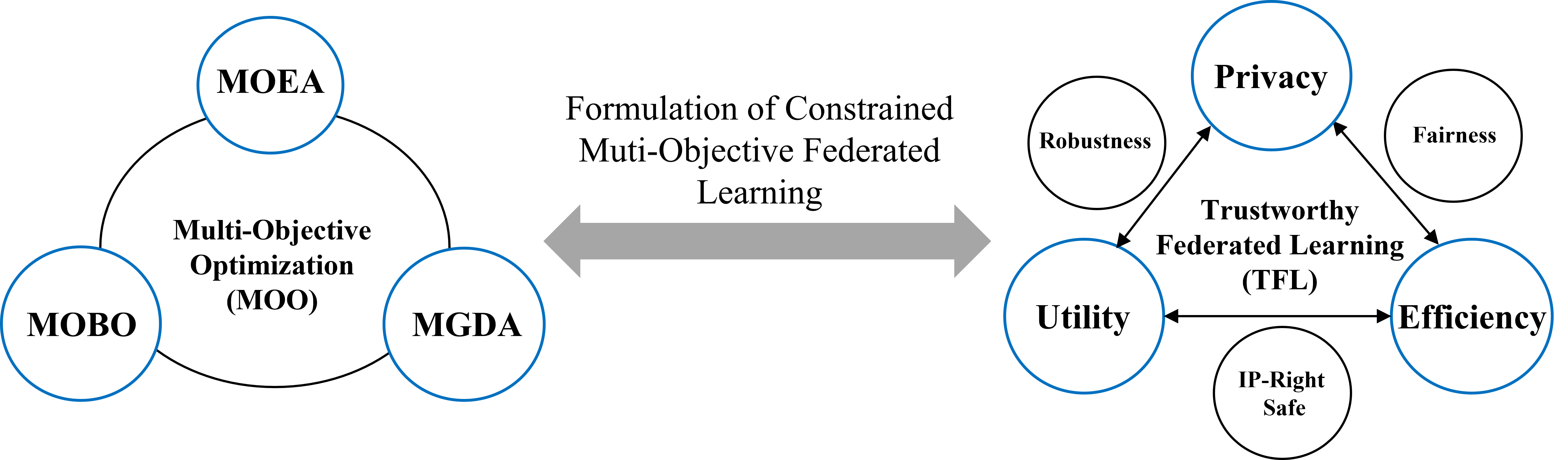
Conventionally, federated learning aims to optimize a single objective, typically the utility. However, for a federated learning system to be trustworthy, it needs to simultaneously satisfy multiple/many objectives, such as maximizing model performance, minimizing privacy leakage and training cost, and being robust to malicious attacks. Multi-Objective Optimization (MOO) aiming to optimize multiple conflicting objectives at the same time is quite suitable for solving the optimization problem of Trustworthy Federated Learning (TFL). In this paper, we unify MOO and TFL by formulating the problem of constrained multi-objective federated learning (CMOFL). Under this formulation, existing MOO algorithms can be adapted to TFL straightforwardly. Different from existing CMOFL works focusing on utility, efficiency, fairness, and robustness, we consider optimizing privacy leakage along with utility loss and training cost, the three primary objectives of a TFL system. We develop two improved CMOFL algorithms based on NSGA-II and PSL, respectively, for effectively and efficiently finding Pareto optimal solutions, and we provide theoretical analysis on their convergence. We design specific measurements of privacy leakage, utility loss, and training cost for three privacy protection mechanisms: Randomization, BatchCrypt (An efficient version of homomorphic encryption), and Sparsification. Empirical experiments conducted under each of the three protection mechanisms demonstrate the effectiveness of our proposed algorithms.
研究动机与目标
- 解决联邦学习系统中隐私、效用和效率缺乏集成优化的问题。
- 构建统一的约束型多目标联邦学习(CMOFL)框架,以实现在可信联邦学习(TFL)中的多目标优化。
- 扩展现有的多目标优化(MOO)算法(NSGA-II和PSL),以处理隐私泄露、效用损失和训练成本的联合优化。
- 为CMOFL框架下的所提算法提供理论收敛性分析。
- 设计并评估三种隐私保护机制——随机化、BatchCrypt和稀疏化——下的隐私泄露、效用损失和训练成本度量指标。
提出的方法
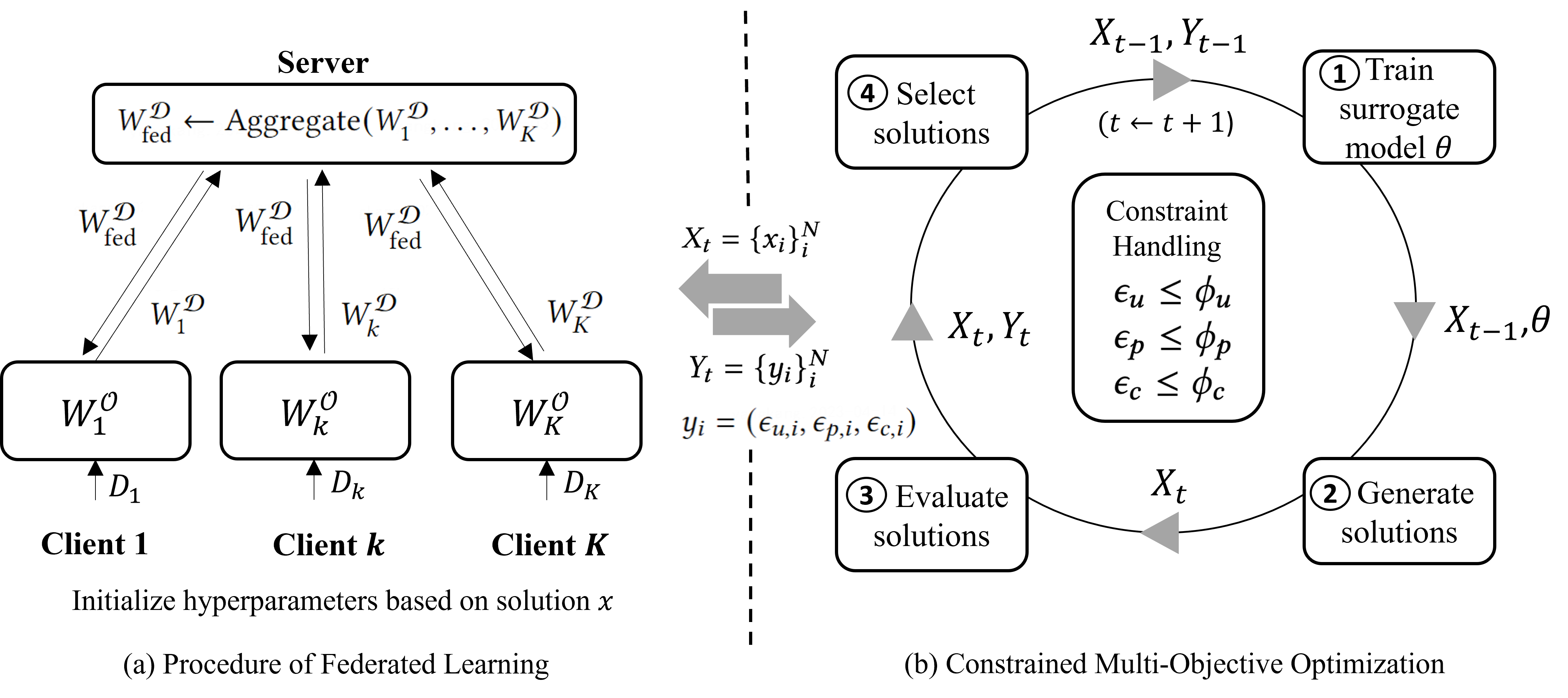
- 将CMOFL建模为一个具有三个主要目标的约束型多目标优化问题:隐私泄露、效用损失和训练成本。
- 调整NSGA-II和PSL算法以处理可信联邦学习(TFL)的多目标特性,整合约束条件并探索Pareto前沿。
- 使用标量化技术定义目标函数,包括Tchebyshev和基于超体积的标量化,用于多目标贝叶斯优化。
- 引入超体积遗憾界以分析收敛性,利用贝叶斯优化中的期望遗憾和最大信息增益($\gamma_T$)。
- 设计隐私泄露(例如通过差分隐私)、效用损失(模型准确率)和训练成本(通信与计算)的测量函数。
- 在多种实验设置下,将算法应用于三种隐私机制——随机化、BatchCrypt(同态加密)和稀疏化。
实验结果
研究问题
- RQ1在实际约束下,如何在联邦学习中联合优化隐私、效用和效率?
- RQ2NSGA-II和PSL-based CMOFL算法在多目标联邦学习中在收敛性和Pareto最优性方面达到何种程度?
- RQ3不同的隐私机制(随机化、BatchCrypt、稀疏化)如何影响隐私、效用和训练成本之间的权衡?
- RQ4Pareto前沿是否能揭示现实应用中隐私保护强度的关键边界?
- RQ5在基于超体积和遗憾的标量化下,所提CMOFL算法的理论收敛行为如何?
主要发现
- 所提出的CMOFL框架成功将多目标优化与可信联邦学习统一,实现了隐私、效用和效率的联合优化。
- 基于NSGA-II和PSL的CMOFL算法实现了收敛性,其超体积遗憾具有理论界,表现为$\text{HV}_{z}(Y^{*}) - \text{HV}_{z}(Y_{T}) \leq O(m^{2}d^{1/2}[γ_{T}ln(T)/T]^{1/2})$。
- 实证结果表明,Pareto前沿揭示了关键权衡:降低差分隐私噪声以提升效用会导致隐私泄露急剧增加。
- BatchCrypt在保持较低隐私泄露的同时实现了更好的效用,但训练成本更高;而稀疏化则提供了更均衡的权衡。
- Pareto前沿能够识别隐私机制的最优配置,为实际应用中隐私等级的标准化提供指导。
- 算法在所有三个目标的权衡空间中有效探索,NSGA-II在收敛性和解集多样性方面表现优异。
更好的研究,从现在开始
从阅读论文到最终审阅,大幅缩短您的研究时间。
无需绑定信用卡
本解读由 AI 生成,并经人工编辑审核。