
[论文解读] OPUS: An Integrated Assessment Model for Satellites and Orbital Debris
OPUS 是一种集成评估模型,将轨道动力学仿真与卫星运营商的理论经济模型相结合,用于评估轨道碎片减缓政策干预措施。通过建模轨道拥堵以及对经济激励(如发射成本和处置法规)的行为响应,该模型表明,诸如轨道使用费等政策工具可提升可持续性与经济福利,为评估空间交通管理策略提供一种多功能工具。
An increasingly salient public policy challenge is how to manage the growing number of satellites in orbit, including large constellations. Many policy initiatives have been proposed that attempt to address the problem from different angles, but there is a paucity of analytical tools to help policymakers evaluate the efficacy of these different proposals and any potential counterproductive outcomes. To help address this problem, this paper summarizes work done to develop an experimental integrated assessment model -- Orbital Debris Propagators Unified with Economic Systems (OPUS) -- that combines both astrodynamics of the orbital population and economic behavior of space actors. For a given set of parameters, the model first utilizes a given astrodynamic propagator to assess the state of objects in orbit. It then uses a set of user-defined economic and policy parameters -- e.g. launch prices, disposal regulations -- to model how actors will respond to the economic incentives created by a given scenario. For the purposes of testing, the MIT Orbital Capacity Tool (MOCAT) version 4S was used as the primary astrodynamics propagator to simulate the true expected target collision probability ($p_c$) for a given end-of-life (EOL) disposal plan. To demonstrate propagator-agnosticism, a Gaussian mixture probability hypothesis density (GMPHD) filter was also used to simulate $p_c$. We also explore economic policy instruments to improve both sustainability of and economic welfare from orbit use. In doing so, we demonstrate that this hybrid approach can serve as a useful tool for evaluating policy proposals for managing orbital congestion. We also discuss areas where this work can be made more robust and expanded to include additional policy considerations.
研究动机与目标
- 解决现有分析工具在空间政策评估中缺乏轨道动力学与经济行为结合的问题。
- 开发一种混合模型,能够模拟经济激励如何影响卫星部署与碎片减缓行为。
- 使政策制定者能够评估轨道使用费、脱轨时间表和碎片清除补贴等提案的有效性。
- 构建一种与轨道传播器无关的框架,兼容现有碎片分析工具。
- 支持对关键政策参数的敏感性分析,提升空间可持续性评估的稳健性。
提出的方法
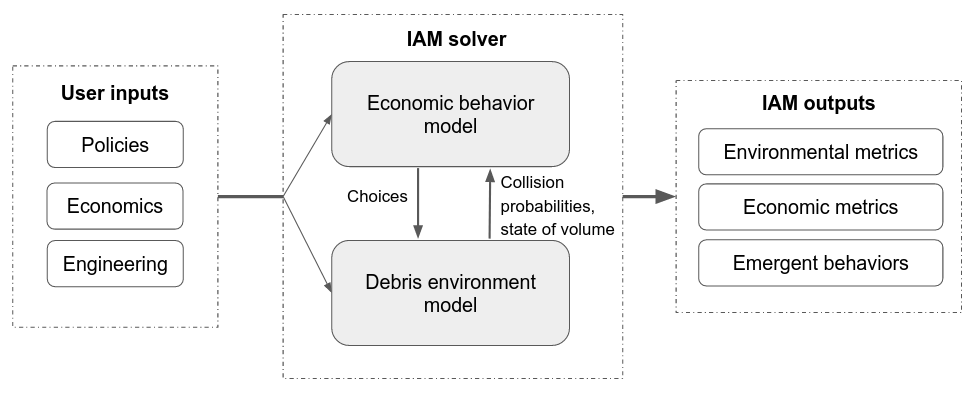
- OPUS 采用双模型架构:使用轨道动力学传播器(如 MOCAT-4S 或 GMPHD 滤波器)来模拟轨道物体状态与碰撞概率。
- 将其与基于运载火箭市场均衡条件的理论经济模型相结合,以描述发射行为。
- 基于发射价格、处置法规和轨道使用费等经济参数,内生化确定发射速率。
- 通过将物理引擎与经济模型解耦,实现传播器无关性,从而兼容多种碎片追踪工具。
- 仿真在 MATLAB 中进行传播,分析与可视化则使用 R 完成。
- 通过调整经济参数(如税收、处置要求和市场结构)来测试不同政策情景。
实验结果
研究问题
- RQ1轨道使用费等经济激励如何影响卫星星座部署与碎片减缓行为?
- RQ2后任务处置时间表的变化对长期轨道拥堵与碰撞概率有何影响?
- RQ3不同经济政策工具在提升空间可持续性与经济福利方面表现如何比较?
- RQ4混合物理-经济模型在评估空间交通管理政策方面能多大程度上提升评估效果?
- RQ5大型星座与非商业行为体如何影响政策干预在轨道拥堵中的有效性?
主要发现
- OPUS 表明,轨道使用费可有效减少碎片积累,提升长期轨道可持续性。
- 该模型显示,更严格的处置法规(如将25年处置标准缩短)可显著降低碰撞概率。
- 诸如脱轨绩效保证金或定向补贴等经济激励,可改变卫星设计与末期行为,从而降低长期碎片风险。
- 模型的传播器无关设计确保了在不同轨道动力学工具下结果的一致性,增强了其稳健性与兼容性。
- 敏感性分析表明,若未辅以有效的经济或监管控制,发射成本下降可能加剧轨道拥堵。
- OPUS 可模拟复杂政策情景,包括反卫试验与商业需求变化,揭示潜在的意外后果。
更好的研究,从现在开始
从阅读论文到最终审阅,大幅缩短您的研究时间。
无需绑定信用卡
本解读由 AI 生成,并经人工编辑审核。