
[论文解读] Origin and magnitude of 'designer' spin-orbit interaction in graphene on semiconducting transition metal dichalcogenides
本文表明,石墨烯在半导体过渡金属二硫属化物(TMDs)上的异质结构表现出一种超强、稳定且由界面诱导的自旋-轨道耦合(SOI),自旋弛豫时间最短可达 ~0.2 ps。该SOI源于能带结构的改变,而非无序效应,这一点通过门电压可调的 Shubnikov-de Haas 振荡得到证实,其显示约 10 meV 的能级分裂,表明石墨烯-TMD 异质结构是实现自旋霍尔效应与谷霍尔效应的有前途平台。
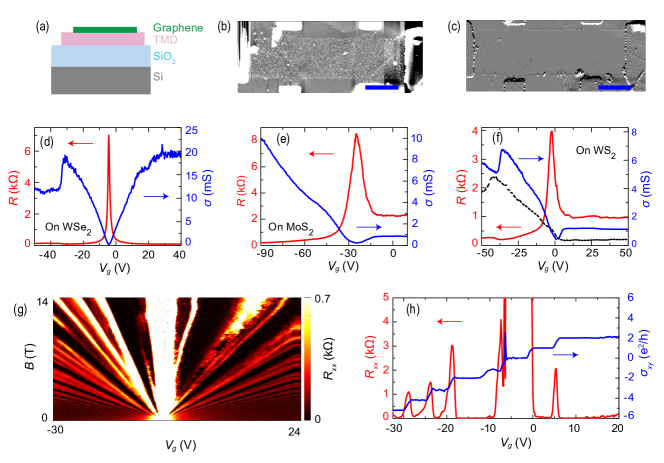
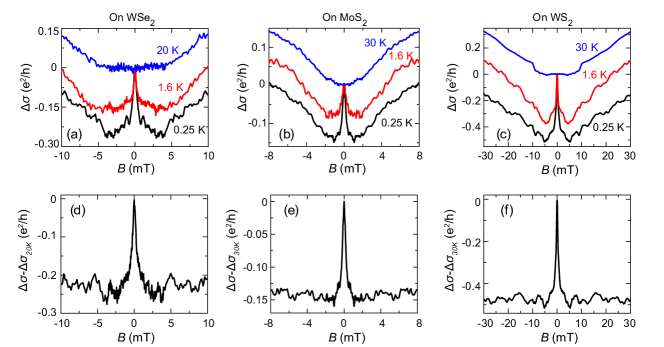
We use a combination of experimental techniques to demonstrate a general occurrence of spin-orbit interaction (SOI) in graphene on transition metal dichalcogenide (TMD) substrates. Our measurements indicate that SOI is ultra-strong and extremely robust, despite it being merely interfacially-induced, with neither graphene nor the TMD substrates changing their structure. This is found to be the case irrespective of the TMD material used, of the transport regime, of the carrier type in the graphene band, and of the thickness of the graphene multilayer. Specifically, we perform weak antilocalization measurements as the simplest and most general diagnostic of SOI, and show that the spin relaxation time is very short in all cases regardless of the elastic scattering time. Such a short spin-relaxation time strongly suggests that the SOI originates from a modification of graphene band structure. We confirmed this expectation by measuring a gate-dependent beating, and a corresponding frequency splitting, in the low-field Shubnikov-de Haas magneto-resistance oscillations in high quality bilayer graphene on WSe$_2$. These measurements provide an unambiguous diagnostic of a SOI-induced splitting in the electronic band structure, and their analysis allows us to determine the SOI coupling constants for the Rashba term and the so-called spin-valley coupling term, i.e., the terms that were recently predicted theoretically for interface-induced SOI in graphene. The magnitude of the SOI splitting is found to be on the order of 10 meV, more than 100 times greater than the SOI intrinsic to graphene. Both the band character of the interfacially induced SOI, as well as its robustness and large magnitude make graphene-on-TMD a promising system to realize and explore a variety of spin-dependent transport phenomena, such as, in particular, spin-Hall and valley-Hall topological insulating states.
研究动机与目标
- 确定石墨烯在半导体过渡金属二硫属化物(TMDs)上所表现出的‘设计型’自旋-轨道相互作用(SOI)的起源及其强度。
- 确定所观测到的 SOI 是否为不同 TMD 材料和石墨烯结构中的普遍且稳定的现象。
- 区分这些异质结构中 SOI 的机制是源于无序散射还是能带结构改变。
- 通过输运测量量化所诱导的 SOI 中 Rashba 项与自旋-谷耦合项的强度。
- 探索石墨烯-TMD 作为实现自旋霍尔与谷霍尔拓扑态平台的潜力。
提出的方法
- 通过提取自旋弛豫时间来探测自旋-轨道耦合强度,开展弱反局域化(WAL)测量。
- 在 WSe₂ 上的高质量双层石墨烯中测量门电压依赖的 Shubnikov-de Haas(SdH)磁阻振荡,以检测能带结构的分裂。
- 通过分析 SdH 振荡的频率分裂,提取 Rashba 与自旋-谷耦合常数。
- 基于含自旋-轨道项的狄拉克哈密顿量的理论模型,解释实验数据。
- 通过比较不同弹性散射时间下的自旋弛豫时间,分离本征 SOI 效应。
- 应用 Hikami-Larkin-Nagaoka(HLN)公式拟合 WAL 数据,提取自旋弛豫时间 τ_so。
实验结果
研究问题
- RQ1石墨烯在 TMD 基底上所表现出的超强自旋-轨道相互作用的微观起源是什么?
- RQ2所观测到的自旋-轨道耦合是否为石墨烯-TMD 异质结构的普遍特性,且与 TMD 材料、载流子类型或石墨烯厚度无关?
- RQ3自旋-轨道相互作用是源于能带结构的改变,还是源于无序散射?
- RQ4在石墨烯-TMD 界面处所诱导的 Rashba 项与自旋-谷耦合项的定量数值是多少?
- RQ5自旋-轨道相互作用的强度是否可通过电场栅压调控?这对拓扑自旋电子学应用有何意义?
主要发现
- 所有器件中的自旋弛豫时间 τ_so 均稳定 ≤ 0.2 ps,无论弹性散射时间如何变化,表明存在一种稳定且本征的 SOI 机制。
- 所观测到的 SOI 并非由无序引起,因为当弹性散射时间变化近两个数量级时,τ_so 仍保持极短。
- 在 WSe₂ 上的双层石墨烯中,门电压依赖的 SdH 振荡显示出约 10 meV 的频率分裂,直接证明了 SOI 导致的能带结构改变。
- Rashba 与自旋-谷耦合项被定量提取,证实了其在界面诱导 SOI 中的作用。
- SOI 分裂能级的大小约为 10 meV,比石墨烯中的本征 SOI 大超过 100 倍。
- SOI 在不同 TMD 材料、载流子类型及石墨烯多层厚度下均表现出普适性,表明这是一种稳定且具有界面特异性的效应。
更好的研究,从现在开始
从论文设计到论文写作,大幅缩短您的研究时间。
无需绑定信用卡
本解读由 AI 生成,并经人工编辑审核。