
[论文解读] Overview and Comparison of Gate Level Quantum Software Platforms
本文对四种主流的门级量子软件平台——Forest(pyQuil)、Qiskit、ProjectQ 和 Quantum Developer Kit(Q#)——进行了全面且对比性的分析,评估了它们在安装、语法、库支持、模拟器性能以及硬件集成方面的表现。该研究为研究人员提供了实用且最新的指导,帮助其根据性能、生态系统和目标硬件能力选择最合适的平台。
Quantum computers are available to use over the cloud, but the recent explosion of quantum software platforms can be overwhelming for those deciding on which to use. In this paper, we provide a current picture of the rapidly evolving quantum computing landscape by comparing four software platforms---Forest (pyQuil), Qiskit, ProjectQ, and the Quantum Developer Kit (Q\#)---that enable researchers to use real and simulated quantum devices. Our analysis covers requirements and installation, language syntax through example programs, library support, and quantum simulator capabilities for each platform. For platforms that have quantum computer support, we compare hardware, quantum assembly languages, and quantum compilers. We conclude by covering features of each and briefly mentioning other quantum computing software packages.
研究动机与目标
- 解决量子软件平台日益增长的复杂性与碎片化问题,该问题阻碍了研究人员和学生选择合适的工具。
- 提供对最主流门级量子软件平台的实用且最新的对比分析,以指导工具选择。
- 评估包括安装、语法、库支持、模拟器性能以及真实量子硬件访问在内的关键指标。
- 突出展示各平台在量子编译器、汇编语言以及对真实设备支持方面的差异。
- 为研究人员提供一个决策框架,根据其计算需求和目标硬件选择最合适的平台。
提出的方法
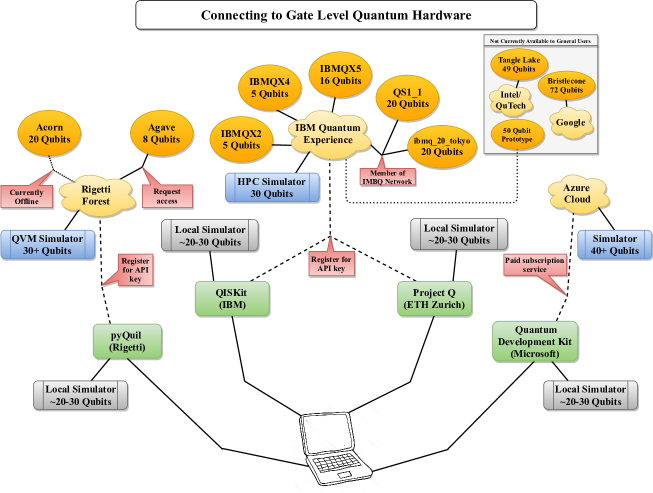
- 选取四种具备真实硬件访问能力的主流门级量子软件平台:Forest(pyQuil)、Qiskit、ProjectQ,以及微软的 Quantum Developer Kit(Q#)。
- 从多个维度评估各平台:安装要求、通过示例程序(如量子隐形传态)测试的语法,以及库支持情况。
- 使用标准化的量子电路对量子模拟器进行基准测试与对比,包括性能指标和资源使用情况。
- 分析硬件支持情况,包括可用的量子处理器(如 8 量子比特的 Rigetti、16 量子比特的 IBM)、访问策略以及量子汇编语言支持。
- 研究量子编译器与优化能力,包括电路编译(transpilation)和原生门映射。
- 提供所有四个平台的并排代码示例(如量子隐形传态),以展示语法与抽象层次的差异。
实验结果
研究问题
- RQ1哪种量子软件平台在实现标准量子算法时提供了最直观且易读的语法?
- RQ2在四个平台中,本地与基于云的量子模拟器在性能特征上如何比较?
- RQ3各平台在量子算法库支持方面的广度与成熟度如何?
- RQ4在电路优化与门保真度方面,各平台的量子编译器与硬件映射能力有何差异?
- RQ5访问真实量子硬件的实际障碍有哪些?各平台在访问要求与设备可用性方面有何不同?
主要发现
- Qiskit 拥有最全面的文档和教程,使其成为初学者和首次接触量子计算的研究人员最易上手机器。
- Forest(pyQuil)与 Rigetti 的 8 量子比特量子处理器集成良好,并支持自定义门定义,但访问权限受限于经批准的用户。
- ProjectQ 具备高度表达性的门级语法,利用 Python 操作符实现,并通过其编译器栈支持高级电路优化。
- Quantum Developer Kit(Q#)因其与 Visual Studio 的集成以及对经典-量子混合编程的强大支持而脱颖而出,尽管目前尚不支持访问真实量子硬件。
- 模拟器性能差异显著:Qiskit 的本地 QASM 模拟器在小型电路中运行迅速,而 ProjectQ 的模拟器支持高量子比特数量,并具备高效的态矢量模拟能力。
- 所有平台均支持量子隐形传态电路,但 Q# 和 ProjectQ 在条件操作的古典控制流方面更清晰,而 Qiskit 和 pyQuil 需要更冗长的语法来实现基于测量的反馈。
更好的研究,从现在开始
从阅读论文到最终审阅,大幅缩短您的研究时间。
无需绑定信用卡
本解读由 AI 生成,并经人工编辑审核。