
[论文解读] Overview of the Instrumentation for the Dark Energy Spectroscopic Instrument
本文介绍了暗能量光谱仪(DESI)的设计、集成与调试,该仪器安装于梅纳尔望远镜,旨在测量宇宙时空中2000万个星系和类星体的红移。DESI在首个运行年度内实现了超过1500万个红移测量,实现了对宇宙加速膨胀、暗能量演化以及中微子质量的前所未有的测量精度。
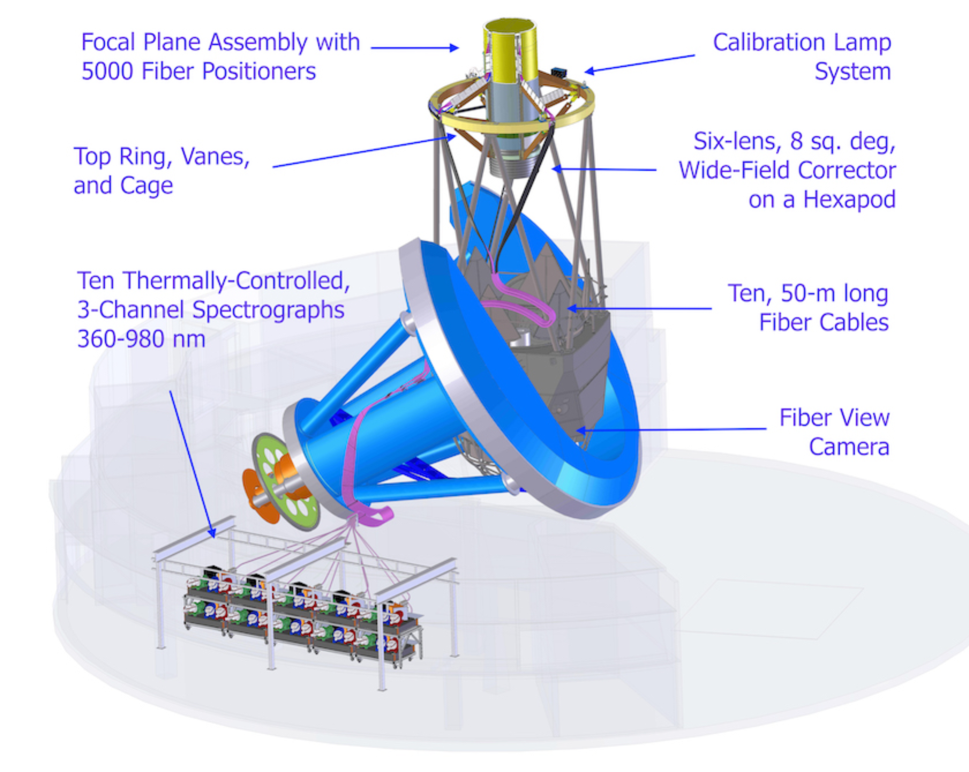
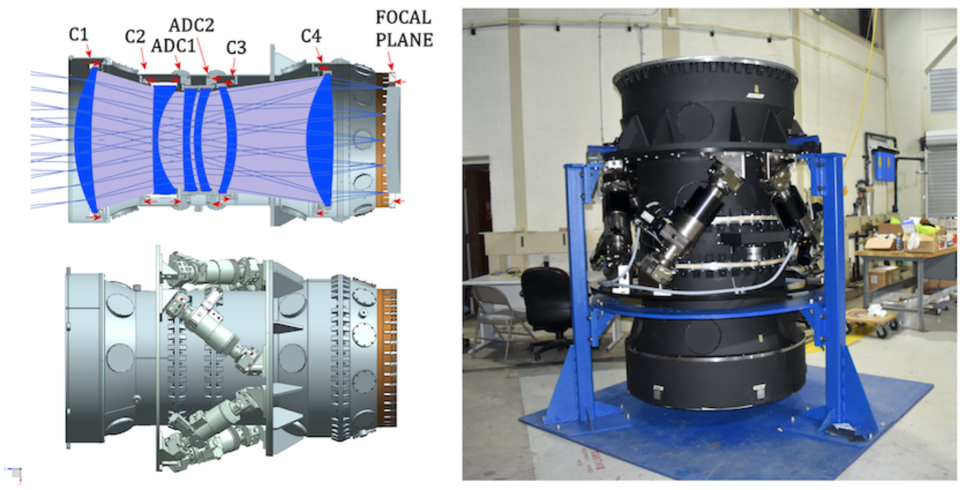
The Dark Energy Spectroscopic Instrument (DESI) has embarked on an ambitious five-year survey to explore the nature of dark energy with spectroscopy of 40 million galaxies and quasars. DESI will determine precise redshifts and employ the Baryon Acoustic Oscillation method to measure distances from the nearby universe to z > 3.5, as well as measure the growth of structure and probe potential modifications to general relativity. In this paper we describe the significant instrumentation we developed for the DESI survey. The new instrumentation includes a wide-field, 3.2-deg diameter prime-focus corrector that focuses the light onto 5020 robotic fiber positioners on the 0.812 m diameter, aspheric focal surface. The positioners and their fibers are divided among ten wedge-shaped petals. Each petal is connected to one of ten spectrographs via a contiguous, high-efficiency, nearly 50 m fiber cable bundle. The ten spectrographs each use a pair of dichroics to split the light into three channels that together record the light from 360 - 980 nm with a resolution of 2000 to 5000. We describe the science requirements, technical requirements on the instrumentation, and management of the project. DESI was installed at the 4-m Mayall telescope at Kitt Peak, and we also describe the facility upgrades to prepare for DESI and the installation and functional verification process. DESI has achieved all of its performance goals, and the DESI survey began in May 2021. Some performance highlights include RMS positioner accuracy better than 0.1", SNR per \sqrtÅ > 0.5 for a z > 2 quasar with flux 0.28e-17 erg/s/cm^2/A at 380 nm in 4000s, and median SNR = 7 of the [OII] doublet at 8e-17 erg/s/cm^2 in a 1000s exposure for emission line galaxies at z = 1.4 - 1.6. We conclude with highlights from the on-sky validation and commissioning of the instrument, key successes, and lessons learned. (abridged)
研究动机与目标
- 开发并部署一种多目标光谱仪,能够测量宇宙时空中2000万个河外源的红移。
- 通过高精度红移巡天,实现对宇宙加速膨胀、暗能量演化以及中微子质量的精确宇宙学测量。
- 通过先进的仪器与控制系统,实现高在轨效率和低天背景误差(赤经方向1.6"/小时,赤纬方向0.1"/小时)。
- 在主巡天阶段之前,通过巡天验证阶段验证目标选择算法与仪器性能。
- 为未来大型天文项目提供项目管理、进度与预算决策的全面回顾。
提出的方法
- 在梅纳尔望远镜上部署一种机器人控制的、光纤馈源的光谱仪,配备5000根光纤,实现每张曝光同时测量5000个源的红移。
- 集成先进的定位器与机器人定位系统,实现对目标天体的亚角秒级精确对准。
- 采用多级校准系统,包括波长校准、通量校准与平场校准,以确保光谱测量的准确性。
- 开展在轨调试,验证真实观测条件下的总透过率与性能表现。
- 利用外部巡天(如盖亚)提供的多波段测光与天体测量数据,实施自动化目标选择算法。
- 建立严格的流水线处理系统,用于红移测量、红移质量评估与红移误差预算分析。
实验结果
研究问题
- RQ1在实际观测条件下,DESI的仪器性能(包括透过率、天背景与指向精度)如何?
- RQ2DESI在红移z = 0至z = 3.7范围内,对星系与类星体的红移测量精度如何?
- RQ3DESI在观测效率与数据质量方面,实现其目标巡天任务的程度如何?
- RQ4哪些关键技术与管理决策使DESI能够按计划进度与预算完成?
- RQ5DESI的红移测量对暗能量演化与中微子质量等宇宙学参数有何约束作用?
主要发现
- DESI在赤经方向的天背景误差为1.6"/小时,赤纬方向为0.1"/小时,满足严格的指向精度要求。
- 该仪器在主巡天运行的第一个年度内测量了超过1500万个河外红移,成为迄今规模最大的光谱巡天。
- DESI将实现从z = 0至z = 1.1的宇宙距离尺度测量精度达0.22%,从z = 1.1至z = 1.9的精度为0.31%,从z = 1.9至z = 3.7的哈勃参数测量精度达0.84%。
- 该巡天将显著提高中微子质量总和的上限限制,并可能区分正常与倒序中微子质量谱。
- DESI的数据将通过各向异性团 clustering 测量,对修正引力模型提供强有力约束。
- 仪器展现出高在轨效率,技术停机时间极少,通常每晚可观测约80,000个星系与类星体。
更好的研究,从现在开始
从阅读论文到最终审阅,大幅缩短您的研究时间。
无需绑定信用卡
本解读由 AI 生成,并经人工编辑审核。