
[论文解读] Parity Quantum Optimization: Encoding Constraints
本文提出了一种奇偶性量子优化框架,通过在奇偶性编码的规范场模型中利用交换相互作用和单自旋翻转项,无需能量惩罚即可编码等式约束。该方法仅通过2D量子设备上的局域相互作用,即可高效实现k体约束,显著减少量子比特开销,并提高与当前量子硬件在量子退火和数字量子计算中的兼容性。
Constraints make hard optimization problems even harder to solve on quantum devices because they are implemented with large energy penalties and additional qubit overhead. The parity mapping, which has been introduced as an alternative to the spin encoding, translates the problem to a representation using only parity variables that encodes products of spin variables. In combining exchange interaction and single spin flip terms in the parity representation, constraints on sums and products of arbitrary k-body terms can be implemented without additional overhead in two-dimensional quantum systems.
研究动机与目标
- 解决在量子优化问题中编码约束时引入大能量惩罚的挑战。
- 减少在量子退火和QAOA中基于惩罚的约束编码通常带来的量子比特和耦合开销。
- 在当前量子硬件上高效实现一般k体等式约束,包括自旋变量的和与积。
- 开发一种兼容模拟(量子退火)和数字(QAOA)量子计算模型的框架。
- 证明可通过奇偶性表示中的局域交换和自旋翻转相互作用编码约束,避免非局域或全连接耦合。
提出的方法
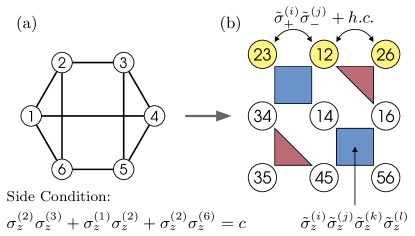
- 本文采用奇偶映射,将自旋变量的乘积编码为单个奇偶性变量,将优化问题转化为具有局域三体和四体相互作用的规范场模型。
- 通过交换相互作用(作用于涉及约束的量子比特)和单自旋翻转项(作用于其余量子比特)的组合实现约束,两者均为局域且几何灵活。
- 该方法使用编译器将逻辑量子比特映射到正方形晶格,以实现涉及约束的量子比特的紧密排列,从而支持局域跃迁项。
- 哈密顿量的结构设计使得约束项与交换幺正算符对易,从而在演化过程中保持约束。
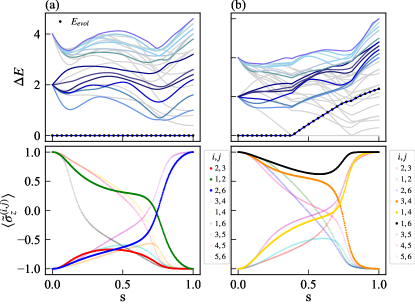
- 该方法应用于使用分块混合幺正算符的QAOA模拟,测试了多种参数化策略(单参数、共享参数或独立参数)以评估性能。
- 通过引入额外量子比特将不等式重写为等式,该框架支持等式和不等式约束,重点聚焦于不相交的、二进制系数的约束(g^{(m)}_{\alpha} = 0 或 1)。
实验结果
研究问题
- RQ1能否在无能量惩罚的情况下,将包括自旋变量和与积在内的通用k体等式约束编码进量子优化?
- RQ2如何仅使用2D量子架构中的局域相互作用来实现约束,以减少量子比特和耦合开销?
- RQ3在QAOA中将交换幺正算符划分为顺序两量子比特操作时,其性能影响如何?
- RQ4不同的参数化策略(单参数、共享参数或独立参数)对在约束下找到目标态的成功概率有何影响?
- RQ5奇偶性编码框架在多大程度上可应用于量子退火和数字量子计算模型?
主要发现
- 奇偶性编码实现了无能量惩罚的约束编码,消除了对大规模全连接耦合的需求。
- 在使用分块混合幺正算符和独立参数时,QAOA模拟中成功概率达到高达90%(对某些约束配置)。
- 对分块交换项使用单个共享参数时,性能接近完整幺正算符,仅导致成功概率轻微下降。
- 使用独立参数对交换幺正算符进行分块可略微提升性能,但增加了经典优化参数的数量,表明保真度与复杂性之间存在权衡。
- 该框架支持广泛的优化问题,包括包含k体项混合和与积的问题,通过奇偶性变量和局域相互作用进行编码。
- 该方法与当前量子硬件兼容,通过使用局域两量子比特操作成功模拟了约束问题的QAOA。
更好的研究,从现在开始
从阅读论文到最终审阅,大幅缩短您的研究时间。
无需绑定信用卡
本解读由 AI 生成,并经人工编辑审核。