
[论文解读] Particle discrimination in a NaI crystal using the COSINUS remote TES design
该论文展示了在低温钠碘(NaI)闪烁量热计中,利用COSINUS远程过渡边缘传感器(remoTES)设计实现逐事件粒子鉴别。通过同步测量声子和闪烁光信号,原型装置成功将电子/伽马事件与核 recoil 事件在低至15 keV核 recoil 能量阈值下清晰分离,证明了在低本底环境中使用NaI晶体进行直接暗物质探测的可行性。
The COSINUS direct dark matter experiment situated at Laboratori Nazionali del Gran Sasso in Italy is set to investigate the nature of the annually modulating signal detected by the DAMA/LIBRA experiment. COSINUS has already demonstrated that sodium iodide crystals can be operated at mK temperature as cryogenic scintillating calorimeters using transition edge sensors, despite the complication of handling a hygroscopic and low melting point material. With results from a new COSINUS prototype, we show that particle discrimination on an event-by-event basis in NaI is feasible using the dual-channel readout of both phonons and scintillation light. The detector was mounted in the novel remoTES design and operated in an above-ground facility for 9.06 g$\cdot$d of exposure. With a 3.7 g NaI crystal, e$^-$/$γ$ events could be clearly distinguished from nuclear recoils down to the nuclear recoil energy threshold of 15 keV.
研究动机与目标
- 证明在一种具有强吸湿性且熔点较低的材料——低温NaI晶体中,实现直接暗物质探测的粒子鉴别能力。
- 验证remoTES设计作为脆弱吸收体材料(如NaI)在低温量热测量中的可行读出方法。
- 实现亚keV能量阈值性能,并具备高精度的逐事件鉴别能力。
- 为COSINUS实验的目标奠定基础,即通过提升能量分辨率和粒子识别能力,验证DAMA/LIBRA实验中观测到的年调制信号。
提出的方法
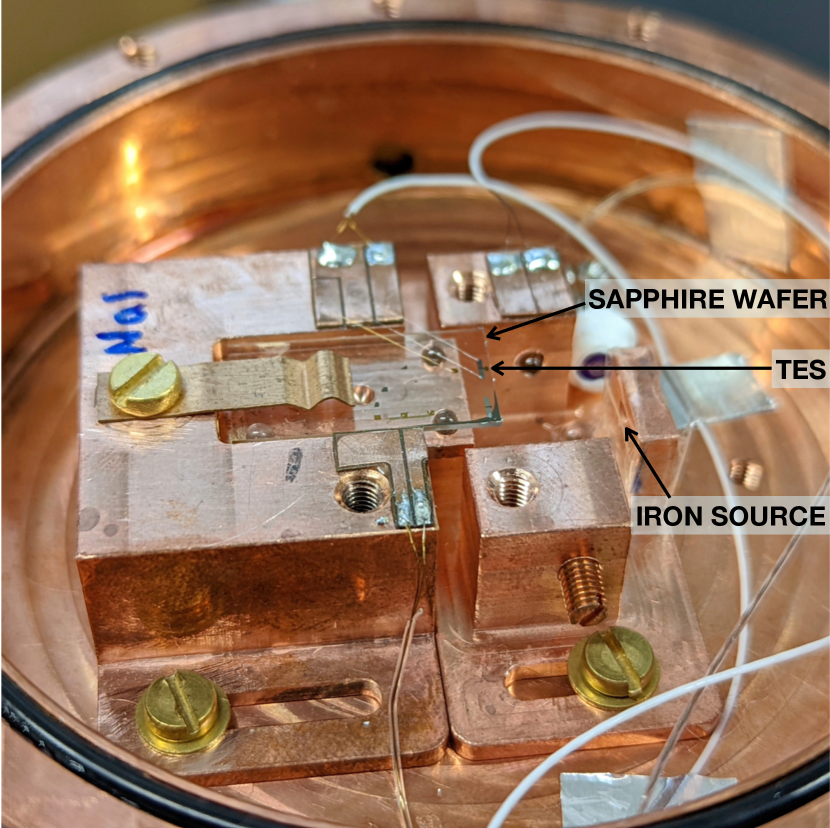
- COSINUS原型使用3.7 g NaI晶体,通过金丝和焊盘实现与独立硅片上的远程过渡边缘传感器(remoTES)的热耦合。
- 对每个事件同时记录声子和闪烁光信号,实现双通道读出以支持粒子识别。
- 探测器在地面上的设施中于毫开尔文温度下运行,使用57Co伽马源和AmBe中子源进行标定。
- 采用基于似然的带拟合方法重构光产额(LY)与声子能量的关系,以区分电子/伽马事件与核 recoil 事件。
- 核 recoil 检测的能量阈值确定为15 keV,依据为核 recoil 带中可观察到的最低事件能量。
- 在参数拟合中考虑了光探测器响应的非线性,尤其在较高能量下对电子/伽马带的影响。
![Figure 1 : Schematic of the remoTES detector. The TES is deposited on a wafer, which is separated from the absorber crystal. The coupling between the absorber and the TES consists of an Au-pad glued on the absorber surface and connected to the TES by two Au-wire bonds [ 6 ] .](https://ar5iv.labs.arxiv.org/html/2307.11066/assets/x1.png)
实验结果
研究问题
- RQ1能否在低温NaI探测器中,通过同时测量声子和闪烁光信号,实现逐事件粒子鉴别?
- RQ2remoTES设计是否适用于在低温量热设置中处理吸湿性强且熔点低的材料(如NaI)?
- RQ3采用这种双通道方法的NaI基低温探测器,可实现的核 recoil 能量阈值是多少?
- RQ4NaI中核 recoil 的光产额(LY)与电子/伽马事件相比如何?其是否随能量变化?
- RQ5在地面上条件下,探测器能否在电子/伽马带下方分辨出一个独立的核 recoil 带?
主要发现
- remoTES设计成功实现了在毫开尔文温度下,对3.7 g NaI晶体作为低温闪烁量热计的稳定运行,尽管其具有强吸湿性和低熔点特性。
- 在地面上环境中实现了2 keV的基线能量分辨率,证明了remoTES方法的鲁棒性。
- 在光产额(LY)与声子能量的二维直方图中,电子/伽马事件与核 recoil 事件被清晰区分,核 recoil 带明显位于电子/伽马带之下。
- 在100 keV以上能量区域,核 recoil 带的淬灭光产额约为0.5,与NaI中预期的淬灭行为一致。
- 核 recoil 能量阈值确定为15 keV,低于该能量的事件因探测器能量阈值而无法分辨。
- 电子/伽马带在高能区出现向下倾斜,归因于光探测器响应的非线性增强,该影响已在参数拟合中予以校正。
更好的研究,从现在开始
从阅读论文到最终审阅,大幅缩短您的研究时间。
无需绑定信用卡
本解读由 AI 生成,并经人工编辑审核。