
[论文解读] Particle track reconstruction with noisy intermediate-scale quantum computers
该论文展示了在含噪声的中等规模量子(NISQ)计算机上使用变分量子本征求解器(VQE)求解粒子轨迹重建问题作为无约束二次二值优化(QUBO)问题的可行性。通过将完整的QUBO问题分解为与当前硬件兼容的较小子QUBO,研究表明,在理想条件下,采用CVaR损失函数和L-VQE增强的VQE在32量子比特子QUBO上可实现高达70%的基态成分保真度,且当子QUBO大小为128至512个三元组时,性能接近完整QUBO的结果。
The reconstruction of trajectories of charged particles is a key computational challenge for current and future collider experiments. Considering the rapid progress in quantum computing, it is crucial to explore its potential for this and other problems in high-energy physics. The problem can be formulated as a quadratic unconstrained binary optimization (QUBO) and solved using the variational quantum eigensolver (VQE) algorithm. In this work the effects of dividing the QUBO into smaller sub-QUBOs that fit on the hardware available currently or in the near term are assessed. Then, the performance of the VQE on small sub-QUBOs is studied in an ideal simulation, using a noise model mimicking a quantum device and on IBM quantum computers. This work serves as a proof of principle that the VQE could be used for particle tracking and investigates modifications of the VQE to make it more suitable for combinatorial optimization.
研究动机与目标
- 探索在高能物理中使用NISQ时代量子计算机进行粒子轨迹重建的可行性。
- 通过将大型QUBO问题分解为更小、硬件兼容的子QUBO,应对量子比特数量有限的挑战。
- 在理想、噪声和真实量子硬件条件下,评估VQE在子QUBO上的性能表现。
- 研究对VQE的改进方法,特别是CVaR损失函数和L-VQE,以提升组合优化问题在高能物理中的性能。
- 在真实轨迹密度场景下,将重建轨迹的效率与纯度与完整QUBO解进行基准对比。
提出的方法
- 将粒子轨迹重建表述为QUBO问题,其中系数 $ a_i $ 表示三元组质量,$ b_{ij} $ 表示三元组兼容性。
- 采用几何切片方法将完整QUBO划分为16至512个三元组的重叠子QUBO,以保证空间一致性。
- 通过 $ T_i \to (1 - Z_i)/2 $ 将QUBO映射为量子哈密顿量,使VQE能够找到对应于最优解的基态。
- 采用参数化量子线路的变分量子本征求解器(VQE),使用COBYLA优化器,每轮迭代进行1024次测量。
- 实施两种VQE增强方法:CVaR损失函数($ \alpha = 0.1 $ 和 $ \alpha = 1 $)以及最多增加两层纠缠的L-VQE。
- 在三种设置下评估性能:理想模拟、噪声模型(ibmq_kolkata)以及使用Qiskit的IBM真实量子硬件。

实验结果
研究问题
- RQ1当完整QUBO被分解为子QUBO时,NISQ设备上的VQE是否能以足够的效率和纯度实现粒子轨迹重建?
- RQ2子QUBO大小如何影响VQE在基态保真度、效率和纯度方面的性能表现?
- RQ3噪声(模拟或真实)对VQE在粒子轨迹重建中的性能有何影响?
- RQ4CVaR损失函数和增加层的L-VQE是否能提升此类组合优化问题中的收敛速度与解质量?
- RQ5子QUBO分解在多大程度上能保留当前及近中期量子硬件上完整QUBO解的性能?
主要发现
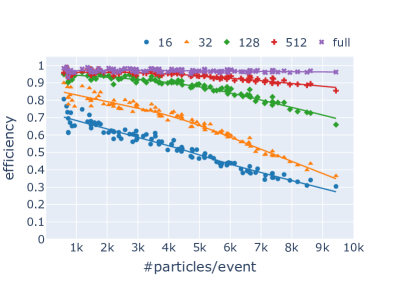
- 对于128和512个三元组的子QUBO,效率超过0.9,且在每事件最多5000个粒子时,纯度与完整QUBO解相当。
- 在32量子比特子QUBO上,理想VQE模拟可使高达70%的实例达到至少1%的基态成分,表明解的保真度较强。
- CVaR损失函数($ \alpha = 0.1 $)在理想和噪声模拟中均显著提升性能,优于标准VQE($ \alpha = 1 $)。
- 在L-VQE中增加一层纠缠门可提升最多20量子比特的噪声模拟性能,但随着规模增大,增益逐渐减弱。
- 来自真实IBM量子硬件(ibmq_kolkata)的结果与经典噪声模拟一致,验证了噪声模型的可靠性。
- 在16量子比特子QUBO中,当轨迹密度较低时效率急剧下降,但大多数条件下纯度仍高于0.8,表明对误报具有鲁棒性。
更好的研究,从现在开始
从阅读论文到最终审阅,大幅缩短您的研究时间。
无需绑定信用卡
本解读由 AI 生成,并经人工编辑审核。