
QUICK REVIEW
[论文解读] Pb$_{10-x}$Cu$_x$(PO$_4$)$_6$O: a Mott or charge transfer insulator in need of further doping for (super)conductivity
Liang Si, Markus Wallerberger|arXiv (Cornell University)|Aug 8, 2023
Physics of Superconductivity and Magnetism被引用 10
一句话总结
这篇论文分析 LK-99,从 ab initio 数据导出两带和五带紧束缚模型,并展示 DMFT 结果指示需要电子或空穴掺杂以获得金属性并可能的超导性。
ABSTRACT
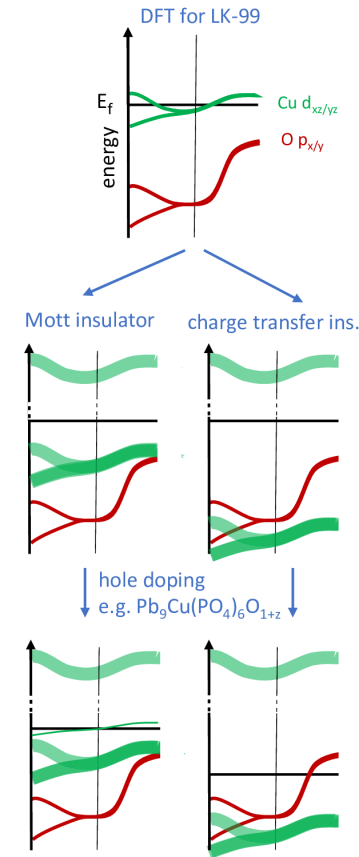
We briefly review the status quo of research on the putative superconductor Pb$_9$Cu(PO$_4$)$_6$O also known as LK-99. Further, we provide {\em ab initio} derived tight-binding parameters for a two- and five-band model, and solve these in dynamical-mean-field theory. The ratio interaction-to-bandwidth makes LK-99 a Mott or charge transfer insulator. Electron or hole doping (which is different from substituting Pb by Cu and thus differs from LK-99) is required to make it metallic and potentially superconducting.
研究动机与目标
- 评估 Pb10-xCux(PO4)6O (LK-99) 的电子本质,并澄清它是 Mott 还是电荷转移绝缘体。
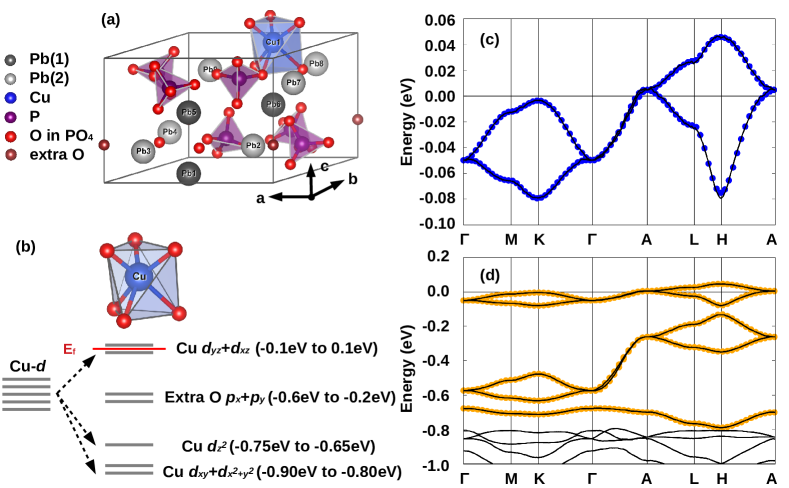
- 从 ab initio 数据推导低能紧束缚模型(两带与五带)。
- 通过 DMFT 研究电子相关性并确定绝缘状态。
- 估计现实的相互作用参数,以讨论实现金属性或超导性所需的掺杂量。
提出的方法
- 进行 DFT 结构弛豫和带结构计算,以获得放松后的结构。
- 将 DFT 带投影到 Wannier 函数以获得两带和五带紧束缚模型。
- 在 Cu 位引入局部 Kanamori 相互作用并在 298 K 下使用连续时间 QMC 求解器通过 DMFT 求解。
- 将 DMFT 谱与 DFT+U 结果进行比较,以评估绝缘行为(Mott 与 电荷转移)。
- 使用受 cRPA 启发的推理讨论模型的 plausible U、J 和 U' 值。
实验结果
研究问题
- RQ1在现实的相互作用强度下,Pb10-xCux(PO4)6O 是 Mott 还是电荷转移绝缘体?
- RQ2LK-99 的低能电子模型(两带和五带)哪些最能描述?
- RQ3DMFT 的电子相关性是否开启能隙,以及该能隙如何依赖于 U'、J 和模型选择?
- RQ4需要何种掺杂(电子或空穴)来驱动该材料的金属性或超导性?
- RQ5DFT+U 与 DMFT 在捕捉绝缘态和轨道极化方面有何比较?
主要发现
- DMFT 在费米能级显示出明显的带隙,Cu d 带(d_xz/d_yz)分裂为下 Hubbard 带和上 Hubbard 带。
- 五带模型在 U' = 3 eV 时指示电荷转移绝缘体,在 U' = 2 eV 时表现出 Mott 式特征;该系统接近电荷转移与 Mott 绝缘行为之间的临界点。
- 两带模型由于屏蔽较弱而产生更大能隙;在 DMFT 中轨道在没有对称性破缺时仍然简并。
- DFT+U 在对称性破缺结构下可以得到绝缘态,强调晶格畸变在稳定绝缘行为中的作用。
- 总体而言,在中等 U 下预测 LK-99 为绝缘体(Mott 或电荷转移);金属性和潜在的超导性需要对 Cu Pb 取代以外的电子或空穴掺杂。
更好的研究,从现在开始
从论文设计到论文写作,大幅缩短您的研究时间。
无需绑定信用卡
本解读由 AI 生成,并经人工编辑审核。