
[论文解读] Performance of Double-Stacked Intelligent Metasurface-Assisted Multiuser Massive MIMO Communications in the Wave Domain
提出一种用于上行多用户mMIMO的双堆叠智能超表(SIM)架构,在不完美CSI下推导闭式上行信道容量(SE),并使用PGAM对基站端和中间空间SIM的相位偏移进行优化。
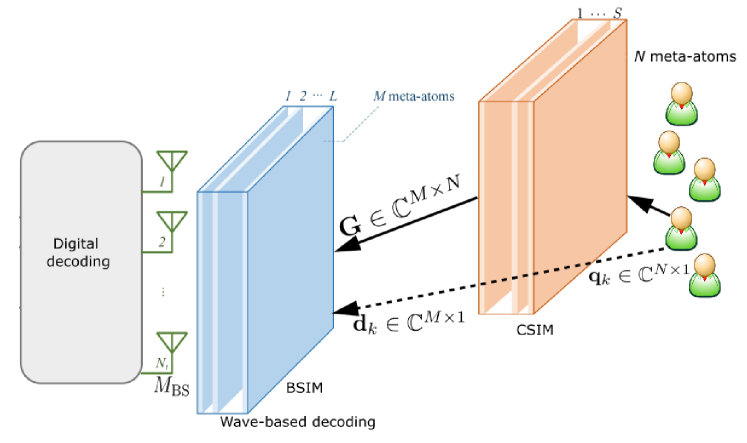
Although reconfigurable intelligent surface (RIS) is a promising technology for shaping the propagation environment, it consists of a single-layer structure within inherent limitations regarding the number of beam steering patterns. Based on the recently revolutionary technology, denoted as stacked intelligent metasurface (SIM), we propose its implementation not only on the base station (BS) side in a massive multiple-input multiple-output (mMIMO) setup but also in the intermediate space between the base station and the users to adjust the environment further as needed. For the sake of convenience, we call the former BS SIM (BSIM), and the latter channel SIM (CSIM). Hence, we achieve wave-based combining at the BS and wave-based configuration at the intermediate space. Specifically, we propose a channel estimation method with reduced overhead, being crucial for SIMassisted communications. Next, we derive the uplink sum spectral efficiency (SE) in closed form in terms of statistical channel state information (CSI). Notably, we optimize the phase shifts of both BSIM and CSIM simultaneously by using the projected gradient ascent method (PGAM). Compared to previous works on SIMs, we study the uplink transmission, a mMIMO setup, channel estimation in a single phase, a second SIM at the intermediate space, and simultaneous optimization of the two SIMs. Simulation results show the impact of various parameters on the sum SE, and demonstrate the superiority of our optimization approach compared to the alternating optimization (AO) method.
研究动机与目标
- 通过堆叠智能超表(SIM)来激发可编程无线环境,以提高mMIMO系统的能源效率和连接性。
- 引入一个集成在基站的SIM(BSIM)和一个位于中间空间的SIM(CSIM),以实现波域解码和环境成形。
- 为SIM辅助系统开发低开销的信道估计方法,并在统计CSI下推导上行总和谱效率。
- 利用投影梯度上升法对两颗SIM的相位偏移同时进行优化,并给出求解。
- 给出参数影响的数值洞见,并将PGAM与交替优化(AO)进行比较。
提出的方法
- 建立一个配备大规模天线阵列的基站模型,由BSIM和位于中间空间的CSIM协同辅助。
- 通过相位对角矩阵和层间传输矩阵,描述通过级联的SIM的波域信道。
- 给出基于信道协方差和统计CSI、采用最大比合并(MRC)解码的闭式上行SE表达(定理1)。
- 提出一种降低开销的LMMSE信道估计方法,在一个时相内估计聚合后的BSIM-CSIM信道(非单个链路)。
- 将BSIM和CSIM的相位偏移建模为非凸优化,以最大化总和SE,并应用同时投影梯度上升法(PGAM)。
- 给出闭式梯度(命题1),并采用Armijo回退线搜索进行步长选择(算法1)。
实验结果
研究问题
- RQ1双SIM架构(BSIM和CSIM)如何影响多用户mMIMO系统的上行SE?
- RQ2通过估计聚合信道而非单个链路,是否可以以较低开销完成信道估计?
- RQ3通过PGAM对BSIM-CSIM相位进行同时优化,与AO相比的性能提升是多少?
- RQ4系统参数(元原子数量、层数、用户数)如何影响所提架构中的总和SE?
- RQ5在波域结合和SIM下,不完美CSI对上行SE有何影响?
主要发现
- 上行SE在统计CSI与最大比合并(MRC)下的闭式推导(定理1)。
- 提出并分析了聚合BSIM-CSIM信道的降低开销的LMMSE信道估计器。
- 在仿真中,利用PGAM对BSIM和CSIM相位进行同时优化的效果优于交替优化(AO)。
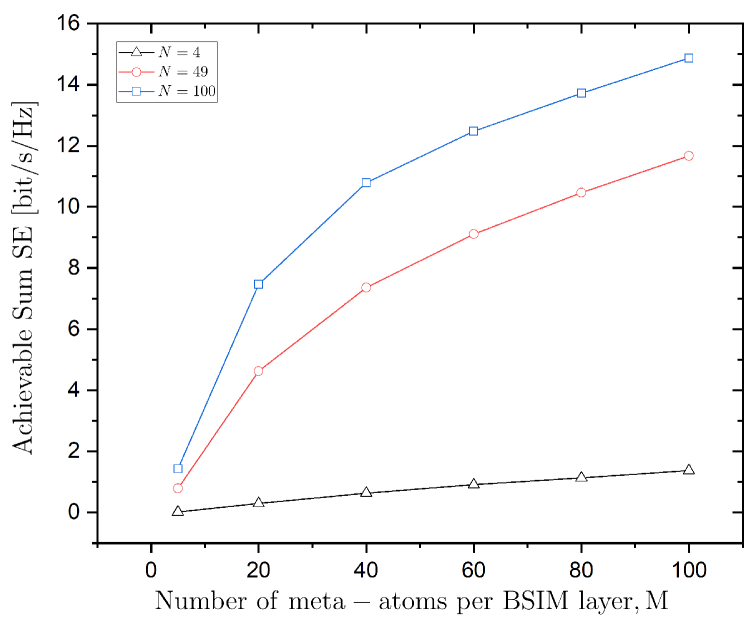
- 在报道的结果中,增加CSIM元原子数(N)比等效增加BSIM元原子数(M)带来更大的SE增益(CSIM影响更大)。
- 增加更多的超表(层数L、S)和更大阵列可提升SE,在某些设置中,CSIM带来显著提升(将N加倍时增益高达170%,将M加倍时增益高达200%)。
- 在所给定场景中,双SIM架构显著优于单层BSIM或CSIM配置。
更好的研究,从现在开始
从论文设计到论文写作,大幅缩短您的研究时间。
无需绑定信用卡
本解读由 AI 生成,并经人工编辑审核。