
[论文解读] Personal VAD: Speaker-Conditioned Voice Activity Detection
本文提出 Personal VAD,一种轻量级、说话人条件化的语音活动检测系统,通过使用 130K 参数的神经网络并结合说话人嵌入,将音频帧分类为非语音、目标说话人语音或非目标说话人语音。该系统在保持低延迟、低功耗的同时,仅在目标用户说话时触发语音识别,显著优于标准 VAD 与说话人验证的级联基线模型。
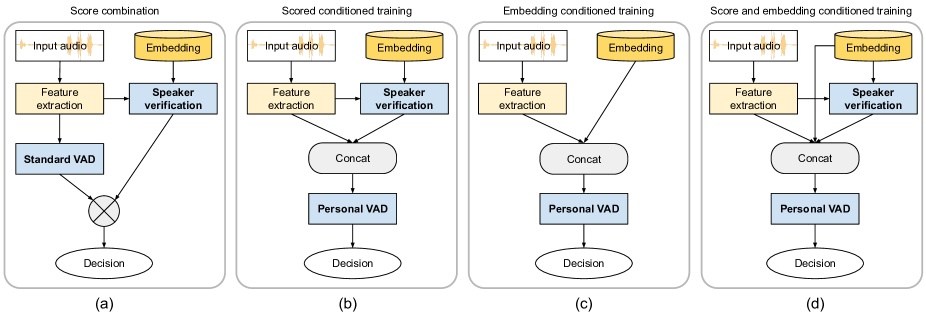
In this paper, we propose "personal VAD", a system to detect the voice activity of a target speaker at the frame level. This system is useful for gating the inputs to a streaming on-device speech recognition system, such that it only triggers for the target user, which helps reduce the computational cost and battery consumption, especially in scenarios where a keyword detector is unpreferable. We achieve this by training a VAD-alike neural network that is conditioned on the target speaker embedding or the speaker verification score. For each frame, personal VAD outputs the probabilities for three classes: non-speech, target speaker speech, and non-target speaker speech. Under our optimal setup, we are able to train a model with only 130K parameters that outperforms a baseline system where individually trained standard VAD and speaker recognition networks are combined to perform the same task.
研究动机与目标
- 开发一种实时、设备端的语音活动检测系统,仅在目标说话人说话时触发语音识别,从而降低电池和计算资源消耗。
- 解决将独立的 VAD 与说话人验证模型组合所带来的高延迟和高计算开销问题。
- 设计一种轻量级、帧级推理模型,能够区分非语音、目标说话人语音与非目标说话人语音。
- 通过极小的模型规模学习说话人特定的语音活动模式,提升在噪声环境和多人说话场景下的鲁棒性。
- 通过消除唤醒词检测需求,实现无缝、无关键词的语音助手交互。
提出的方法
- 提出一种三分类帧级分类模型,输入为声学特征和目标说话人嵌入,输出预测:非语音、目标说话人语音或非目标说话人语音。
- 采用两层 LSTM 网络(每层 64 个单元)和一个全连接输出层,使用交叉熵损失进行初始三分类训练。
- 引入一种加权成对损失函数,赋予区分目标说话人语音与非语音、非目标说话人语音更高的重要性,同时降低非语音与非目标说话人语音之间区分的权重。
- 使用 d-vector 说话人嵌入模型(在 8 种语言上微调)编码说话人身份,并在推理阶段作为条件输入。
- 通过最小化模型大小(0.13M 参数)和实现逐帧实时处理,优化推理成本。
- 使用增强版 LibriSpeech 数据集评估性能,指标为平均精度(AP),并分别在有无多轮识别(MTR)条件下进行测试。
![Figure 1: The speaker verification system [ 13 ] produces an utterance-level d-vector by aggregating window-level embeddings.](https://ar5iv.labs.arxiv.org/html/1908.04284/assets/x1.png)
实验结果
研究问题
- RQ1单一轻量级神经网络能否在检测目标说话人语音活动方面超越标准 VAD 与说话人验证模型的级联结构?
- RQ2损失函数的选择——特别是加权成对损失——如何影响模型区分目标说话人语音与非语音、非目标说话人语音的能力?
- RQ3个人化 VAD 模型在优化目标说话人检测的同时,能在多大程度上保持在标准 VAD 任务(语音/非语音检测)上的性能?
- RQ4在设备端实时说话人条件化 VAD 中,模型大小、推理速度与准确率之间的最优权衡是什么?
- RQ5在噪声和多人说话环境中,将 VAD 条件化于说话人嵌入是否能显著降低误报率和漏检率?
主要发现
- ET 架构(嵌入条件化 Transformer)在无 MTR 条件下实现 0.932 mAP 的目标说话人语音(tss)检测性能,有 MTR 时为 0.878,仅使用 0.13 百万参数,比基线说话人验证模型小 40 倍。
- 加权成对损失优于标准交叉熵损失,最优性能出现在 w<ns,ntss> = 0.1 时,有效减少非语音与非目标说话人语音之间的混淆,且未降低整体准确率。
- Personal VAD 模型在语音检测任务上的 AP 得分为 0.991(交叉熵损失)和 0.991(加权成对损失),与标准 VAD 模型(0.992)相当,证明在标准 VAD 任务上性能损失可忽略。
- ET 模型在 MTR 条件下实现非语音(ns)的 mAP 为 0.893,非目标说话人语音(ntss)为 0.901,表明在三类任务上均具备出色的泛化能力。
- 所提出的 Personal VAD 系统在准确率与效率方面均优于基线的 VAD 与说话人验证级联模型,尤其在资源受限的设备端场景中表现更优。
- 结果证实,Personal VAD 可在不增加模型大小或计算成本的前提下,替代下游自动语音识别系统中的标准 VAD,同时实现仅目标说话人激活的功能。
更好的研究,从现在开始
从阅读论文到最终审阅,大幅缩短您的研究时间。
无需绑定信用卡
本解读由 AI 生成,并经人工编辑审核。