
[论文解读] Personalization of Stress Mobile Sensing using Self-Supervised Learning
本文提出一种自监督学习(SSL)方法,通过极少的用户标注数据,实现可穿戴电活动(EDA)信号的个性化应激预测。通过在无标签生物信号序列上预训练一维卷积神经网络(1D CNN),学习个体特异的时间动态特征,该方法仅需监督基线模型所需标注数据的30%以下,即可实现高精度的应激预测,显著降低了个性化数字健康系统中的标注负担。
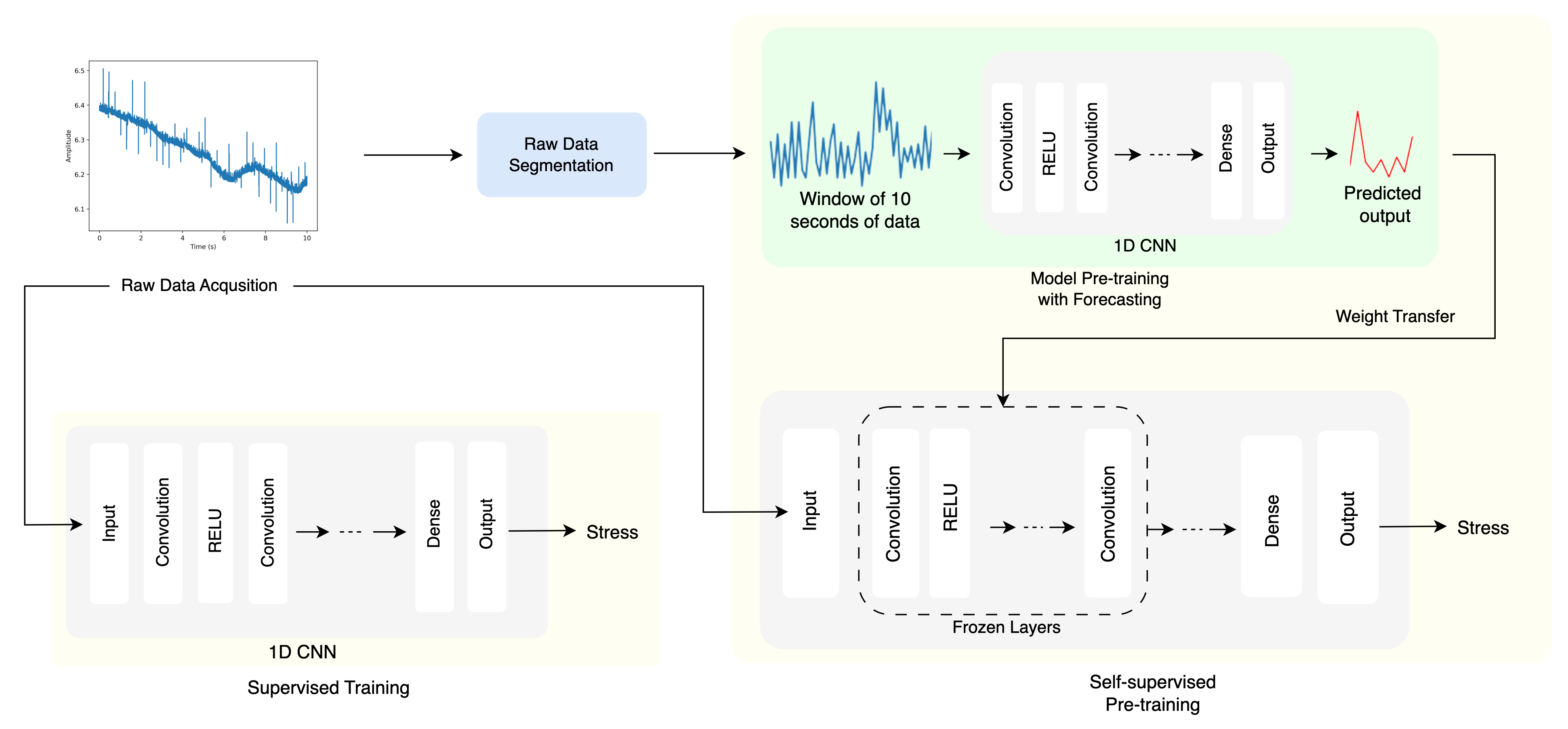
Stress is widely recognized as a major contributor to a variety of health issues. Stress prediction using biosignal data recorded by wearables is a key area of study in mobile sensing research because real-time stress prediction can enable digital interventions to immediately react at the onset of stress, helping to avoid many psychological and physiological symptoms such as heart rhythm irregularities. Electrodermal activity (EDA) is often used to measure stress. However, major challenges with the prediction of stress using machine learning include the subjectivity and sparseness of the labels, a large feature space, relatively few labels, and a complex nonlinear and subjective relationship between the features and outcomes. To tackle these issues, we examine the use of model personalization: training a separate stress prediction model for each user. To allow the neural network to learn the temporal dynamics of each individual's baseline biosignal patterns, thus enabling personalization with very few labels, we pre-train a 1-dimensional convolutional neural network (CNN) using self-supervised learning (SSL). We evaluate our method using the Wearable Stress and Affect prediction (WESAD) dataset. We fine-tune the pre-trained networks to the stress prediction task and compare against equivalent models without any self-supervised pre-training. We discover that embeddings learned using our pre-training method outperform supervised baselines with significantly fewer labeled data points: the models trained with SSL require less than 30% of the labels to reach equivalent performance without personalized SSL. This personalized learning method can enable precision health systems which are tailored to each subject and require few annotations by the end user, thus allowing for the mobile sensing of increasingly complex, heterogeneous, and subjective outcomes such as stress.
研究动机与目标
- 解决可穿戴生物信号传感中稀疏、主观且成本高昂的人工标注应激数据挑战。
- 在极少用户标注标签的前提下,实现高性能、个体特异的应激预测模型。
- 利用无标签纵向生物信号数据进行自监督预训练,学习个性化基线动态特征。
- 提升在真实环境中部署实时个性化数字干预措施以管理应激的可行性。
- 减少在情感计算中训练深度学习模型时对大规模标注数据集的依赖。
提出的方法
- 使用对比自监督学习目标,在无标签EDA序列上预训练一维卷积神经网络(CNN),以捕捉个体特异的时间模式。
- 将预训练的编码器用作下游应激预测微调任务的特征提取器。
- 在WESAD数据集的小部分用户特定应激标签上微调SSL学习到的模型。
- 与未使用SSL预训练的监督基线模型进行对比,变化标注样本数量以评估性能。
- 应用实例级对比学习并结合时间裁剪增强,以提升从原始EDA信号中学习表征的能力。
- 采用SimCLR风格的对比损失,最大化同一序列正样本视图之间的一致性,同时拉远负样本视图。
实验结果
研究问题
- RQ1自监督预训练能否减少个性化EDA信号应激预测所需的标注样本数量?
- RQ2在标注数据有限的情况下,基于SSL的个性化方法与监督学习相比性能如何?
- RQ3SSL在多大程度上能从未标记的生物信号序列中学习到个体特异的生理动态?
- RQ4预训练模型是否具备跨受试者的泛化能力,并在极少标注下实现临床可用的性能?
- RQ5SSL能否实现在真实世界、低数据条件下对主观结果(如应激)的个性化移动传感?
主要发现
- 基于SSL的个性化方法在使用少于30%的标注数据时,性能与监督基线相当。
- 使用SSL进行预训练显著提升了模型收敛速度与泛化能力,尤其在低数据场景下表现更优。
- 该方法显著降低了个性化应激预测的标注负担,使实时数字干预更具可行性。
- 预训练嵌入成功捕捉了EDA信号的个体特异时间动态,从而在少量标签下实现更优的微调效果。
- 即使在极少量监督下,该方法在多个评估指标上也优于非个性化和非SSL微调的模型。
- 结果表明,SSL能够有效利用大量无标签生物信号数据,在极少人工标注下实现高精度、个性化的应激监测。

更好的研究,从现在开始
从阅读论文到最终审阅,大幅缩短您的研究时间。
无需绑定信用卡
本解读由 AI 生成,并经人工编辑审核。