
[论文解读] Physical Layer Security Enhancement With Reconfigurable Intelligent Surface-Aided Networks
本文提出了一种基于随机几何的框架,用于分析具有随机分布多天线用户和多天线窃听者的可重构智能表面(RIS)辅助下行链路MIMO网络中的物理层安全性能。通过使用Fisher-Snedecor F-分布建模,推导出接收信干噪比(SINR)分布的精确闭式表达式,研究结果表明,RIS显著提升了保密性能,尤其是在反射单元数量较多时,其在保密中断概率、保密容量和平均保密速率方面均优于传统MIMO系统。
Reconfigurable intelligent surface (RIS)-aided wireless communications have drawn significant attention recently. We study the physical layer security of the downlink RIS-aided transmission framework for randomly located users in the presence of a multi-antenna eavesdropper. To show the advantages of RIS-aided networks, we consider two practical scenarios: Communication with and without RIS. In both cases, we apply the stochastic geometry theory to derive exact probability density function (PDF) and cumulative distribution function (CDF) of the received signal-to-interference-plus-noise ratio. Furthermore, the obtained PDF and CDF are exploited to evaluate important security performance of wireless communication including the secrecy outage probability, the probability of nonzero secrecy capacity, and the average secrecy rate. Monte-Carlo simulations are subsequently conducted to validate the accuracy of our analytical results. Compared with traditional MIMO systems, the RIS-aided system offers better performance in terms of physical layer security. In particular, the security performance is improved significantly by increasing the number of reflecting elements equipped in a RIS. However, adopting RIS equipped with a small number of reflecting elements cannot improve the system performance when the path loss of NLoS is small.
研究动机与目标
- 评估在用户随机分布且存在多天线窃听者的实际场景下,RIS辅助下行链路MIMO网络的物理层安全(PLS)性能。
- 基于随机几何建立一种新颖的分析框架,以建模用户位置和信道条件的拓扑随机性。
- 量化RIS相较于传统MIMO系统提供的保密性能增益,尤其关注保密中断概率、非零保密容量和平均保密速率。
- 研究RIS配置(特别是反射单元数量)在不同传播条件下对安全性能增强的影响。
提出的方法
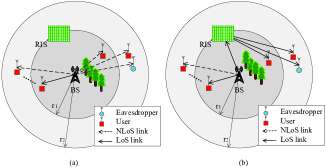
- 利用随机几何建模下行链路RIS辅助MIMO系统,以捕捉用户与窃听者位置的随机空间分布。
- 基于Fisher-Snedecor F-分布,推导接收SINR的概率密度函数(PDF)和累积分布函数(CDF)的精确闭式表达式。
- 应用Mellin-Barnes积分表示法与Meijer's G-函数,将CDF与中断概率表示为可解析处理的形式。
- 考虑两种场景:有RIS部署与无RIS部署,以实现保密性能的对比分析。
- 利用推导出的SINR分布计算关键保密性能度量:保密中断概率、非零保密容量概率以及平均保密速率。
- 通过蒙特卡洛仿真验证分析结果的准确性,确保在不同路径损耗与部署条件下的可靠性。
实验结果
研究问题
- RQ1在用户随机分布的下行链路MIMO网络中,可重构智能表面(RIS)的部署如何影响物理层保密性能?
- RQ2RIS中反射单元数量的增加对保密中断概率与平均保密速率有何影响?
- RQ3在何种传播条件下,RIS无法提升安全性,特别是当非视 Line-of-Sight(NLoS)路径损耗较小时?
- RQ4RIS辅助系统与非RIS辅助系统在SINR的统计特性(特别是PDF与CDF)方面有何差异?
- RQ5随机几何能否有效建模具有多天线窃听者与用户移动性的RIS辅助网络的保密性能?
主要发现
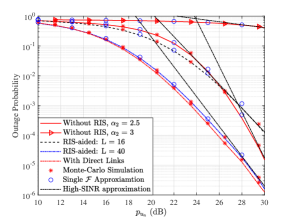
- RIS辅助系统在物理层安全性能方面显著优于传统MIMO系统,尤其在降低保密中断概率方面表现突出。
- 随着RIS上反射单元数量的增加,保密性能显著提升,表明存在直接的可扩展增益。
- 当非视 Line-of-Sight(NLoS)链路路径损耗较小时,具有少量反射单元的RIS无法提升安全性,表明存在阈值效应。
- 推导出的SINR的PDF与CDF以Meijer's G-函数形式表达,从而实现了保密性能度量的精确解析评估。
- 非零保密容量概率与平均保密速率均被精确推导,并通过蒙特卡洛仿真验证,确认了随机几何框架的准确性。
- 所提出的框架成功捕捉了用户位置随机性与多天线窃听的影响,为安全RIS网络设计提供了实用工具。
更好的研究,从现在开始
从阅读论文到最终审阅,大幅缩短您的研究时间。
无需绑定信用卡
本解读由 AI 生成,并经人工编辑审核。