
[论文解读] Physics-Informed Deep Learning for Traffic State Estimation
本文提出了一种基于环形检测器数据的物理信息深度学习(PIDL)框架,用于高速公路交通状态估计,将LWR交通流模型与深度神经网络相结合,以提升估计精度和数据效率。该方法在传感器数量较少的情况下表现优异——仅使用八个环形检测器即可实现误差低于0.06,优于所有基于模型和纯数据的基线方法。
Traffic state estimation (TSE), which reconstructs the traffic variables (e.g., density) on road segments using partially observed data, plays an important role on efficient traffic control and operation that intelligent transportation systems (ITS) need to provide to people. Over decades, TSE approaches bifurcate into two main categories, model-driven approaches and data-driven approaches. However, each of them has limitations: the former highly relies on existing physical traffic flow models, such as Lighthill-Whitham-Richards (LWR) models, which may only capture limited dynamics of real-world traffic, resulting in low-quality estimation, while the latter requires massive data in order to perform accurate and generalizable estimation. To mitigate the limitations, this paper introduces a physics-informed deep learning (PIDL) framework to efficiently conduct high-quality TSE with small amounts of observed data. PIDL contains both model-driven and data-driven components, making possible the integration of the strong points of both approaches while overcoming the shortcomings of either. This paper focuses on highway TSE with observed data from loop detectors, using traffic density as the traffic variables. We demonstrate the use of PIDL to solve (with data from loop detectors) two popular physical traffic flow models, i.e., Greenshields-based LWR and three-parameter-based LWR, and discover the model parameters. We then evaluate the PIDL-based highway TSE using the Next Generation SIMulation (NGSIM) dataset. The experimental results show the advantages of the PIDL-based approach in terms of estimation accuracy and data efficiency over advanced baseline TSE methods.
研究动机与目标
- 为解决传统基于模型的交通状态估计(TSE)方法过度依赖物理模型,以及基于数据的TSE方法严重依赖大规模数据的问题。
- 开发一种混合框架,结合交通流模型的物理一致性与深度学习的建模能力,以提升TSE性能。
- 通过使用NGSIM数据集中的真实世界环形检测器数据,证明物理信息深度学习(PIDL)在高速公路TSE中的有效性。
- 通过在深度学习中引入物理信息正则化,实现数据高效估计,降低对大规模传感器部署的依赖。
- 探索通过超参数调节基于模型和基于数据的组件,以在不同数据可用性条件下优化性能。
提出的方法
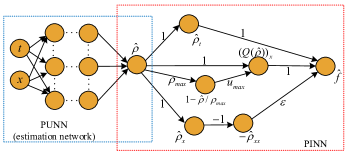
- PIDL框架由一个物理无关神经网络(PUNN)用于交通状态估计,以及一个引入物理约束的物理信息神经网络(PINN)组成,该约束源自LWR模型。
- PINN组件将LWR偏微分方程(PDE)编码为残差损失,确保估计的交通状态与底层交通动力学保持物理一致性。
- 设计了两种架构:一种基于Greenshields的LWR模型,另一种基于三参数LWR模型,分别用于在训练过程中正则化PUNN。
- 损失函数结合了数据保真度损失(来自观测的环形检测器数据)和物理残差损失(来自PDE),其中超参数α和β控制数据与物理之间的权衡。
- 模型参数(如自由流速度、阻塞密度)通过优化损失函数实现端到端发现。
- 该框架在Next Generation Simulation(NGSIM)数据集上进行训练和评估,性能在不同数量的环形检测器条件下进行评估。
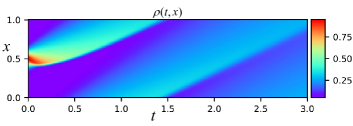
实验结果
研究问题
- RQ1与传统基于模型和基于数据的方法相比,物理信息深度学习是否能提升交通状态估计精度并减少数据需求?
- RQ2在仅使用少量环形检测器的情况下,PIDL框架在估计交通密度方面的有效性如何?
- RQ3在估计过程中,PIDL框架在LWR基础交通流模型中发现未知参数的能力有多大?
- RQ4当数据可用性变化时,基于模型和基于数据的组件的相对贡献如何影响估计性能?
- RQ5与成熟的TSE基线相比,PIDL框架在训练和推理时间方面的计算成本如何?
主要发现
- 基于PIDL的方法在仅使用八个环形检测器的情况下,估计误差低于0.06,优于所有基线方法,包括EKF和深度学习模型,在相同条件下表现更优。
- 当环形检测器数量有限(≤6)时,EKF方法优于基于神经网络的方法,但PIDL方法在所有数据水平下均持续优于EKF。
- 随着环形检测器数量的增加,由于模型限制,EKF的性能趋于饱和,而PIDL方法通过利用更多数据持续提升性能。
- 当传感器数量较少时,最优的模型驱动与数据驱动组件平衡更倾向于物理信息组件(更高的β/α比值);当数据丰富时,则更倾向于数据驱动组件(更低的β/α比值)。
- 由于在PINN中进行反向传播,PIDL的训练时间高于EKF,但推理时间与标准神经网络相当,使其适用于实时应用。
- PIDL框架在训练过程中成功发现模型参数(如自由流速度、阻塞密度),证明其具备联合估计与校准的能力。
更好的研究,从现在开始
从阅读论文到最终审阅,大幅缩短您的研究时间。
无需绑定信用卡
本解读由 AI 生成,并经人工编辑审核。