
[论文解读] Piercing the Veil of TVL: DeFi Reappraised
本文提出总赎回价值(TVR)作为去中心化金融(DeFi)中总锁仓价值(TVL)的改进指标,以解决系统性重复计算问题,该问题可使TVL虚增高达2倍。通过形式化TVR框架并引入DeFi货币乘数,研究显示TVR在市场下行周期中比TVL更稳定、更准确,尤其在2021年12月DeFi活动高峰期,两者之间观测到1398.7亿美元的差异。
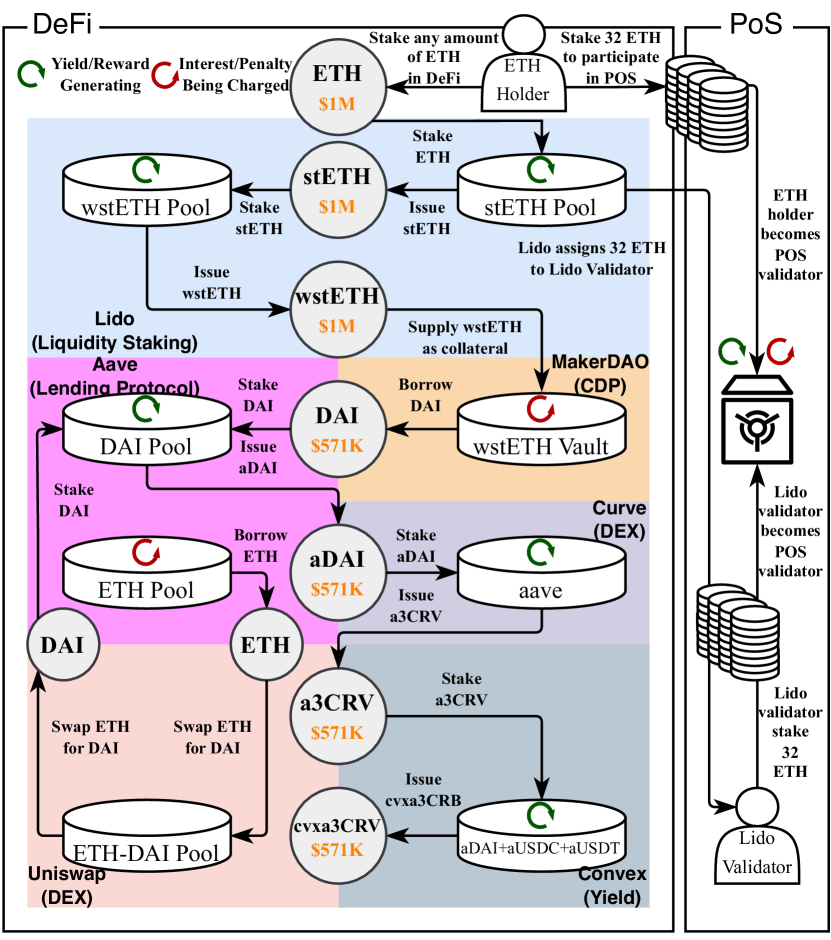
Total value locked (TVL) is widely used to measure the size and popularity of decentralized finance (DeFi). However, TVL can be easily manipulated and inflated through "double counting" activities such as wrapping and leveraging. As existing methodologies addressing double counting are inconsistent and flawed, we propose a new framework, termed "total value redeemable (TVR)", to assess the true underlying value of DeFi. Our formal analysis reveals how DeFi's complex network spreads financial contagion via derivative tokens, increasing TVL's sensitivity to external shocks. To quantify double counting, we construct the DeFi multiplier, which mirrors the money multiplier in traditional finance (TradFi). This measurement reveals substantial double counting in DeFi, finding that the gap between TVL and TVR reached \$139.87 billion during the peak of DeFi activity on December 2, 2021, with a TVL-to-TVR ratio of approximately 2. We conduct sensitivity tests to evaluate the stability of TVL compared to TVR, demonstrating the former's significantly higher level of instability than the latter, especially during market downturns: A 25% decline in the price of Ether (ETH) leads to a \$1 billion greater non-linear decrease in TVL compared to TVR via the liquidations triggered by derivative tokens. We also document that the DeFi money multiplier is positively correlated with crypto market indicators and negatively correlated with macroeconomic indicators. Overall, our findings suggest that TVR is more reliable and stable than TVL.
研究动机与目标
- 解决DeFi中总锁仓价值(TVL)指标普遍存在的重复计算问题,该问题导致协议价值被高估。
- 形式化一种新指标——总赎回价值(TVR),以反映DeFi协议中实际锁定的底层价值。
- 通过一种新颖的DeFi货币乘数,量化重复计算的程度,该乘数类似于传统金融中的货币乘数。
- 证明TVR在市场下行周期中比TVL更稳定,从而减少对损失的过度估计。
- 提供一种透明、标准化的框架,用于评估DeFi系统的真实价值与系统性风险。
提出的方法
- 形式化TVL框架,以识别并隔离DeFi协议中重复计算的来源。
- 将TVR定义为所有普通(非衍生品)代币在协议中锁定的价值总和,排除导致重复计算的衍生代币。
- 构建DeFi货币乘数,即TVL与TVR的比值,以量化金融杠杆程度与重复计算水平。
- 利用主要DeFi协议的链上数据,将TVL分解为普通代币与衍生代币两部分。
- 随时间追踪TVR中代币构成的变化,分析DeFi价值锁定的结构性演变。
- 在压力情景(如ETH价格下跌25%)下比较TVL与TVR的表现,以评估其稳定性。
实验结果
研究问题
- RQ1在DeFi协议中,重复计算在多大程度上虚高了总锁仓价值(TVL)指标?
- RQ2如何构建一种更准确、更稳定的DeFi价值度量指标,以真实反映底层经济价值?
- RQ3在市场下行周期中,TVL中的重复计算引入了何种系统性风险?
- RQ4所提出的DeFi货币乘数如何量化去中心化金融生态系统中的杠杆程度与重复计算水平?
- RQ5在市场波动期间,TVR与TVL在稳定性和可靠性方面有何差异?
主要发现
- 在2021年12月2日DeFi活动高峰期,TVL与TVR之间的差异达到1398.7亿美元,TVL与TVR的比值约为2。
- 当ETH价格下跌25%时,若使用TVL而非TVR,对DeFi市场价值损失的估计将超过10亿美元。
- 在市场动荡期间,TVR指标显著比TVL更稳定,降低了恐慌性提款的风险。
- 研究识别出最高达1821.5亿美元的重复计算,且在所分析的生态系统中,TVL与TVR的比值峰值接近3。
- 由TVL与TVR推导出的DeFi货币乘数与加密市场指标正相关,与宏观经济指标负相关。
- 本文证明,DeFi中的金融传染通过衍生代币传播,在压力事件中加剧了强制平仓与稳定币脱钩现象。
更好的研究,从现在开始
从阅读论文到最终审阅,大幅缩短您的研究时间。
无需绑定信用卡
本解读由 AI 生成,并经人工编辑审核。