
[论文解读] PolyGET: Accelerating Polymer Simulations by Accurate and Generalizable Forcefield with Equivariant Transformer
PolyGET 提出了一种通用的、以力为中心的机器学习力场,用于聚合物模拟,采用等变Transformer模型。通过仅使用力进行训练,而非联合优化能量与力,该方法在24种聚合物家族的分子动力学模拟中实现了最先进的精度和鲁棒性,能够有效泛化至未见过的及更大尺寸的聚合物,达到从头计算级别的保真度。
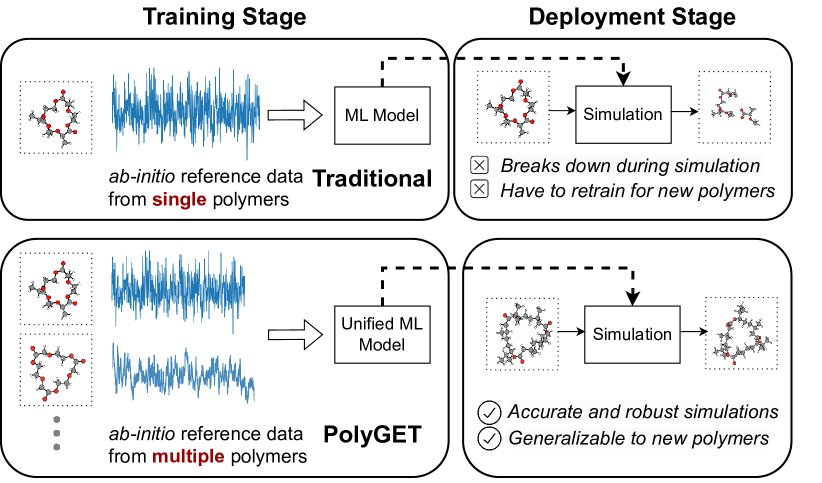
Polymer simulation with both accuracy and efficiency is a challenging task. Machine learning (ML) forcefields have been developed to achieve both the accuracy of ab initio methods and the efficiency of empirical force fields. However, existing ML force fields are usually limited to single-molecule settings, and their simulations are not robust enough. In this paper, we present PolyGET, a new framework for Polymer Forcefields with Generalizable Equivariant Transformers. PolyGET is designed to capture complex quantum interactions between atoms and generalize across various polymer families, using a deep learning model called Equivariant Transformers. We propose a new training paradigm that focuses exclusively on optimizing forces, which is different from existing methods that jointly optimize forces and energy. This simple force-centric objective function avoids competing objectives between energy and forces, thereby allowing for learning a unified forcefield ML model over different polymer families. We evaluated PolyGET on a large-scale dataset of 24 distinct polymer types and demonstrated state-of-the-art performance in force accuracy and robust MD simulations. Furthermore, PolyGET can simulate large polymers with high fidelity to the reference ab initio DFT method while being able to generalize to unseen polymers.
研究动机与目标
- 开发一种可在多样化聚合物家族间泛化的机器学习力场,同时保持高精度和模拟鲁棒性。
- 克服现有机器学习力场在单个分子上训练或采用能量-力联合优化目标时的局限性。
- 通过统一、可迁移的模型,实现对大型复杂聚合物的可靠长时程分子动力学模拟。
- 建立一种仅专注于力预测的训练范式,以增强动态模拟中的泛化能力和稳定性。
- 在涵盖24种不同聚合物类型的大型聚合物基准测试中,展示最先进的性能表现。
提出的方法
- 采用等变Transformer作为主干模型,从三维原子坐标中学习具有旋转平移等变特性的原子表征。
- 提出一种新颖的以力为中心的训练范式,仅优化原子力,避免与势能之间产生竞争目标。
- 在一个包含24种聚合物家族的多样化数据集上训练单一统一模型,实现对未见及更大聚合物的泛化能力。
- 利用模型学习到的力预测结果,通过数值积分估算势能,保持与从头计算参考数据的一致性。
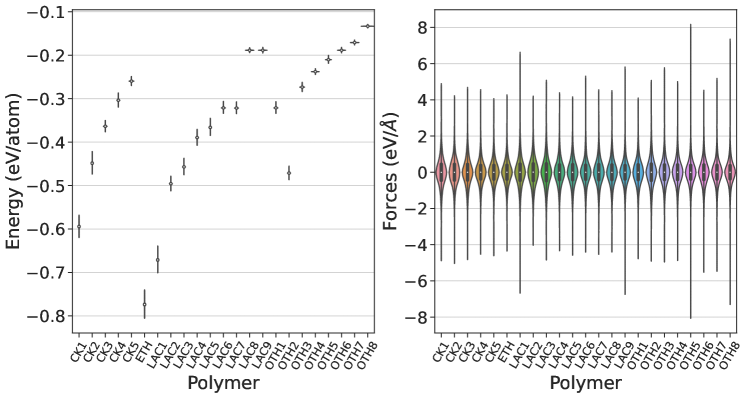
- 使用大规模基准数据集Poly24,涵盖四类:环烷烃、内酯、醚类及其他,共655万种构象。
- 通过注意力机制强制实现等变性,保持物理不变性,确保能量守恒与力的准确性。
实验结果
研究问题
- RQ1一个在多样化聚合物家族上训练的单一统一机器学习模型,能否以高保真度泛化至未见过的及更大尺寸的聚合物?
- RQ2仅基于力的训练目标是否能带来比联合能量-力优化更稳定、更泛化的力预测?
- RQ3基于等变Transformer的模型能否在保持计算效率的同时,实现从头计算级别的力预测精度,适用于大规模聚合物模拟?
- RQ4与现有方法相比,该提出的训练范式在模拟稳定性与分布外泛化能力方面表现如何?
- RQ5该模型在无需微调的情况下,能否在化学性质截然不同的聚合物家族之间实现知识迁移?
主要发现
- PolyGET在Poly24基准测试中实现了最先进的力预测精度,无论在分布内还是分布外设置下,均优于现有机器学习力场。
- 该模型能有效泛化至此前未见过的大尺寸聚合物,在无需微调的情况下保持分子动力学模拟中的高精度。
- 以力为中心的训练范式相比联合能量-力优化,带来了更稳定、更鲁棒的模拟结果,有效降低了力预测中噪声的放大。
- 尽管训练阶段仅关注力,模型生成的势能值与从头计算参考能量呈线性相关,可通过积分实现高精度的能量估算。
- 统一的多分子训练方法实现了对量子力学相互作用的可迁移知识,涵盖环烷烃、内酯和醚类等多种聚合物家族。
- PolyGET在保持从头计算方法精度的同时,展现出高效的计算性能,支持复杂聚合物体系的长时程模拟。
更好的研究,从现在开始
从阅读论文到最终审阅,大幅缩短您的研究时间。
无需绑定信用卡
本解读由 AI 生成,并经人工编辑审核。