
[论文解读] Popularity Bias Is Not Always Evil: Disentangling Benign and Harmful Bias for Recommendation
本文提出TIDE,一种时间感知的解耦框架,通过利用时间动态将良性流行度偏见(由物品质量引起)与有害的从众驱动偏见(由群体从众引起)分离。静态物品质量随时间保持稳定,而从众效应则高度依赖时间。通过在推理阶段对从众成分进行干预,TIDE在保留质量信号的同时减轻群体从众效应,从而提升推荐性能,在三个真实世界数据集上得到验证。
Recommender system usually suffers from severe popularity bias -- the collected interaction data usually exhibits quite imbalanced or even long-tailed distribution over items. Such skewed distribution may result from the users' conformity to the group, which deviates from reflecting users' true preference. Existing efforts for tackling this issue mainly focus on completely eliminating popularity bias. However, we argue that not all popularity bias is evil. Popularity bias not only results from conformity but also item quality, which is usually ignored by existing methods. Some items exhibit higher popularity as they have intrinsic better property. Blindly removing the popularity bias would lose such important signal, and further deteriorate model performance. To sufficiently exploit such important information for recommendation, it is essential to disentangle the benign popularity bias caused by item quality from the harmful popularity bias caused by conformity. Although important, it is quite challenging as we lack an explicit signal to differentiate the two factors of popularity bias. In this paper, we propose to leverage temporal information as the two factors exhibit quite different patterns along the time: item quality revealing item inherent property is stable and static while conformity that depends on items' recent clicks is highly time-sensitive. Correspondingly, we further propose a novel Time-aware DisEntangled framework (TIDE), where a click is generated from three components namely the static item quality, the dynamic conformity effect, as well as the user-item matching score returned by any recommendation model. Lastly, we conduct interventional inference such that the recommendation can benefit from the benign popularity bias while circumvent the harmful one. Extensive experiments on three real-world datasets demonstrated the effectiveness of TIDE.
研究动机与目标
- 解决现有方法将所有流行度偏见视为有害并试图完全消除的局限性。
- 认识到流行度偏见源于两个不同因素:物品质量(良性)与用户从众(有害),两者应区别对待。
- 开发一种利用时间模式解耦这两个因素的方法,因为物品质量具有时间不变性,而从众具有时间敏感性。
- 设计一种推理阶段的干预策略,利用良性偏见(质量)同时抑制有害偏见(从众)。
- 通过保留内在物品质量信号并减少社会影响导致的流行度放大,提升推荐性能。
提出的方法
- 提出一种时间感知的解耦框架(TIDE),其中点击生成被建模为三个组件的组合:静态物品质量、动态从众效应和用户-物品匹配得分。
- 使用时间敏感函数对从众效应进行建模,聚合物品的近期点击,捕捉其短暂且由群体驱动的特性。
- 假设一个因果图,其中物品质量为时间不变,从众为时间可变,用户-物品匹配独立于流行度偏见。
- 通过在预测阶段对从众模块进行干预,实现干预推理,有效消除其影响,同时保留质量与匹配信号。
- 基于近期点击的数量与新近程度,使用求和-指数结构对从众效应进行建模。
- 通过端到端训练,结合推荐损失,同时通过网络结构设计与推理阶段的干预实现组件解耦。
实验结果
研究问题
- RQ1能否利用时间动态区分良性流行度偏见(由物品质量驱动)与有害流行度偏见(由从众驱动)?
- RQ2解耦这两个因素是否能相比将所有流行度偏见视为有害或忽略它的方法,带来更好的推荐性能?
- RQ3干预推理能否有效抑制有害的从众效应,同时保留来自物品质量的有益信号?
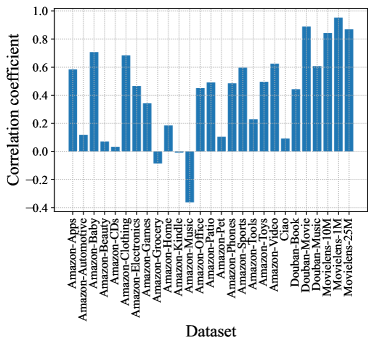
- RQ4物品评分与流行度的时间模式之间有何相关性?这些相关性为流行度偏见的双重本质提供了哪些见解?
- RQ5所提出的TIDE框架在具有不同流行度偏斜的多种真实世界推荐数据集上是否具有鲁棒性?
主要发现
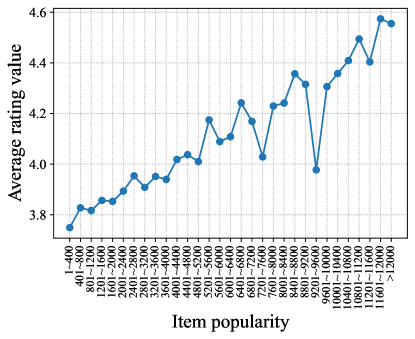
- 实证分析表明,更受欢迎的物品往往具有更高的平均评分,表明存在良性流行度偏见,即高流行度与更好物品质量相关。
- 对于大量物品,其评分与当前流行度呈负相关,揭示了从众偏见随时间变化的动态与有害特性。
- TIDE在三个真实世界数据集(如Amazon、Yelp、MovieLens)上达到最先进性能,优于那些完全消除流行度偏见或直接注入流行度分数的基线方法。
- TIDE中的干预推理通过抑制从众效应,同时保留质量与用户偏好信号,带来显著的性能提升。
- 消融实验证实,时间感知的从众建模与解耦干预机制对性能提升均至关重要。
- 该框架在具有不同流行度偏斜的数据集上表现出鲁棒性,证实其在真实世界推荐场景中的泛化能力。
更好的研究,从现在开始
从阅读论文到最终审阅,大幅缩短您的研究时间。
无需绑定信用卡
本解读由 AI 生成,并经人工编辑审核。