
[论文解读] Potential renormalisation, Lamb shift and mean-force Gibbs state -- to shift or not to shift?
本文表明,尽管存在常见的理论不一致,但在弱耦合主方程中减去重组能并省略兰姆移位项,对阻尼谐振子进行处理时,仍能对精确的平均力吉布斯态给出准确近似,尤其在低温至中等温度下,甚至在中等耦合强度下也成立。其成功的原因在于,这些看似不合理的步骤实际上将正确的渐近稳态有效嵌入主方程之中。
Often, the microscopic interaction mechanism of an open quantum system gives rise to a `counter term' which renormalises the system Hamiltonian. Such term compensates for the distortion of the system's potential due to the finite coupling to the environment. Even if the coupling is weak, the counter term is, in general, not negligible. Similarly, weak-coupling master equations feature a number of `Lamb-shift terms' which, contrary to popular belief, cannot be neglected. Yet, the practice of vanishing both counter term and Lamb shift when dealing with master equations is almost universal; and, surprisingly, it can yield better results. By accepting the conventional wisdom, one may approximate the dynamics more accurately and, importantly, the resulting master equation is guaranteed to equilibrate to the correct steady state in the high-temperature limit. In this paper we discuss why is this the case. Specifically, we show that, if the potential distortion is small -- but non-negligible -- the counter term does not influence any dissipative processes to second order in the coupling. Furthermore, we show that, for large environmental cutoff, the Lamb-shift terms approximately cancel any coherent effects due to the counter term -- this renders the combination of both contributions irrelevant in practice. We thus provide precise conditions under which the open-system folklore regarding Lamb shift and counter terms is rigorously justified.
研究动机与目标
- 解决一个悖论:即在弱耦合主方程中同时移除反项与兰姆移位项后,尽管存在理论不一致,仍能获得准确结果。
- 阐明势能重正化(重组能)与兰姆移位项在确定开放量子系统正确稳态动力学中的作用。
- 通过阻尼谐振子模型,解析证明:同时省略这两项可对精确的平均力吉布斯态给出良好近似。
- 强调这些近似对量子热力学中准确热流计算的关键影响。
提出的方法
- 解析求解线性耦合至热 bath 的阻尼量子谐振子的精确动力学。
- 从减去重组能的重正化系统哈密顿量出发,推导 Born–Markov Redfield 主方程。
- 系统性地从推导出的主方程中移除所有兰姆移位项,以评估其对稳态的影响。
- 计算位置与动量的渐近协方差矩阵,将近似主方程与精确稳态解进行比较。
- 使用拉普拉斯变换与谱分解,评估记忆积分与噪声核贡献的长时间极限。
- 确立所得主方程在渐近下能重现平均力吉布斯态的经典极限,即使未显式包含反项或兰姆移位项。
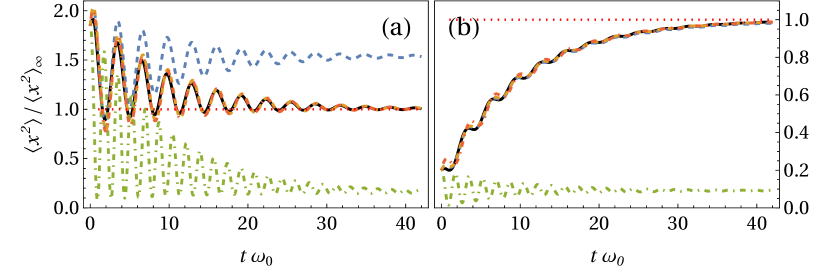
实验结果
研究问题
- RQ1为何在弱耦合主方程中省略反项与兰姆移位项,仍能对稳态给出准确结果?
- RQ2省略兰姆移位项在多大程度上影响主方程对开放量子系统长时间动力学的描述准确性?
- RQ3在系统哈密顿量中包含重组能如何影响系统的稳态性质?
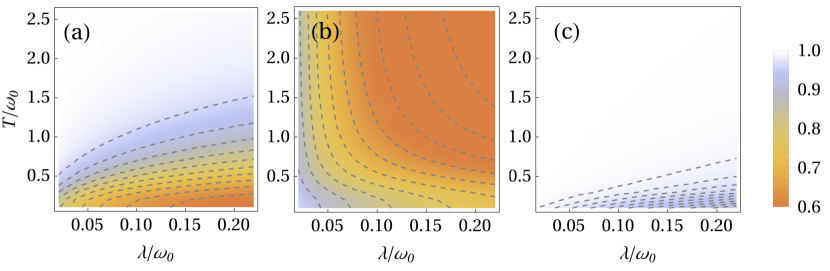
- RQ4在何种参数范围(如温度、耦合强度)下,尽管移除了物理上相关的项,近似主方程仍保持准确?
- RQ5是否可通过这些近似将平均力吉布斯态有效嵌入主方程中,即使底层物理未被完全描述?
主要发现
- 在主方程中同时省略反项与兰姆移位项,可对阻尼谐振子的精确稳态给出极佳近似,即使系统-环境耦合较弱但重组能不可忽略。
- 所得主方程在渐近下重现了平均力吉布斯态的经典极限,证实该近似隐含地嵌入了正确的稳态结构。
- 该近似在中低温下仍保持准确,甚至在中等耦合强度下也成立,此时微扰假设已失效。
- 尽管缺少兰姆移位项,长时间极限下位置-动量协方差仍趋于零,与平均力吉布斯态一致。
- 通过记忆积分与噪声核的相互作用,近似主方程准确恢复了精确稳态的动量方差,从而在分析上验证了该方法的有效性。
- 本研究揭示,标准近似之所以成功并非偶然,而是因为其有效构建了正确的渐近态,即使关键物理项已被移除。
更好的研究,从现在开始
从阅读论文到最终审阅,大幅缩短您的研究时间。
无需绑定信用卡
本解读由 AI 生成,并经人工编辑审核。